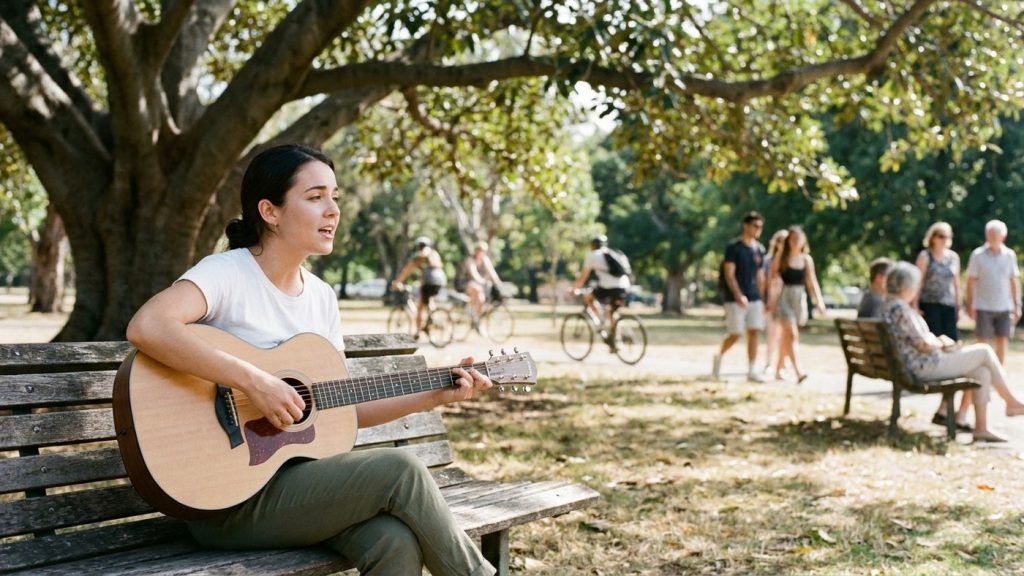
You know the moment. The chords are solid, the strumming feels good, and then you open your mouth to sing – and your strumming hand freezes, or your voice drifts behind the guitar and comes in halfway through a word. That is not a lack of talent. To sing and play at the same time you are running two motor tasks with two different rhythms, and your brain needs time to learn how to link them. The good news: it is a skill with clear stages, and you can practise it like any other technique.
This guide is for high schoolers, students and adults in North Tel Aviv who already play a few chords on guitar or piano and want to finally accompany themselves – at a get-together with friends, at a small gig or on a bedroom recording. In our singing lessons in North Tel Aviv it is one of the most requested topics, especially from students who live near the music school in Ramat Aviv Gimel and walk in with a guitar on their back.
Why singing and playing at the same time is so hard
When you only play, your hand follows the beat. When you speak or sing, your mouth follows the syllables. In most songs the two do not line up: a word starts just before the beat, a syllable is held across a chord change, a line begins in the middle of a strumming pattern. As long as one of the two tasks needs your full attention, the other one falls apart.
So the first goal is not to “concentrate harder”. It is to make the playing fully automatic – something that happens without thinking, like walking. Only then is there room in your head for the words, the melody and your breathing.
Three things to have in place first
- Chord changes without looking. If you are still hunting for your fingers on the neck or the keys, fix that first. Our full guide on switching guitar chords fast covers it.
- One strumming or accompaniment pattern you own. Not five. One that you can play for a full minute without stopping.
- The melody by heart. If you have to think about how the verse goes, your hands will not hold. Sing it without the instrument until it sits.
The 7-step method to sing and play guitar or piano
These steps work for almost any song. Do not skip any: each one takes load off the next. Keep an online metronome running from start to finish.
Step 1: Pick the right song
Your first song should be slow to medium tempo, with two to four chords that repeat. Bob Dylan’s Knockin’ on Heaven’s Door on guitar, or the Beatles’ Let It Be on piano, are classic choices: few chords, a predictable form and room to breathe. A song you love and listen to a lot beats an “easy” song you do not care about.
Step 2: Put the playing on autopilot
Loop the verse accompaniment and count out loud, “one, two, three, four”. Then talk over it – describe your breakfast – without letting your hand stop. If the playing falls apart while you talk, it is not automatic yet. Spend a few minutes on this every day until it feels boring. Boring means it worked.
Step 3: Hum over the accompaniment
Hum the melody with your mouth closed, or sing it on “la”, over the accompaniment. No words means no text to process, and you can hear whether voice and instrument really sit together. If the humming goes off pitch or drags, stop, sing the passage without the instrument, then go back.
Step 4: Speak the words in rhythm
Now say the words in a speaking voice, in the rhythm of the song, over the accompaniment – like a slow rap. This teaches you where each syllable falls against your hand without worrying about pitch. Most problems get solved at this stage.
Step 5: Map the syllables to the beats
Print or write out the words and mark each chord exactly above the syllable where it changes. Then add a small tick on the first beat of every bar. You will find words that start before the beat (a pickup) and words that start after it. Practise those spots slowly, one line at a time.
Step 6: Simplify, then build back up
If a line still will not come together, simplify the part: on guitar, one downstroke per beat; on piano, one long chord per bar. Sing over the simple version until it is steady, and only then bring back the full pattern. Drop the tempo to roughly 60 to 70 percent of the original and raise it by 4 to 5 BPM each time you get three clean passes in a row.
Step 7: Record and listen
Record yourself on your phone. While you play it is hard to hear whether your voice is late, the guitar is too loud or your breaths are audible. One honest listen teaches you more than ten more takes.
Tips for guitar and piano
Guitar: keep the strumming hand moving
Keep your strumming hand in a steady pendulum – down on the beats, up between them – even when you are not hitting the strings. That way the next syllable lands on a motion that already exists instead of one you have to start from scratch. In our guitar lessons we drill this first without singing, then with humming.
Piano: simple left hand, inversions in the right
Let your left hand play only the root of each chord and your right hand a triad. Use inversions so the right hand barely moves between chords – it frees up a lot of attention for singing. If inversions are new to you, see our guide to piano chords made simple. Start with a chord on beat 1 only, then on beats 1 and 3, and only at the end a full pattern.
The key has to fit your voice
Very often “I can’t sing and play” really means “the song is in the wrong key for me”. If you are straining in the chorus, move the song down a tone or two with the chord transposer; on guitar you can also use a capo. A key that is comfortable for your voice leaves more attention for your hands.
From your room to an audience
Singing and playing for people adds another layer: nerves, different acoustics and sometimes a microphone. So practise at home the way you will perform. Play the song start to finish without stopping, even after a mistake, and rehearse a clean start – a quiet one-bar count before you come in. Before an evening with friends or an open mic, run the song three times in a row with no break in between.
Posture and breathing with an instrument on you
A guitar on your knee invites you to hunch over it, and a piano invites you to stare at your hands and close your throat. Both squeeze your breathing. Sit on the front edge of the chair with a long back and bring the guitar to you instead of leaning into it. At the piano, lift your gaze to a point above the keys. Mark fixed breathing spots in the words, usually at the end of a line, and keep your hands playing while you breathe. To go deeper on hearing your voice against the instrument, read our guide on how to sing harmony.
If you feel hoarseness, pain or strain that does not go away after a few days, stop practising singing and see an ENT doctor or a speech therapist.
A 4-week plan
| Week | What you practise | Time per day | Ready to move on when |
|---|---|---|---|
| 1 | Verse accompaniment on autopilot, counting and talking over it | 15 minutes | You can talk for a full minute without your hand stopping |
| 2 | Humming the melody and speaking the words in rhythm over a simple part | 15 to 20 minutes | Syllables land where you marked them |
| 3 | Singing a full verse and chorus at a slow tempo, bringing the full pattern back | 20 minutes | Three clean passes in a row with the metronome |
| 4 | The whole song at the original tempo, recording and listening, a second song | 20 minutes | You perform the song for one other person |
Halfway through the plan, get feedback from a teacher. The problem is often one small detail – a word that comes in early, a hand that stops just before a chord change – that is hard to hear on your own. That is exactly what we work on in vocal lessons for teens and adults when a student brings their own instrument.
Common mistakes
- Starting with a fast song. At a high tempo there is no time to fix anything. Start slow, even if it feels strange.
- Learning the words and the part on the same day. Melody by heart first, then the connection.
- Stopping your hand at every mistake. Practise keeping the part going even when the singing slips. On stage that habit will save you.
- Playing too loud. When the instrument covers your voice, you push from the throat. Play softly, especially in the verses.
- Watching your hands the whole time. It closes your throat and cuts you off from the audience. Mark only the hard changes for yourself.
- Never checking the key. If the chorus sits too high, no exercise will fix it. Change the key.
How we teach it at Rockstar in North Tel Aviv
At the music school in Ramat Aviv Gimel our teachers are working musicians, and many of them sing and accompany themselves on stage. In the lesson we work on the song you choose: we fit the key to your voice, simplify the part and build the connection step by step. You can combine voice with guitar or with piano lessons, and later move on to a band. Students come to us from Neve Avivim, Green Ramat Aviv, North Afeka and Tzukei Aviv, and there are also Rockstar Home lessons at your place, subject to teacher availability. The first step is a free intro singing lesson with no commitment.
Frequently asked questions
Is it easier to sing with guitar or with piano?
There is no single answer. On guitar the basic accompaniment is simpler and portable, but your strumming hand has to be very steady. On piano you see the whole harmony and can simplify easily, but you have two hands to coordinate. Choose the instrument you already play best.
How long does it take to learn to sing and play at the same time?
It depends mostly on how automatic your playing already is. If you can play chords without thinking, you will usually feel clear progress after a few weeks of regular practice. If changes are still a struggle, work on those first.
Do I need to read music?
No. Most students work from a chord and lyric sheet. What matters is knowing where the chord changes against the syllable, and you mark that in pencil.
What do I do if my hand stops every time I start singing?
It means the accompaniment is not automatic yet or is too busy. Go back to the speaking step, simplify the pattern to one stroke per beat and lower the tempo. Add things back only once it is steady.
Where can I learn to sing and play near Ramat Aviv Gimel?
The Rockstar music school is right in Ramat Aviv Gimel, a few minutes’ drive from Neve Avivim and North Afeka. There are also Rockstar Home lessons at your place, subject to teacher availability. See music lessons in Ramat Aviv Gimel.
Read also: Breath Support for Singers: A Practical Breathing Guide
Vocal lessons · All lessons · Contact us · Book a free intro lesson