Song AnalyzerChords for Today's Top 20 Hits
The 20 most-streamed songs on Spotify in Israel and worldwide, each with its key, BPM, difficulty, chord diagrams, a progression for every section and a strumming pattern. Free, right in your browser, no app and no sign-up.

How to use the chart
The song everyone's streaming right now usually isn't in any songbook yet. Here you get chords for top songs while they're still at the top, broken down section by section. Pick a tab, Israel or Global, and click any song to open it:
- Read the row. Every song shows its chart position, an arrow for how it moved since last month, its key, BPM and a difficulty from 1 to 3. Level 1 is open chords, 2 adds barres or sevenths, 3 is for confident players.
- Listen before you play. Each card has a Spotify player. Play it once with the chart in front of you.
- Learn the chords. Every chord in the song comes with a guitar diagram. Don't know one? Click it to open it in the full chord dictionary, with more shapes and a piano view.
- Work section by section. The progression is split into intro, verse, chorus and bridge, with Roman numerals next to each.
- Fit the key. The transpose control moves the song up or down in semitones until it suits your voice or your hands.
- Lock in the groove. Each song has a strumming pattern, a playing tip and a button that opens the metronome at exactly the song's BPM.
What the "verified" badge means
A song marked verified has been checked against at least two independent sources: its key, its tempo and the chords of every section. Without the badge, check the chart against the recording – your ears have the final say. That's exactly what we teach in our guitar lessons: listen first, then trust the page.

From the playlist to the rehearsal room
This week's hit is the fastest way to fall in love with the guitar. Grab the chords, set the key for your voice, and play.
How to learn a new hit in one evening
Most chart songs loop 3 to 5 chords, so one focused session is enough to play them start to finish. Here's a plan built around the tools on this site:
| Step | Time | What to do |
|---|---|---|
| 1. Listen | 5 min | Play the track and mark where each section starts |
| 2. Chords | 10 min | Learn any new chord from the chord dictionary, then drill the change between each pair of neighbours |
| 3. Slow loop | 10 min | Play the chorus with the metronome at 60% of the song's BPM |
| 4. Speed up | 10 min | Add 5 BPM every time the progression goes by clean twice in a row |
| 5. Play along | 5 min | Play the whole song with the Spotify player |
For a song at 120 BPM, that means starting at 72 and working up. Learning something that isn't on the list? Find its tempo with our tap tempo BPM counter: tap along with the recording, then jump straight to the metronome. If the chord changes are what's holding you back, the drills in how to change guitar chords fast will shorten the road.
Why so many hits use the same four chords
Open a few songs from the list and you'll hear the same four chords again and again, just in different keys. That's no accident. A major key has seven natural chords: I, IV and V are major, ii, iii and vi are minor, and vii° is diminished. Between them, the three major chords – I, IV and V – contain all seven notes of the scale, so almost any melody finds a comfortable home over them. The vi, the relative minor, adds that bittersweet colour. And V resolving to I creates the tension and release your ear is waiting for.
| Progression | In C | In G | Famous example |
|---|---|---|---|
| I–V–vi–IV | C – G – Am – F | G – D – Em – C | "Let It Be", The Beatles |
| vi–IV–I–V | Am – F – C – G | Em – C – G – D | "Zombie", The Cranberries |
| I–vi–IV–V | C – Am – F – G | G – Em – C – D | "Stand by Me", Ben E. King |
| I–IV–vi–V | C – F – Am – G | G – C – Em – D | A pop-ballad staple |
Notice that vi–IV–I–V is simply I–V–vi–IV starting from a different point: start the loop on the minor chord and the song sounds darker. And because most hits are in 4/4 with four-bar phrases, a four-chord loop fits them perfectly. Want to hear it for yourself? Our chord progression generator plays any progression in any key – and from there it's a short step to writing your first song.
Choosing a key for your voice, or a capo for your hands
The original key was chosen for the original singer's voice, not yours. To find your key, sing the highest line of the chorus and move the song a semitone at a time until it comes out without strain. Usually one to three semitones is enough. When a woman sings a song by a male artist, or the other way round, the shift is bigger – often 3 to 5 semitones. Singers in our vocal lessons often find that a single semitone is the difference between shouting and actually performing.
Key suits your voice but it's full of barre chords? That's what the capo is for: the shape you play plus the capo fret equals the key you hear. G shapes with a capo on 2 sound in A; C shapes with a capo on 3 sound in E♭. Paste the chords into our chord transposer with capo helper and it suggests the easiest open shapes for any key.
Common mistakes when learning chart songs
- Going full speed from the start. Playing at the full BPM with messy changes just locks the mistakes in. Slow and clean first, then fast.
- An over-complicated strum. Start with one downstroke per beat, then add the full pattern. A steady strumming hand matters more than a fancy one.
- Working down from number 1. Pick a song at your difficulty level, not the one at the top. After three level-1 songs, level 2 stops being scary.
- Forgetting to listen. The chart tells you what to play; the recording tells you how.
- Chasing every update. The list changes every month, but one song you can play all the way through is worth more than five you started.
The chords work on keys too: same progression, same Roman numerals. If you'd rather accompany yourself on piano, our piano lessons will get you there. And if you already play the hits and want to turn them into your own version – arrangement, sound, a band – that's exactly what our guitar lessons for teens and young adults are for.
Spotify Top 20 chords: FAQ
How often is the list updated?
Once a month, automatically. The list is built from the top 20 songs on Spotify's charts in Israel and globally, and the arrows show which songs went up, went down or are new since the last update.
Why aren't there any lyrics?
Song lyrics are protected by copyright. We're adding them gradually, subject to rights. Meanwhile, you can listen to each song in the Spotify player on its card and play along.
What's the difference between verified and unverified songs?
For a verified song, the key, tempo and chords were checked against at least two independent sources. A song without the badge is a good starting point, but check it against the recording.
The song is too high or too low for me. What do I do?
Use the transpose control on the song's card and move it a semitone at a time until the highest line of the chorus comes out without strain. One to three semitones is usually enough.
I've just started playing. Which song should I learn first?
Pick a difficulty-1 song with a relatively low BPM, ideally one that loops the same four chords all the way through. Start with the chorus, slowly with the metronome, and only then play along with the recording.
Where can I learn to play the hits in North Tel Aviv?
Rockstar music school is in Ramat Aviv Gimel, a short drive from Neve Avivim, Afeka, Ramat HaHayal, Tzahala and Tel Baruch. We offer guitar lessons in North Tel Aviv, plus piano and singing at the school, and Rockstar Home lessons at your place, subject to teacher availability.
More free tools for musicians
Every Rockstar tool runs right in your browser, no app needed.
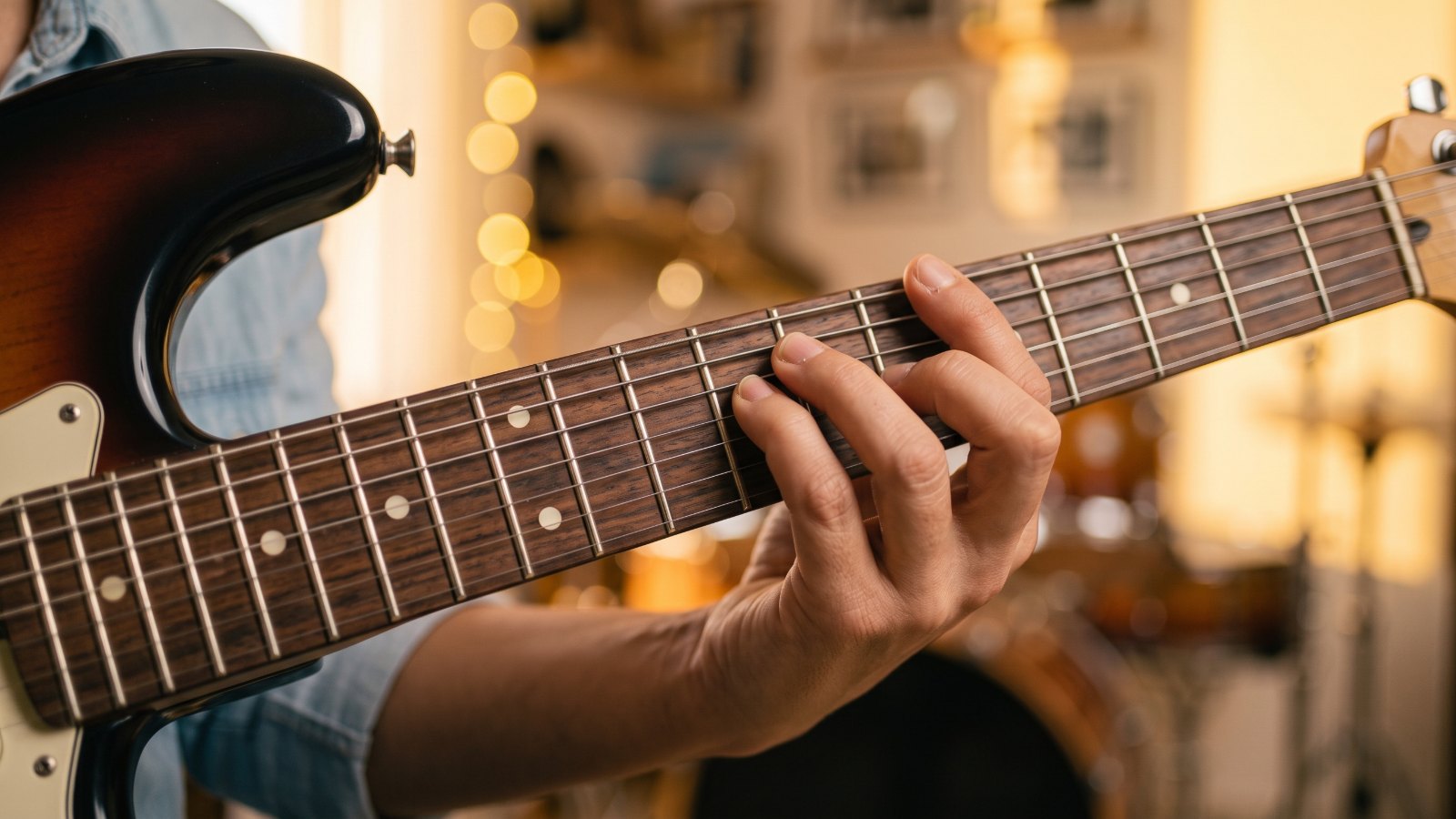
Guitar Chord Chart
144 chords with up to 3 shapes each, fretboard diagrams, interval formulas and a piano keyboard view. Tap any shape to hear how it sounds.
Open tool →
Chord Transposer
Paste a chord sheet and move it to any key, slash chords and extensions included. It detects the original key and suggests a capo with easy open shapes.
Open tool →
Tap Tempo & BPM Counter
Tap along to any song for a precise BPM, a stability score, the tempo marking and half- and double-time values. One click opens the metronome at that tempo.
Open tool →From the charts to the stage
This page gives you the chords. A teacher helps you turn them into a performance: clean changes, a groove that holds and a key that fits your voice perfectly. Come for a free, no-commitment intro lesson at our music school in Ramat Aviv Gimel, North Tel Aviv.