Chord Progression GeneratorFind, Hear and Loop Progressions in Any Key
Pick a key and a style and get chord progressions with Roman numerals and real chord names, looping on piano or strummed guitar. Free, right in your browser, no app and no sign-up.

How to use the chord progression generator
Most songs you love sit on three to five chords going round and round. The magic isn't in the chords themselves – it's in which progression you choose, the groove you put under it and the melody you sing over it. That's the question that comes up in our guitar lessons for teens and young adults the moment someone brings in a notebook full of lyrics and no idea where to start. The generator gives you a starting point in seconds:
- Pick a key. Any of the twelve, C through B. If you sing, choose a key that sits comfortably in your voice. On guitar, G, D, A, E and C give you the most open chords.
- Major or minor. Major usually sounds bright and open, minor darker and more emotional. The same style gives completely different progressions in each.
- Choose a style. Pop, Rock, Ballad, 12-bar Blues, Jazz ii–V–I, Folk / Israeli-pop feel, Punk, Funk/Soul or Epic/Film. Each style shows several progressions, written in Roman numerals and as chord names in your key.
- Loop it. The progression plays on repeat. Set the tempo, pick a sound – piano or guitar strum – and hum a melody or jam along.
- Hit “Surprise me”. The generator builds a brand-new progression from functional-harmony rules, so even a random result makes musical sense and lands back home.
- Click any chord. It opens in our guitar chord chart, with diagrams, fingerings and a piano view.
How “Surprise me” thinks
Every key has seven chords, and each has a job. Tonic chords (I, and to a lesser extent vi and iii) are home – rest. Subdominant chords (IV and ii) move away from home and get things going. Dominant chords (V and vii°) build tension that wants to resolve. A good progression usually travels home → away → tension → home, so the generator doesn’t just shuffle chords: it picks each step by function, which is why a surprise still sounds like a song rather than a list.
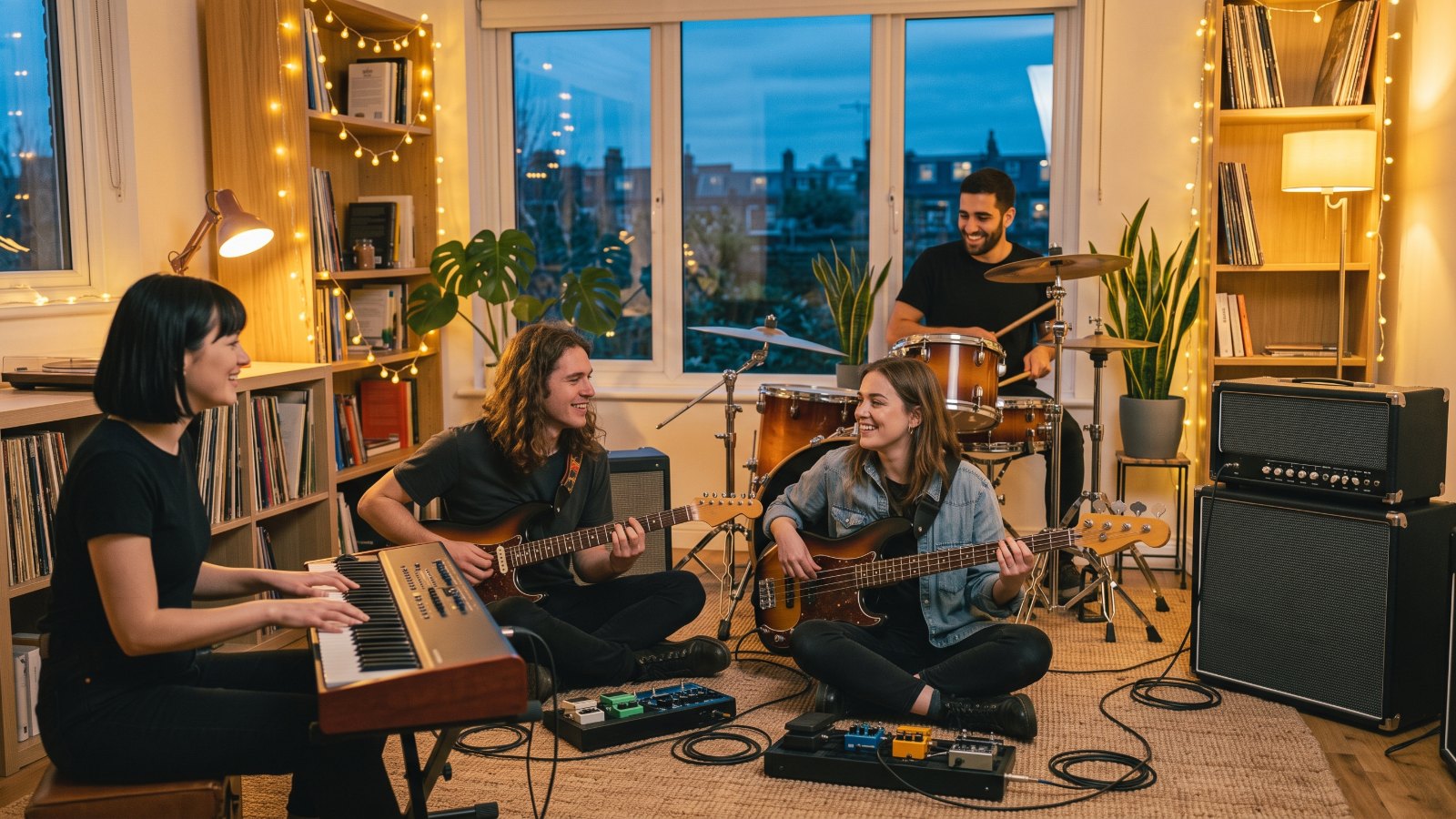
A great progression is half a song
Four chords on a loop and suddenly there's something to write a melody over. Bring it to rehearsal and hear the band wrap around it.
The most-used chord progressions – and how each one feels
Roman numerals describe where a chord sits in the key, whatever the key. Upper case means major (I, IV, V), lower case means minor (ii, iii, vi), and ° marks a diminished chord. The payoff is huge: learn I–V–vi–IV once and you know it in all twelve keys. In C major the seven chords are C, Dm, Em, F, G, Am and Bdim. To see how this plays out across every key, try our interactive circle of fifths.
Major-key progressions
| Progression | In C | Feel | Where you’ve heard it |
|---|---|---|---|
| I–V–vi–IV | C–G–Am–F | Upbeat, anthemic. “The pop progression”. | “Let It Be” (verses), “With or Without You”, “I’m Yours” |
| vi–IV–I–V | Am–F–C–G | Same chords, starts sad and opens up into hope. | The Cranberries’ “Zombie” (Em–C–G–D) |
| I–vi–IV–V | C–Am–F–G | Nostalgic, the classic ’50s sound. | “Stand By Me” (A–F♯m–D–E) |
| I–IV–V | C–F–G | Direct and driving. Rock ’n’ roll, punk, folk. | “Twist and Shout” (D–G–A) |
| I–♭VII–IV–I | C–B♭–F–C | Gritty rock, Mixolydian flavour. | “Sweet Child O’ Mine” (D–C–G–D) |
| ii–V–I | Dm7–G7–Cmaj7 | The engine of jazz. Smooth tension and release. | “Autumn Leaves” is built almost entirely on it |
Minor-key progressions
In natural minor (A minor, say) the chords are i, ii°, III, iv, v, VI and VII: Am, Bdim, C, Dm, Em, F and G. Some books write III, VI and VII with a ♭ in front – same thing. Many songs swap the minor v for a major V (E instead of Em), borrowed from harmonic minor, for a much stronger pull back to i.
| Progression | In Am | Feel | Where you’ve heard it |
|---|---|---|---|
| i–VI–III–VII | Am–F–C–G | Epic and dramatic, melancholy with momentum. | Soundtracks, alt-rock, emotional pop |
| i–VII–VI–V | Am–G–F–E | The “Andalusian cadence”. Spanish, dramatic. | “Hit the Road Jack” |
| i–iv–V–i | Am–Dm–E–Am | Mediterranean – instantly familiar to Israeli ears. | Israeli folk, Mediterranean pop, classical |
| VI–VII–i | F–G–Am | A rising climb that lands in minor. Cinematic. | Big choruses, film scores |
| i7–IV7 | Am7–D7 | Warm Dorian groove. A two-chord vamp. | “Oye Como Va” (Am7–D9) |
The 12-bar blues
The form behind blues, rock ’n’ roll and countless rock songs, “Johnny B. Goode” among them. Each bar is four beats, and the chords are usually all dominant 7ths:
| Bars | Numerals | In A |
|---|---|---|
| 1–4 | I – I – I – I | A7 – A7 – A7 – A7 |
| 5–8 | IV – IV – I – I | D7 – D7 – A7 – A7 |
| 9–12 | V – IV – I – V | E7 – D7 – A7 – E7 |
Two common variations: the “quick change”, where bar 2 jumps to IV and back, and ending bar 12 on I instead of V on the final chorus. That V in bar 12 is the turnaround – it sends you back to the top.
From progression to song: rhythm, voicings, arrangement
A progression is a skeleton. To get a song you have to dress it. These four things change the result the most:
- Harmonic rhythm. How long each chord lasts. One chord per bar feels relaxed; two per bar feels urgent. A classic move: one chord per bar in the verse, the same progression twice as fast in the chorus – the energy lifts without changing a single chord.
- Strumming and groove. The same C–G–Am–F is a ballad as slow arpeggios at 70 BPM, a pop song with an eighth-note strum, and a punk track as power chords hammered with fast downstrokes. For funk and soul, play short, muted sixteenths, usually on 7th and 9th chords.
- Voicings and colour. On guitar, swap C for Cadd9 or Am for Asus2, or use a capo to keep open shapes in a higher key. On piano, stop jumping between root positions: right hand plays C (C–E–G), G (B–D–G), Am (C–E–A) and F (C–F–A), left hand plays the roots. No finger moves more than a step, and the progression suddenly sounds smooth and professional – exactly the kind of thing we work on in our piano and theory lessons.
- Arrangement. Change the texture between sections: just guitar and bass on the roots in the verse, the whole band in the chorus. A second progression for the bridge (IV–V–vi–V, for instance) gives the song some air before the last chorus. If you already play with friends, our golden rules for playing in a band help every instrument find its space – and in Rockstar’s ensembles and bands that’s exactly what happens at every rehearsal.
The melody – the part that makes it your song
Thousands of songs share the same progression; what sets them apart is melody, lyrics and rhythm. Start the loop and hum. A rule of thumb that works: on the strong beat of each bar, land on a chord tone (over C – C, E or G), and move freely in between. From there it’s a short step to writing your first song.
Common mistakes – and how to fix them
- Same progression, same rhythm, whole song. After a minute it sounds like a loop, not a song. Change at least one thing between verse and chorus: harmonic rhythm, strumming, starting chord or dynamics.
- No sense of home. A progression that never returns to the tonic feels suspended. That can be deliberate, but the end of a chorus usually wants to land on I (or i).
- A key that doesn’t suit the singer. A perfect progression in a key that’s too high sounds bad. Choose the key for the voice, not for the easy chords – a capo solves the guitar side.
- Changes that stall. If F to G breaks the flow, the loop will expose it straight away. Drop the tempo and drill that one change with the exercises in how to change guitar chords fast.
- Fancy chords to impress. maj7s and 9ths everywhere don’t make a pop song better. Let one colour stand out in the right place.
Chord progression FAQ
What is a chord progression, and what do the Roman numerals mean?
A chord progression is a sequence of chords that repeats through a song or a section of it. Roman numerals mark each chord’s position in the key: I is the chord built on the first degree, V on the fifth, and so on. Upper case is major, lower case is minor. That way you write a progression once and play it in any key.
Why do so many songs use the same four chords?
Because I, V, vi and IV cover all three jobs in harmony – home, away and tension – and together create a natural motion that keeps coming back home. The progression is only the skeleton. Melody, lyrics, rhythm and arrangement are what make a song unique.
What’s the difference between vi–IV–I–V and i–VI–III–VII?
Sometimes the chords are identical: Am–F–C–G is vi–IV–I–V in C major and i–VI–III–VII in A minor. The difference is where the song feels at home. If the melody rests and ends on C, the song is in major. If it rests on A, it’s in minor and sounds darker and more dramatic.
How does “Surprise me” build a progression?
It follows functional-harmony rules: every chord in the key has a role – tonic, subdominant or dominant – and the progression is built step by step along a path that sounds natural, from home through movement and tension and back home. That’s why even a brand-new progression sounds musical.
Which key should I write my song in?
The key where the singer sounds best – that comes first. On guitar, G, D, A, E and C are especially friendly because of the open chords, and a capo lets you use the same shapes in a higher key. In the generator you can switch keys and instantly hear how the same progression sits higher or lower.
Where can I learn songwriting and play in a band in North Tel Aviv?
Rockstar music school is in Ramat Aviv Gimel, a short drive from Afeka, Ramat HaHayal, Tel Baruch, Neve Avivim and the Old North. We teach guitar, piano and voice, run ensembles and bands for teens and young adults, and offer Rockstar Home lessons at your place, subject to teacher availability. More in our guide to music lessons in Ramat Aviv.
More free tools for musicians
Every Rockstar tool runs right in your browser, no app needed.

Jamming & Improv
24 original backing tracks in seven styles, with an example-solo toggle, suggested scales and tips for players and singers.
Open tool →
Interactive Circle of Fifths
Click any key to see its key signature, scale notes and the 7 diatonic chords in Roman numerals. Hear every chord, the scale and a I–V–vi–IV progression.
Open tool →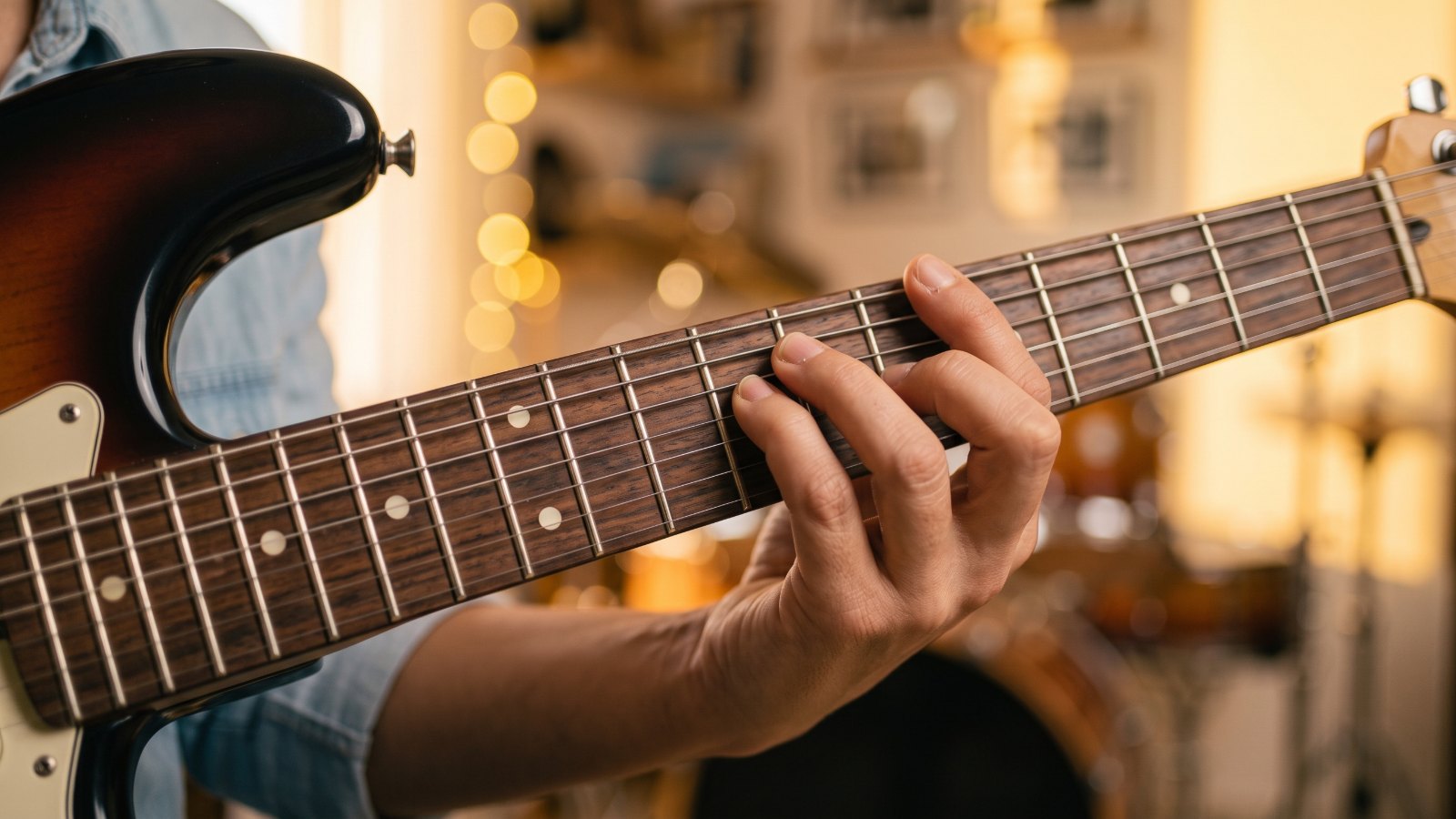
Guitar Chord Chart
144 chords with up to 3 shapes each, fretboard diagrams, interval formulas and a piano keyboard view. Tap any shape to hear how it sounds.
Open tool →From a loop on your screen to your song on stage
The generator gives you a progression. A teacher helps you turn it into a song: groove, voicings, melody, arrangement and a band to play it with. Come for a free, no-commitment intro lesson at our music school in Ramat Aviv Gimel, North Tel Aviv.