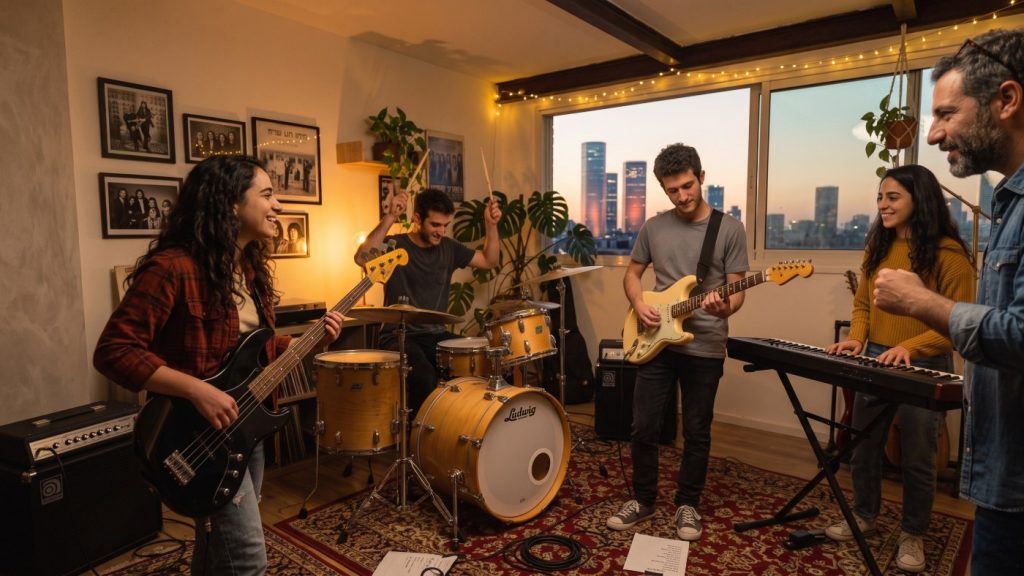
You can play every note right and still sound bad in a band. The reverse is true too: four average players who listen to each other and know when to lay out will sound better than four virtuosos each playing their own gig. Playing in a band is a skill of its own, and you learn it faster in a rehearsal room than in any private lesson.
Here are the golden rules every band musician should know – from listening and arranging, through stage volume and visual cues, to a 90-minute rehearsal plan you can print out and bring to your next session. And if you are looking for a band for your child or yourself, the end of the article explains how our ensembles and bands in North Tel Aviv work.
Rule 1: Listen more than you play
The first mistake almost everyone makes when they join a band is listening only to themselves. In a band, your part only makes sense in relation to what is happening around you.
A simple exercise for your next rehearsal: whenever you play a song you already know well, pick one bandmate and listen only to them for the whole song. Next time, pick someone else. Soon you start hearing the band as one unit.
Who to listen to first
- The drummer – for tempo and groove. They are the foundation. If you feel yourself rushing or dragging, lock back onto the drums.
- The bassist – for harmony and groove. The bass connects rhythm and harmony, so anyone playing chords should stay tight with it (we wrote more about that role in Bass guitar: the instrument that holds the band together).
- The singer or lead instrument – for dynamics and structure. Everyone is playing for them. When they come in, you come down. When they breathe, there is room to fill.
Rule 2: Leave space – arranging is also about what you don’t play
A band has limited real estate, both in frequency and in time. If the guitar, keys and bass are all playing full chords in the same range, you get mud. A good arrangement divides up the space.
Three ways to make room
- By register. If the guitar is strumming open chords in the middle, the keyboard player can move up an octave and play just three notes in the right hand, with no left hand – the bass already covers the low end.
- By rhythm. If the guitar is strumming eighth notes, the keys can hold long pads. If both are playing the same strumming pattern, one of them is redundant.
- By time. Not everyone needs to play all the time. Verse one with just bass, drums and one guitar, with the second instrument coming in on the chorus – and suddenly the song has shape and a natural build.
A good question to ask in every section: “If I stopped playing right now, would anything be missing?” If the answer is no, less is probably better.
Rule 3: Dynamics – breathe together
The records you love breathe: quiet verses, choruses that explode, a bridge that drops almost to nothing. Beginner bands tend to play everything at one constant forte, and then even the big moments don’t feel big.
A 10-minute band dynamics drill:
- Pick a simple four-chord progression at 90 BPM.
- Play it 4 times at volume level 2 out of 10, 4 times at 5, 4 times at 8 – then drop sharply back to 2.
- One person (usually the drummer) cues the changes, without talking.
- Watch out: playing soft does not mean playing slow. The tempo has to stay steady at every level – and it is hardest at level 2.
Rule 4: Volume on stage and in the rehearsal room
“I can’t hear myself” is the most common sentence in any rehearsal room – and the fix is usually not to turn up, but for everyone else to turn down. Otherwise you get an arms race that ends with the singer screaming and nobody hearing anything.
- Set levels around the acoustic drums. Drums are the one instrument you can’t turn down with a knob. Everyone else fits around them, and the vocals need to sit on top.
- Point your amp at your ears, not your ankles. A guitar amp sitting on the floor and firing at your legs will be loud for the room but quiet for you. Tilting it back or raising it solves half the problem.
- Protect your hearing. Long exposure to rehearsal-room volumes can damage hearing over time. Musician’s earplugs reduce volume fairly evenly across frequencies, so you still hear the full picture – worth the investment, especially for drummers.
Rule 5: Cues, eye contact and counting in
A good band communicates in real time without words. That is what lets it stretch a solo, repeat a chorus or end together when something went wrong.
The count-in – the few seconds that set the whole song
Whoever counts the song in sets its tempo – and plenty of songs start badly because the count was hesitant or rushed by adrenaline.
- Decide in advance who counts in each song – usually the drummer or whoever starts the song.
- Before a gig, check each song’s tempo against a metronome and write the BPM on the setlist.
- Count clearly and evenly: “One… two… one, two, three, four.” A two-bar count helps everyone lock into the groove before the first downbeat.
Cues worth agreeing on in advance
| What you want to say | Common cue |
|---|---|
| “One more time around” | Raised index finger or an exaggerated nod |
| “Back to the top” | Hand on head – borrowed from jazz, where the “head” is the main tune |
| “Bring it down” | Open palm moving downward |
| “This is the last note” | Lift the instrument or guitar neck, then bring it down sharply |
| “The solo keeps going” | Eye contact with the drummer and keep playing – no ending cue |
Whatever cues you choose, what matters is that everyone knows them and that you stand where you can see each other. A half-open semicircle beats a straight line.
Rule 6: Know the song structure and use charts
“Wait, how many choruses at the end?” That question eats precious minutes at every rehearsal. The fix: one page per song that everyone has.
A good chart doesn’t need full notation. It needs:
- Song title, key and BPM.
- The form on one line – for example: Intro (4 bars) · Verse · Chorus · Verse · Chorus · Bridge · Chorus ×2 · Outro.
- The chords for each section, with bar counts.
- Key notes: “stop on bar 8”, “only bass and drums in verse 2”, “end on the I chord, held”.
Reading music is a big advantage, but basic reading of chords and bars is enough to function well in a band. If that feels intimidating, start with our guide to reading sheet music in 5 steps.
How to run an efficient rehearsal
Many bands waste half a rehearsal on tuning and chatting. A good one starts before you walk in: everyone has practised their part at home, and there is a clear goal – say, “nail the bridge of the new song and do one full run of the set”.
Sample 90-minute rehearsal plan
| Minutes | What you do | Focus |
|---|---|---|
| 0–10 | Set up, tune, line check | Everyone tunes silently with a tuner. Nobody cranks up until everyone is ready. |
| 10–15 | Agree on goals | Two minutes on what you are working on today. No more. |
| 15–25 | Warm-up song | A song everyone knows. Balance levels while you play. |
| 25–50 | New material | Break it into sections: loop one part, slower if needed (around 80% of the original tempo), then stitch sections together. |
| 50–55 | Break | Water, rest your ears. No noodling “in the meantime”. |
| 55–75 | Full run-throughs | 2–3 songs back to back, no stopping for mistakes – like a gig. Record on a phone. |
| 75–85 | Listen back and give notes | Listen to the recording together. Each person names one thing they will improve. |
| 85–90 | Wrap up and homework | What everyone practises before next week, and the goal for next rehearsal. |
Rehearsal etiquette
- Silence between songs. This is the big one. When someone is talking, nobody plays, noodles or tunes out loud.
- Show up on time and prepared. “Prepared” means the part is already practised, not being learned now.
- Critique the music, not the person. “In the chorus, the bass and kick aren’t locking” is far better than “you’re rushing again”.
- One person runs the room. Not a boss – just the person who says “from the top of the bridge” and keeps an eye on the clock.
Handling mistakes live
Everyone makes mistakes on stage – professionals included. The rule is simple: don’t stop.
- Keep playing. Audiences rarely notice a wrong note. They always notice when a song stops.
- Keep it off your face. A panicked look or a head shake draws more attention to the mistake than the mistake itself.
- Lost? Find the “one”. Listen to the drums and bass, wait for the next bar or the next section, and come back in. In the meantime, it is fine to simply play less.
- Talk about it after the show, not on stage. Then work on exactly that spot at the next rehearsal.
Practise this in rehearsal: during full runs, nobody stops, even when someone slips. That is how a band learns to recover together.
What a band gives kids and adults
For kids and teens
- Real motivation to practise. When there is a rehearsal on Thursday and everyone is counting on you, you practise.
- Social skills. Listening, waiting your turn, taking feedback and giving it respectfully.
- A clear goal. An end-of-term show gives all that practice a purpose.
- A fixed weekly slot. For North Tel Aviv families juggling several kids and a packed after-school schedule, a set weekly rehearsal is easy to plan around – and gives your child something that is theirs.
For adults
- A dream fulfilled. Many adults played once, or always wanted to, and a band for adults is the most fun way back in.
- Two hours without your phone. Playing in a band demands total focus – which is exactly why it clears your head.
Common mistakes (and how to fix them)
- Playing all the time. Fix: in every song, find at least one section where you play less – or nothing at all.
- Turning up instead of listening. Fix: before touching your volume knob, ask everyone to come down a little.
- Speeding up in choruses and loud sections. Fix: rehearse the set with a click in the drummer’s headphones, and record to check.
- Stopping on every mistake during a run. Fix: separate “working a section” (stop as often as you like) from “a run” (never stop).
- Never recording. Fix: a phone recording at the end of every rehearsal. Inside the room, everything sounds better than it really is.
How we teach it at Rockstar – ensembles in North Tel Aviv
At Rockstar, ensembles are led by teachers who are working musicians and play in bands and gigs themselves. We put groups together by age and level, choose songs with the students that they actually love, and work on exactly what this article covers – listening, arranging, dynamics and cues – all the way to a live show. You can join an ensemble alongside private lessons – drum lessons or guitar lessons, for example – and your private teacher helps you prepare your part for rehearsals. Our music school is in Ramat Aviv Gimel, a short drive from anywhere in North Tel Aviv, and with Rockstar Home those private lessons can also take place in your own home in North Tel Aviv, subject to teacher availability.
FAQ
What level do I need to join a band?
You don’t need to be advanced. Being comfortable with a handful of chords or basic beats and holding a steady tempo is enough. A good arrangement fits each part to the player’s level.
How much should I practise at home between rehearsals?
It depends on how much material you have, but short, consistent practice – 20–30 minutes most days – beats cramming the night before. If you are not sure where to spend those minutes, start with groove and timing practice with a metronome – it is the first thing the rest of the band will feel.
What do we do when one player is too loud?
Raise it at rehearsal, calmly and about the music rather than the person, and record – the recording usually speaks for itself. Rule of thumb: drums and vocals set the ceiling, and everything else fits under it.
Do I need to read music to play in a band?
No. Most rock and pop bands work from chord-and-form charts plus a lot of listening. That said, basic rhythm and bar reading saves a lot of rehearsal time.
How many rehearsals before a first gig?
There is no fixed number, but a good sign you are ready is when the band can play the whole set straight through, twice in one rehearsal, without stopping. For a new group with a short 4–5 song set, that usually takes a few months of weekly rehearsals.
Where can I play in a band in North Tel Aviv?
Rockstar music school is in Ramat Aviv Gimel, a short drive from Kokhav HaTzafon, Azorei Chen, Revivim, HaMishtala and Neve Avivim, and some students come from nearby Ramat HaSharon too. If you live in Neve Avivim, see our page about music lessons in Neve Avivim. That is where you can join an ensemble matched to your age and level. Private lessons to prepare your part can also happen at home through Rockstar Home, subject to teacher availability. The easiest way to start is a free intro lesson, where we get to know your level and see which group fits.
Free tools that help: tap tempo BPM counter · chord transposer · online metronome · chords for today’s top 20 songs · backing tracks for improvisation
Read also: How to prepare for a live performance · How to Arrange a Cover Song · Mic Technique for Singers · Funk Rhythm Guitar Like Nile Rodgers · Saturation and Distortion in Mixing
Ensembles & bands · All lessons · Contact us · Book a free intro lesson