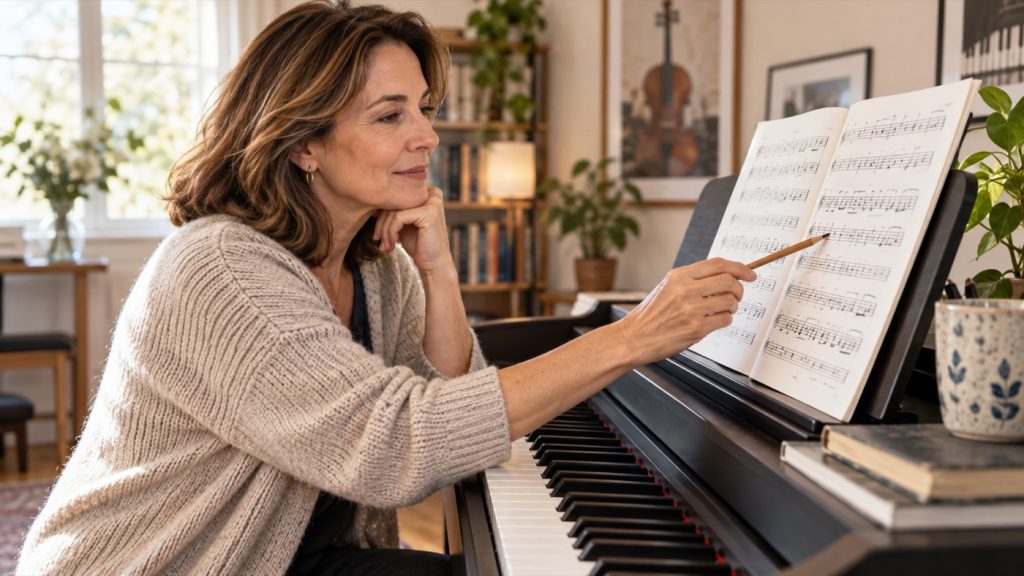
Many students come to us with the same line: “I play by ear, sheet music isn’t for me.” The truth? Reading music is a language with very few rules, and the problem is almost always the teaching method, not the student. Here are five steps we use in our piano and theory lessons at Rockstar, and all of them work.
1. Stop counting lines, learn “anchors”
Instead of counting up from the bottom every time, remember just three anchors: middle C (on the ledger line between the two clefs), G in the treble clef (the second line) and F in the bass clef (the fourth line). Every other note is a step or two away from an anchor. After a week it’s automatic.
2. Read intervals, not single notes
Good sight-readers don’t identify each note separately; they see movement. Did the next note go up a step? Down a leap? Stay put? Once you get used to reading the “shapes” of a melody, your speed multiplies.
3. Rhythm before pitch
Most reading mistakes are rhythm mistakes, not pitch mistakes. Practice tapping the rhythm of a line on the table before you play it. Two minutes of that a day are worth an hour of frustrating practice.
4. Five minutes a day, every day
Reading music is a muscle. Sight-reading apps (there are several excellent free ones) turn it into a game: five minutes a day for a month, and most of our students recognize notes in both the treble and bass clefs almost without thinking.
5. Read music you love
There’s no reason to practice reading on boring exercises. The melody of a song you know is perfect reading material, because your ear already knows how it should sound and corrects your eye.
What about kids?
Kids pick up notes amazingly fast when it comes through play: flashcards, a color for each note, and reading together with the teacher. In our lessons in Ramat Aviv Gimel we don’t start with sheet music; we play first, and bring in reading once it becomes a tool that helps get to the next song.
Read also: A Smart Practice Routine
Piano lessons at Rockstar · Book a no-commitment trial lesson