Ear Training and Rhythm TrainerFree, Right in Your Browser
Intervals, chord qualities and inner time in one place, with a score, a streak and accuracy tracking for every item. No app, no signup.
How the ear trainer works
A good ear is what separates playing songs off a tab from picking them up off the recording, singing harmony without a chart and holding a band together in time. The trainer has three modes, and each one works a different muscle:
- Intervals. You hear two notes and name the distance between them, from a minor second (m2) up to an octave (P8). Play them ascending, descending or harmonic (both notes at once), across three difficulty levels. Start at level 1 with ascending intervals.
- Chord quality. You hear a chord and identify its quality: major, minor, diminished, augmented, maj7, 7 (dominant) or m7. That's the skill you need to learn songs by ear: knowing not just where the chord is, but what kind it is.
- Rhythm. Pick a BPM, the click starts, and you tap along for 8 bars. At the end you get your average offset in milliseconds (early or late), a consistency score and a graph showing where each tap landed against the click.
- Let the click fade out. With the fade-out option on, the click gets quieter and disappears partway through while you keep tapping on your own. The trainer keeps measuring, and that's where you find out whether the time is really yours or the click was carrying you.
- Track your progress. Your score, streak and per-item accuracy are saved in your browser, so next time you'll see at once what still trips you up. Clearing your browser data resets them.
Your ear is your first instrument
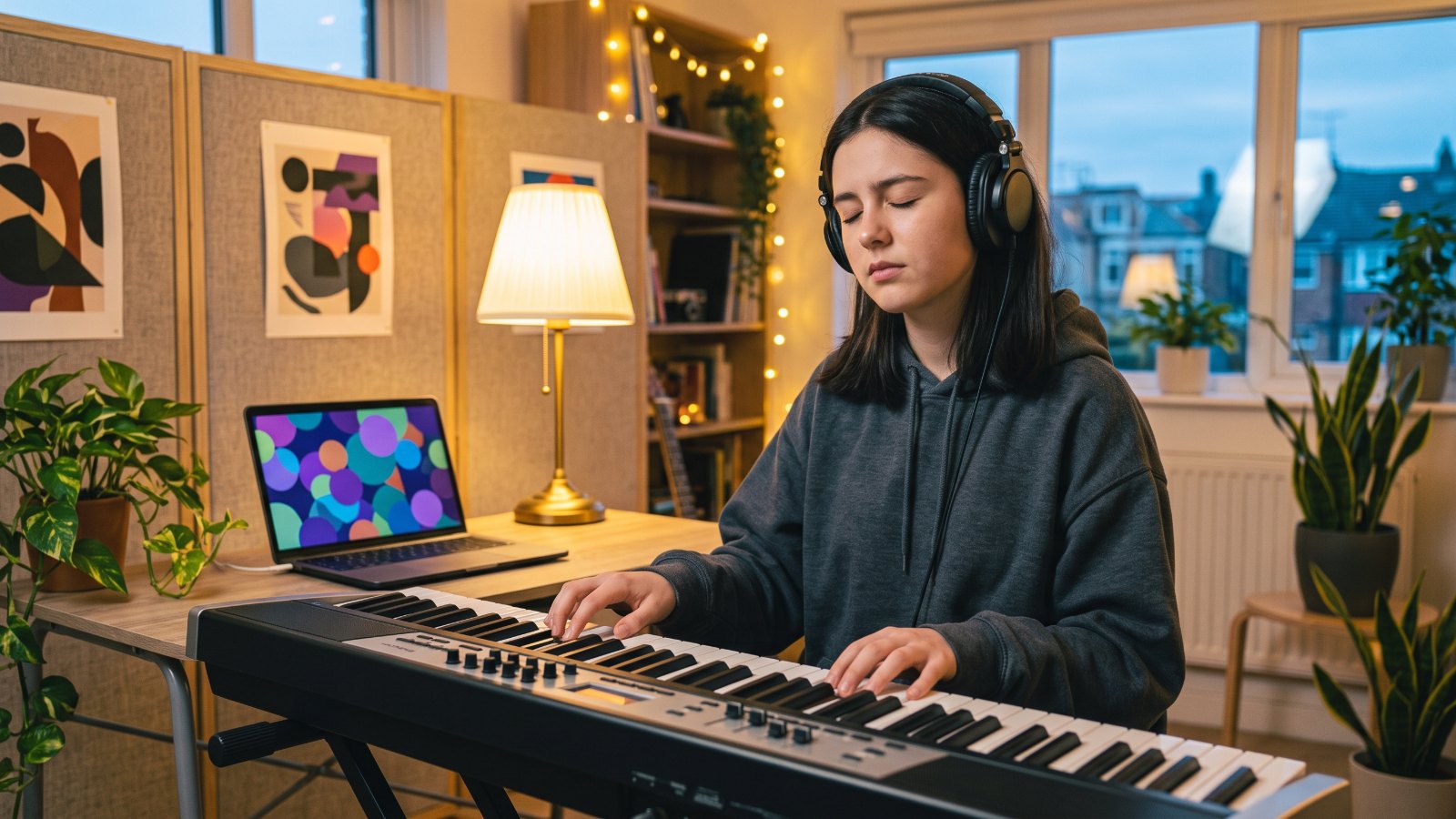
Singers and players who train their ears recognise intervals and chords faster, and keep time even when the click disappears.
Interval chart: semitones, names and reference songs
An interval is the distance between two notes, measured in semitones (one fret on a guitar, one adjacent key on a piano). The fastest way to get started is to link each interval to the opening of a tune you already know. Where no tune is universally known, there's another hint instead.
| Semitones | Interval | Reference (ascending) | Hint / descending |
|---|---|---|---|
| 1 | Minor 2nd (m2) | The "Jaws" theme | Descending: the opening of Beethoven's "Für Elise" |
| 2 | Major 2nd (M2) | Do–re, the first two notes of a major scale | Descending: "Mary Had a Little Lamb" |
| 3 | Minor 3rd (m3) | The first two notes of the "Smoke on the Water" riff | The bottom of a minor chord |
| 4 | Major 3rd (M3) | "When the Saints Go Marching In" | Descending: the opening of Beethoven's Fifth |
| 5 | Perfect 4th (P4) | "Here Comes the Bride", "Amazing Grace" | Do–fa, open and questioning |
| 6 | Tritone | "Maria" from West Side Story | The least stable sound – it wants to resolve |
| 7 | Perfect 5th (P5) | "Twinkle Twinkle Little Star", the Star Wars main theme | The sound of a power chord |
| 8 | Minor 6th (m6) | "The Entertainer" – the leap after the three chromatic pickup notes | Bittersweet |
| 9 | Major 6th (M6) | "My Bonnie Lies Over the Ocean", the NBC chimes | Do–la |
| 10 | Minor 7th (m7) | "Somewhere" from West Side Story | The top note of a dominant 7 chord |
| 11 | Major 7th (M7) | No melody everyone knows | An octave that "falls short" by a semitone |
| 12 | Octave (P8) | "Somewhere Over the Rainbow" (Some–where) | The same note, higher |
Songs are scaffolding, not the goal. Once you're past the basics, stop replaying the tune in your head and start hearing each note as a degree of the scale: do–sol feels stable, do–ti feels tense and wants to rise to do. That's how you hear real music in real time.
How to recognize chord qualities
| Chord | Structure (semitones from root) | What it sounds like | Example on C |
|---|---|---|---|
| Major | 0–4–7 | Stable, bright | C E G |
| Minor | 0–3–7 | Darker, emotional | C E♭ G |
| Diminished | 0–3–6 | Tense, cramped, thriller-like | C E♭ G♭ |
| Augmented | 0–4–8 | Floating, unresolved, dreamy | C E G♯ |
| maj7 | 0–4–7–11 | Soft, jazzy, a little wistful | C E G B |
| 7 (dominant) | 0–4–7–10 | Bluesy, wants to move on | C E G B♭ |
| m7 | 0–3–7–10 | Warm, mellow, neo-soul | C E♭ G B♭ |
A method that works: first ask three notes or four? If three, major and minor are by far the most common; diminished sounds tighter and more tense than either, and augmented sounds like it never lands. If four, decide first whether the base is major or minor, then listen to the top note. In a maj7 it sits a semitone below the root's octave and creates a gentle rub; in a 7 or m7 it's a whole step below, which sounds more open. Want to hear the differences slowly, note by note? In our guitar chord chart you can play any chord and see it on a piano keyboard too.
Rhythm and inner time: what the numbers mean
In rhythm mode the trainer measures how many milliseconds early or late each tap is. For perspective, here's how long each beat and subdivision lasts at common tempos:
| BPM | Quarter (ms) | Eighth (ms) | Sixteenth (ms) |
|---|---|---|---|
| 60 | 1000 | 500 | 250 |
| 80 | 750 | 375 | 187.5 |
| 100 | 600 | 300 | 150 |
| 120 | 500 | 250 | 125 |
| 140 | 429 | 214 | 107 |
| 160 | 375 | 188 | 94 |
Two numbers matter here, and they're not the same thing. The average offset tells you where you tend to sit – slightly ahead of the beat or slightly behind it. Consistency tells you how scattered your taps are. A drummer who always sits a hair behind the beat sounds relaxed and deep; one who lands ahead one bar and behind the next just sounds sloppy. So fix consistency first, and only then worry about moving the average. There's more on the difference between accuracy and groove in our guide to groove and timing.
A 4-week ear training plan
Ten to fifteen minutes a day beats an hour once a week by a long way. Your ear learns from short, frequent repetitions, just like your fingers. Split each session into three: about 5 minutes of intervals, 4 of chords and 4 of rhythm. Two weeks is the minimum to notice a change; four weeks turns it into a habit.
| Week | Intervals and chords | Rhythm | Goal |
|---|---|---|---|
| 1 | Level 1, ascending intervals. Chords: focus on major vs. minor | 80 BPM with the click, 3 rounds | Sing every answer before you click |
| 2 | Add descending intervals. Chords: learn diminished and augmented | 100 BPM, then 60 (slow is harder) | High consistency even at a slow tempo |
| 3 | Level 2 and harmonic intervals. Chords: maj7, 7, m7 | 90 BPM with the click fading out | Keep time without the click |
| 4 | Level 3, all directions. Go back to your lowest-accuracy items | Fade-out at 70 and at 120 | A steady average and a tight graph |
At the end of each week, check your per-item accuracy. If minor and major thirds still swap places for you, that's not failure – it's the most useful information the trainer gives you. Spend your next few sessions on that pair.
Ear training for singers and band musicians
For singers, intervals are everything. A leap that lands flat at the start of a chorus, or backing vocals that are "almost" a third – both are ear problems before they're voice problems. In our vocal lessons for teens and young adults we work on exactly that connection, alongside technique and vocal health (which we cover in our singing tips for a healthy voice). For band musicians, recognizing chord qualities saves hours of hunting around the neck, and rhythm mode is an honest check before rehearsal. To take your inner time seriously, the natural next step is drum and rhythm lessons; if you want to play with other people, try our ensembles and bands.
Common mistakes
Guessing fast. Random clicks bump your score for a moment but teach you nothing. Wait a second, sing, then answer.
Only practicing ascending intervals. Real melodies go down too, and notes sound together. Once ascending feels solid, move on to descending and harmonic.
Watching the graph while you tap. Your eyes start leading your hand. Tap with your eyes closed or fixed on the floor, and look at the result only at the end.
Always late by the same amount. If every round comes out late by roughly the same number of milliseconds, it may be your device: Bluetooth headphones and touchscreens add a fixed delay. Try wired headphones or a speaker and compare.
Only practicing at a comfortable tempo. 60 BPM exposes your inner time far more than 110 does – the big gap between clicks is exactly what pulls you ahead. For more advanced click setups, use our online metronome.
Ear training FAQ
What is ear training and why does it matter?
Ear training is systematic practice in recognizing intervals, chords, melodies and rhythm. It lets you learn songs by ear, sing more in tune, sing harmonies, improvise and keep time in a band. It's a skill you build through practice, just like technique on an instrument.
Can you develop a musical ear, or is it something you're born with?
You can develop it. Relative pitch – recognizing intervals and chords in relation to another note – improves with regular practice. Perfect (absolute) pitch, naming a note with no reference at all, is a different and rare ability, and you don't need it to be an excellent musician.
How long should I practice each day?
Ten to fifteen minutes a day is enough, and consistency matters more than length. A short session on most days beats one long session at the weekend.
What do the early/late milliseconds mean in rhythm mode?
It's the average offset of your taps from the click. "Early" means you tend to rush ahead of the beat; "late" means you tend to drag behind it. Check consistency too: an average close to zero with scattered taps still means your time isn't steady. At 120 BPM each quarter note lasts 500 milliseconds.
Why am I always late in rhythm mode?
If the delay is steady and similar in every round, it's most likely your device: Bluetooth headphones and touchscreens add latency. Try wired headphones or a speaker. If the offset changes from round to round, that's your inner time, and that's what practice fixes.
Where can I take singing and ear training lessons in North Tel Aviv?
Rockstar music school is in Ramat Aviv Gimel, close to Neve Avivim, Afeka, Kokhav HaTzafon, Hadar Yosef and Tel Baruch. We offer voice lessons in North Tel Aviv for teens and adults, with ear training built into the lesson, as well as lessons at your home in nearby neighborhoods, subject to teacher availability. More in our guide to music lessons in Ramat Aviv.
More free tools for musicians
Every Rockstar tool runs right in your browser, no app needed.
Online Metronome
20–300 BPM with 8 time signatures, subdivisions and per-beat accents. A built-in speed trainer and sample-accurate timing that holds steady even in a background tab.
Open tool →
Interactive Circle of Fifths
Click any key to see its key signature, scale notes and the 7 diatonic chords in Roman numerals. Hear every chord, the scale and a I–V–vi–IV progression.
Open tool →
Tap Tempo & BPM Counter
Tap along to any song for a precise BPM, a stability score, the tempo marking and half- and double-time values. One click opens the metronome at that tempo.
Open tool →Want a musician's ear?
The trainer shows you where you stand; a teacher who hears you sing and play knows exactly what to work on next. Come for a free, no-commitment intro lesson at our music school in Ramat Aviv Gimel, North Tel Aviv.