Tap TempoFind the BPM of Any Song in Seconds
Tap along to a song and get its exact tempo, down to a decimal, with a stability score and half-time and double-time values. Free, no app, no signup.
How to use the tap tempo BPM counter
- Play the song. Spotify, YouTube, your phone – anything. The tool doesn't listen to audio or need a mic: you tap, it measures.
- Tap the beat. Click or touch the big pad, or hit any key – Space or T are easiest. Tap every beat (1, 2, 3, 4), not just the start of the bar.
- Keep going until it settles. The BPM appears after a few taps and steadies with each one. 8–12 taps is usually enough; the tap counter shows how many you've logged.
- Check the stability score. It shows how even your taps are. High means trust the number; low usually means a missed beat or a song that drifts – just tap again.
- Read the whole picture. Alongside the BPM you get the tempo marking (Largo to Presto) and half-time and double-time values, in case you tapped eighths or half notes. The visual pulse keeps flashing at the measured tempo so you can see if it sits on the song.
- Send it to the metronome. "Open in metronome" launches our free online metronome at exactly that BPM.
What makes the reading accurate
Basic BPM counters average every tap, so one early tap or accidental double-tap drags the result off. This tool takes the median of the intervals between your recent taps: a sloppy tap simply falls out. The result shows one decimal place (say, 117.8), because plenty of songs recorded without a click don't land on a round number.
Pause for more than two seconds and it resets on its own, so you can move straight to the next song. Range: 20–300 BPM.
Every band starts with a count
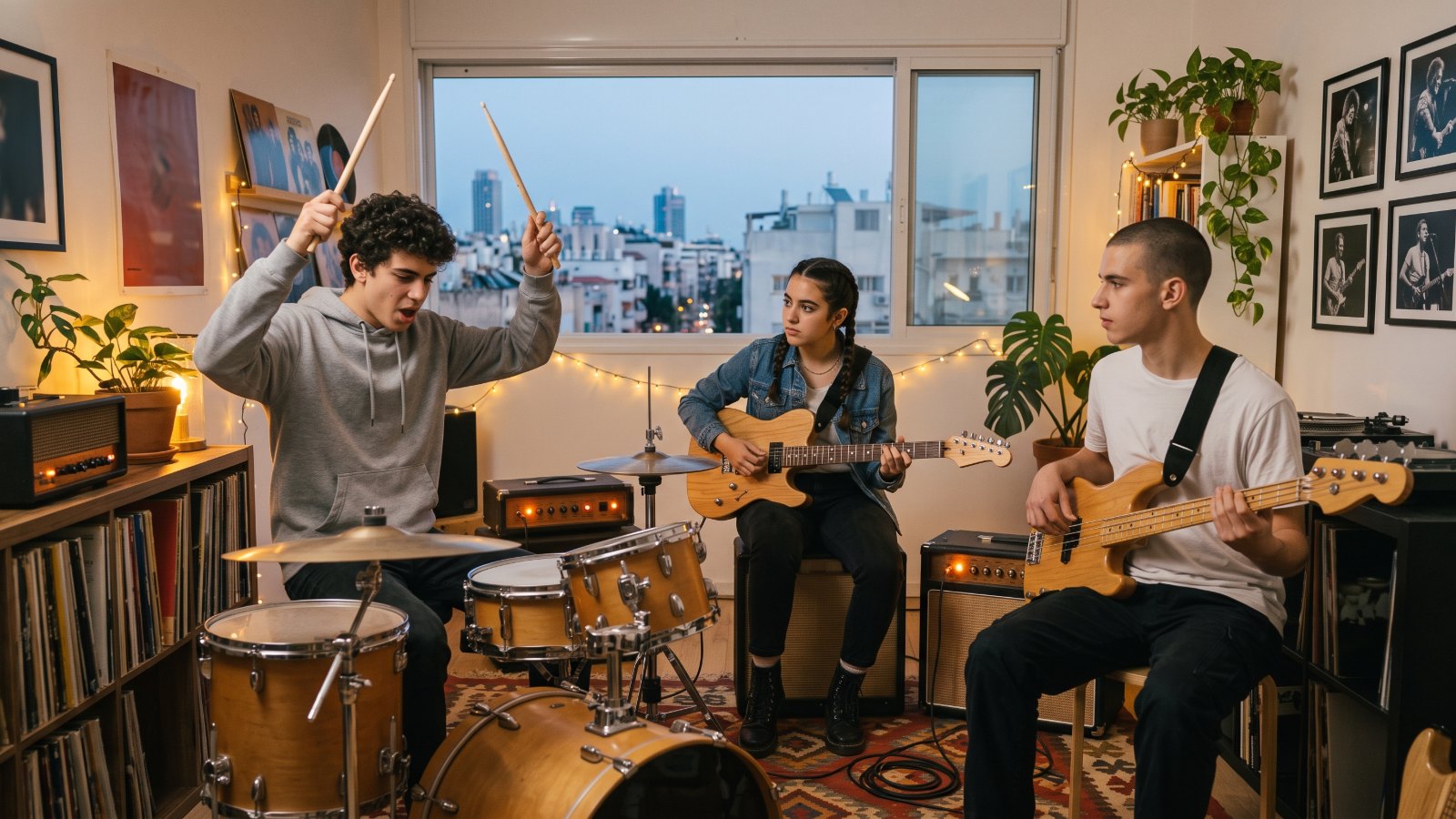
When everyone knows the BPM, rehearsal starts on time and the song doesn't run away. Tap it, send it to the metronome, lock the groove.
What to tap: finding the real beat
The most common mistake isn't the tapping, it's choosing what to tap. Tap where you'd nod your head. In most pop and rock the drums spell it out – kick on 1 and 3, snare on 2 and 4; each "boom" and "tak" is a beat. Reading the pulse like this is one of the first things we cover in drum lessons for teens and young adults.
Don't tap the vocal melody or the guitar riff – they push and lay back on purpose. Lock onto the drums, or with no drums, the bass.
Typical BPM ranges by genre
Use this as a sanity check. Trap measured at 70? You tapped in half-time – fine, as long as you know it.
| Genre | Typical BPM | What to tap | The trap |
|---|---|---|---|
| Ballad, slow R&B | 60–80 | Every beat, snare on 2 and 4 | Tapping once a bar |
| Hip-hop | 80–100 | Kick and snare | Busy hi-hats pull you to double |
| Funk and soul | 95–120 | The backbeat | Don't follow the syncopated bass |
| Pop | 100–130 | Kick and snare | Usually clear |
| Rock | 110–140 | Kick and snare | Eighth-note guitars pull you to double |
| House and techno | 120–135 | The four-on-the-floor kick | Hardly any |
| Trap | 130–160 | Often felt in half (65–80) | Both numbers are right |
| Drum and bass | 160–180 | The snare, felt in half | Both numbers are right |
| Punk rock | 160–200 | Every beat | Hand fatigue – 8 taps, then stop |
For reference: "Billie Jean" sits around 117 BPM, "Seven Nation Army" around 124, and "Blinding Lights" around 171 – a song many people tap in half, at about 86.
Half-time or double-time: which is right?
Often both; it depends on the job. For a project tempo or a band count-in, use the number where the snare lands on 2 and 4. Trap and drum and bass producers usually quote the higher figure (140, 174) even when the groove feels half as fast. That's why the tool shows both values side by side.
Using the BPM in your DAW
In Ableton Live, Logic, GarageBand, FL Studio or Reaper, type the BPM into the project tempo and the grid, loops and quantize line up. If the original was recorded to a click, round to the nearest whole number. If not (a lot of 70s and 80s records), use the decimal and check the grid hasn't drifted by the last chorus.
Tempo also sets effect timings. One beat in milliseconds is 60,000 ÷ BPM, which gives delay times that lock to the song:
| BPM | Quarter (ms) | Eighth (ms) | Dotted eighth (ms) |
|---|---|---|---|
| 90 | 666.7 | 333.3 | 500 |
| 100 | 600 | 300 | 450 |
| 120 | 500 | 250 | 375 |
| 140 | 428.6 | 214.3 | 321.4 |
The dotted eighth is the classic ambient-guitar delay – try it on arpeggios. Building a bedroom setup? See our home recording studio on a budget guide.
From BPM to practice
Don't hammer a new song at full speed – build up to it.
- Open it in the metronome. One click carries the BPM over.
- Drop to 70–80%. Song at 120? Start at 85–95 until the hard section is clean three times in a row.
- Build up. Let the metronome's speed trainer add a few BPM every few bars up to the original tempo.
- Play along with the record. Only once it's clean with the click at full tempo.
Common mistakes
Too few taps. Three taps give you a number, not a reliable one. Wait for the stability score to climb.
Tapping the intro. Intros are often loose. Tap a verse or chorus, once the drums are in.
Chasing a round number. A song tracked without a click really can be 117.8, and a chorus can run a couple of BPM faster than the verse. That's music, not a bug.
Trusting BPM websites blindly. They sometimes list the half or double value, or a different version – a remix, a live take, a remaster. Playing along with a specific recording? Tap it yourself.
Tap tempo in the rehearsal room
In rehearsal, "faster" and "slower" are an argument; 124 versus 118 is a decision. Tap the original, agree on a number and write it next to the song on the setlist, so the drummer counts in right even when show-night adrenaline wants to rush. More in our golden rules for playing in a band. And if you're the one locking the groove with the drummer, bass guitar lessons build exactly that skill.
Tap tempo and BPM: frequently asked questions
What is tap tempo?
Tap tempo is a way to measure speed: you tap along with a song's beat, and the tool works out the beats per minute (BPM) from the gaps between your taps.
How many times do I need to tap for an accurate BPM?
Usually 8–12 taps is enough. The tool uses the median of your most recent taps, so one sloppy tap won't throw the result off. Once the stability score is high and the number stops jumping, you can trust it.
Can the tool detect a song's BPM automatically?
No. It doesn't listen to audio or use your microphone – it measures your taps. So you decide where the beat is, and it works on any source, even live.
Why do I get double or half the BPM listed online?
You most likely tapped eighth notes instead of quarters, or once every two beats. It's especially common in trap, drum and bass and ballads. That's why the tool also shows the half-time and double-time values – in those styles both numbers count as correct.
Why does the BPM have a decimal point?
Because many songs, especially ones recorded without a click, don't sit exactly on a round number. For metronome practice, round it. For a DAW project tempo, use the decimal value so the grid doesn't drift across the song.
Where can I learn drums and rhythm in North Tel Aviv?
Rockstar music school is in Ramat Aviv Gimel, close to Neve Avivim, New Ramat Aviv, Afeka, Kokhav HaTzafon and Tzukei Aviv. We offer drum lessons in North Tel Aviv for teens and adults, plus lessons at your home in nearby neighborhoods, subject to teacher availability. More in our guide to music lessons in Ramat Aviv.
More free tools for musicians
Every Rockstar tool runs right in your browser, no app needed.
Online Metronome
20–300 BPM with 8 time signatures, subdivisions and per-beat accents. A built-in speed trainer and sample-accurate timing that holds steady even in a background tab.
Open tool →
Ear & Rhythm Trainer
Intervals, chord quality and a rhythm test that measures in milliseconds whether you rush or drag. Scores and progress are saved in your browser.
Open tool →
Chord Progression Generator
Progressions in 12 keys and 9 styles, from pop and rock to blues and jazz, with loop playback. "Surprise me" builds a fresh one from functional-harmony rules.
Open tool →You found the tempo. Now own it.
The tool tells you the BPM; a good teacher teaches you to play on it without rushing – in a band, in the studio and on stage. Come for a free, no-commitment intro lesson at our music school in Ramat Aviv Gimel, North Tel Aviv.