Online Guitar TunerChromatic, Precise and Free
Tune your guitar, bass or ukulele with the microphone you already have – no app, no sign-up, no cost. Single-cent precision, reference tones for every string, and your audio never leaves the browser.

How to use the tuner
It works like a studio chromatic tuner: it hears the pitch you play, shows the nearest note and string, and measures exactly how far off you are. Your laptop or phone mic is all you need.
- Pick your instrument. Guitar in standard tuning (E A D G B E), Drop D, 4-string bass, ukulele (G C E A), or Chromatic mode, which recognizes any note – for alternate tunings, other instruments, even your voice.
- Start and allow the mic. Press “Start tuner” and accept the browser prompt. Keep the device 20–40 cm from the instrument; with an unplugged electric guitar, bring it right up to the strings.
- Play one string at a time. Pluck at normal strength and let the note settle for a second. The tuner works out which string you're on and highlights it.
- Read the needle. Left of center (♭) is flat – tighten. Right of center (♯) is sharp – loosen. Below the note you'll see the frequency in hertz and the offset in cents.
- Stop on green. Within ±3 cents the note turns green. Hold it for about a second and the string gets a check mark.
- Go round twice. Retuning one string flexes the neck and nudges the others – especially with new strings or a floating tremolo. A second pass locks it all in.
No mic, or access blocked? Tap a string button to hear its reference tone and tune by ear until the two sounds merge. It's great ear training – a skill we start building in our very first guitar lessons for beginners, because practising on an out-of-tune guitar is a fast track to frustration.
What makes it accurate
- YIN pitch detection – an established algorithm from audio research that handles the harmonic-rich sound of strings without jumping octaves, refined by interpolation to a fraction of a cent.
- A steady needle – each reading is the median of the latest measurements, so it doesn't twitch at every noise in the room.
- A clean signal – the browser's own noise suppression, echo cancellation and auto-gain are switched off, since they alter the sound being measured.
- A4 calibration, 430–450 Hz – in 1 Hz steps; the reference tones follow your setting.
- Private by design – audio is analysed only in your browser. Nothing is recorded, stored or sent, and the mic shuts off when you switch tabs.
For the whole process step by step – including what to do with no tuner around – see our complete guide to tuning a guitar. The tuner is part of Rockstar's set of free tools for musicians.

Bass needs sharp ears too
On bass, the 12th-fret harmonic gives a clean, steady tone. Switch to Chromatic mode and check each string on its own.
Tuning reference: guitar, bass and ukulele frequencies
All values assume standard concert pitch, A4 = 440 Hz. Strings are numbered from the thinnest (1), as on the tuner's buttons, and the digit after each note is its octave: E2 is the guitar's low E, E4 two octaves higher.
Guitar – standard tuning
| String | Note | Frequency (Hz) |
|---|---|---|
| 6 (thickest) | E2 | 82.41 |
| 5 | A2 | 110.00 |
| 4 | D3 | 146.83 |
| 3 | G3 | 196.00 |
| 2 | B3 | 246.94 |
| 1 (thinnest) | E4 | 329.63 |
Drop D – one string, a whole new sound
Lower only the 6th string a whole step, from E2 to D2 (73.42 Hz). You get one-finger power chords on the three lowest strings and a deeper bottom end – think Foo Fighters' “Everlong” or The Beatles' “Dear Prudence”. The dedicated Drop D mode reads that low D as the 6th string, not as a badly flat E.
4-string bass
| String | Note | Frequency (Hz) |
|---|---|---|
| 4 (thickest) | E1 | 41.20 |
| 3 | A1 | 55.00 |
| 2 | D2 | 73.42 |
| 1 (thinnest) | G2 | 98.00 |
The bass sits exactly an octave below the guitar's four lowest strings, so a bass that's slightly off muddies the whole band. In our bass guitar lessons, accurate tuning and locking in with the groove start on day one.
Ukulele – GCEA
| String | Note | Frequency (Hz) |
|---|---|---|
| 4 | G4 | 392.00 |
| 3 | C4 | 261.63 |
| 2 | E4 | 329.63 |
| 1 | A4 | 440.00 |
On a standard uke the 4th string (G) is higher than the 3rd (C). This “re-entrant” tuning gives the ukulele its bright sparkle. If yours has a low G (G3), use Chromatic mode.
Alternate tunings in Chromatic mode
Chromatic mode recognizes every note in every octave, so you can tune to anything. It always shows sharp names: D♯ is the same pitch as E♭, A♯ the same as B♭.
| Tuning | Notes (low to high) | Where you hear it |
|---|---|---|
| Half step down (E♭) | D♯ G♯ C♯ F♯ A♯ D♯ | Jimi Hendrix, Stevie Ray Vaughan, Guns N' Roses |
| Drop C | C G C F A D | Hard rock and metal |
| DADGAD | D A D G A D | Folk, Celtic, Led Zeppelin's “Kashmir” |
| Open G | D G D G B D | Slide blues, Keith Richards |
| Open D | D A D F♯ A D | Slide, folk, acoustic songwriting |
What is a cent, and why is ±3 cents “in tune”?
A cent is a hundredth of a semitone – 100 between E and F, 1,200 in an octave. Unlike hertz, it means the same thing across the range: one cent is about 0.06 Hz on the A string (110 Hz) but about 0.19 Hz on the high E. Few people hear a 2–3 cent error on a single note, but two strings drifting in opposite directions produce “beating”, a slow wobble in volume. Hence the green zone of ±3 cents.
A4 calibration: 440, 442 or 432?
440 Hz is the international standard (ISO 16) and almost all modern music uses it – leave it unless you have a reason. Many European orchestras tune to 442–443 Hz, and a piano that hasn't been serviced lately may sit below 440. Each 1 Hz is roughly 4 cents: to match such a piano, play its A in Chromatic mode and adjust the calibration until that A reads zero. As for 432 Hz, the popular claims about it have no research behind them; the setting is there for playing along with recordings or instruments tuned that way.
A teacher's advice: tuning that stays put
An accurate tuner is only half the job. The other half is technique – and that's where most beginners slip.
Always finish by tuning up
If a string is sharp, drop it slightly below the note, then bring it back up. Ending on an upward turn keeps the tuning gears under tension, so the string doesn't creep flat mid-song.
Your picking changes the reading
A hard attack pushes the pitch sharp for a moment. Pick at your real playing strength, read the needle after the note settles, keep your fretting hand off the open string, and palm-mute any strings ringing in sympathy.
New strings stretch
After a string change, gently pull each string away from the fretboard, retune, and repeat two or three times. Moving from a hot car into an air-conditioned room shifts tuning too, so let the guitar acclimatize first.
Open strings in tune, chords still sound off?
That's likely intonation – how well the guitar stays in tune up the neck. Check it in Chromatic mode: play the 12th-fret harmonic, then the fretted 12th-fret note on the same string. They should match. If the fretted note is sharp, move the bridge saddle back, away from the neck; if flat, move it forward. It's part of a proper guitar setup, and sometimes the hidden reason a student “can't sound good” while playing correctly. A teacher hears it instantly – one real advantage of learning guitar with a teacher over learning from videos.
In a band, everyone tunes to the same A
Tune every instrument to the same calibration before rehearsal and again at the break – two instruments “nearly in tune” in different directions sound muddy no matter the mix. More in our golden rules for playing in a band. Once you're in tune, open the guitar chord chart and start playing.
Online tuner FAQ
Is the tuner really free, with nothing to download?
Yes. It runs in any up-to-date Chrome, Safari, Firefox or Edge, on desktop or mobile. No app, no account – just allow microphone access.
Does the tuner record me or send my audio anywhere?
No. Sound is analysed in real time inside your browser; nothing is recorded, stored or sent. Press Stop or switch tabs and the microphone is released.
What's the difference between a chromatic tuner and a guitar tuner?
A guitar tuner only knows the six notes of standard tuning. A chromatic tuner recognizes all 12 notes in every octave. This page has both: Guitar, Drop D, Bass and Ukulele modes detect the string automatically, and Chromatic mode covers any other tuning or instrument.
Why does the needle jump, or not pick up my note?
Usually it's several strings ringing at once, background noise, a distant mic, or an electric guitar without an amp. Play one string, mute the rest and move closer. For very low bass notes, use Chromatic mode and the 12th-fret harmonic. If you blocked the mic, re-enable it via the lock icon next to the address bar.
How often should I tune my guitar?
Every time you pick it up – it takes under a minute. Check again in long practice sessions, before a gig or rehearsal, and after temperature changes. New strings drift more during their first week.
Where can I take guitar lessons in North Tel Aviv?
Rockstar music school is in Ramat Aviv Gimel, with students coming from Neve Avivim, Afeka, Tel Baruch, Ramat HaHayal and Tzahala. Our guitar lessons in North Tel Aviv are taught by working musicians, and home lessons nearby are available subject to teacher availability. See also music lessons in Ramat Aviv.
More free tools for musicians
Every Rockstar tool runs right in your browser, no app needed.
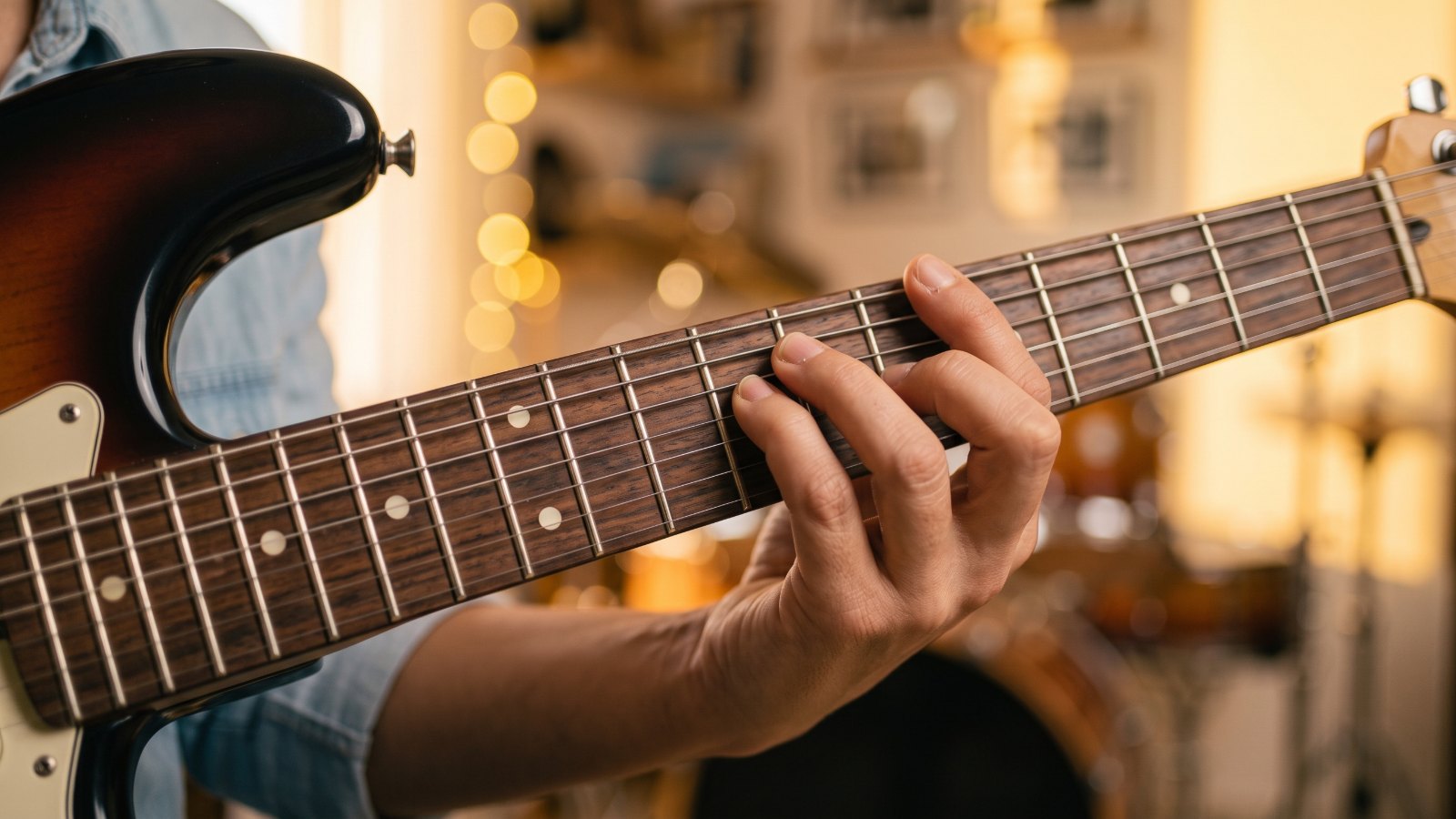
Guitar Chord Chart
144 chords with up to 3 shapes each, fretboard diagrams, interval formulas and a piano keyboard view. Tap any shape to hear how it sounds.
Open tool →
Chord Transposer
Paste a chord sheet and move it to any key, slash chords and extensions included. It detects the original key and suggests a capo with easy open shapes.
Open tool →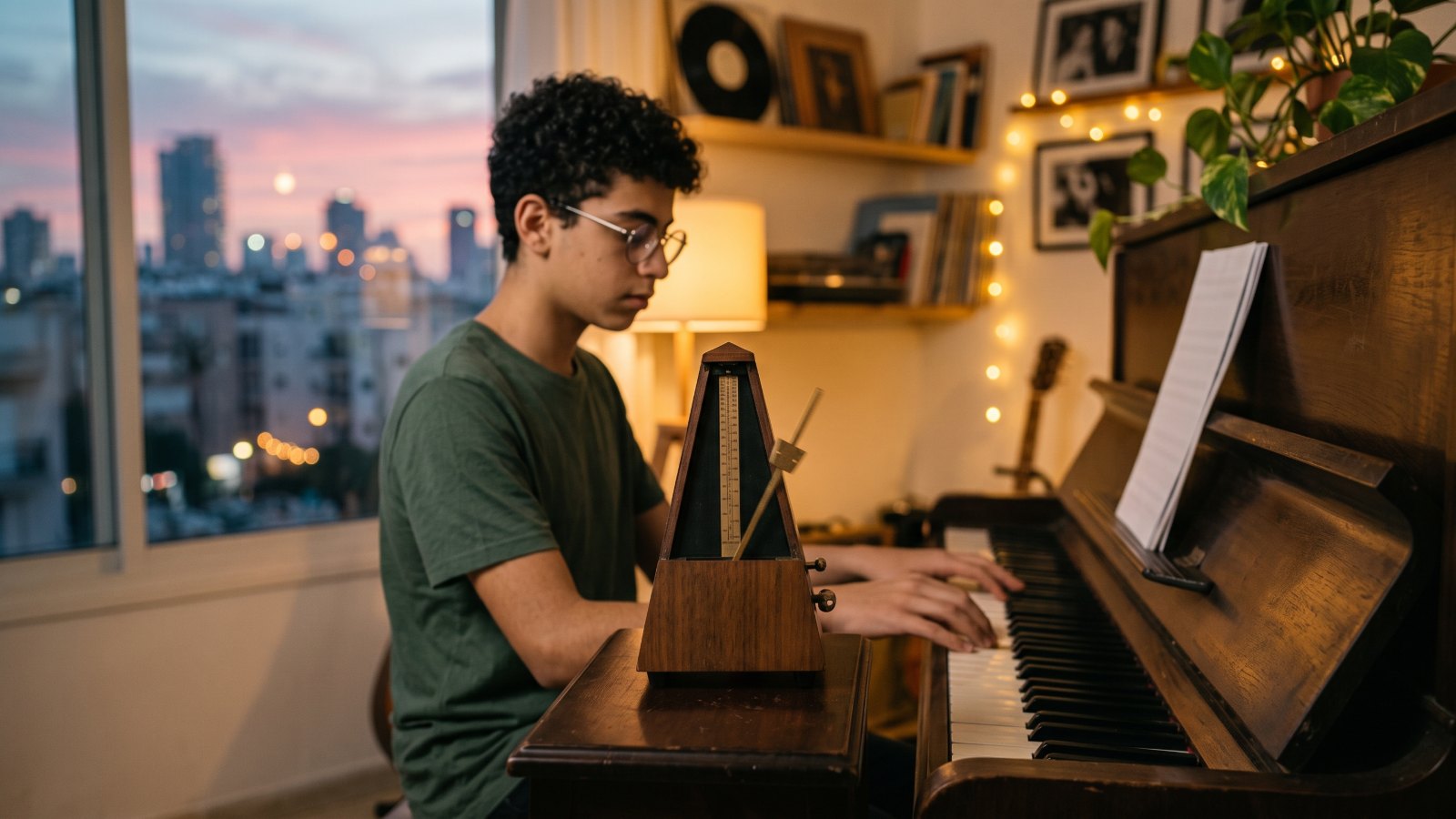
Online Metronome
20–300 BPM with 8 time signatures, subdivisions and per-beat accents. A built-in speed trainer and sample-accurate timing that holds steady even in a background tab.
Open tool →You're in tune. Now let's make music.
At our music school in Ramat Aviv Gimel, North Tel Aviv, teachers who are working musicians will map your path – from your first chord to the song you've always wanted to play. The intro lesson comes with no commitment.