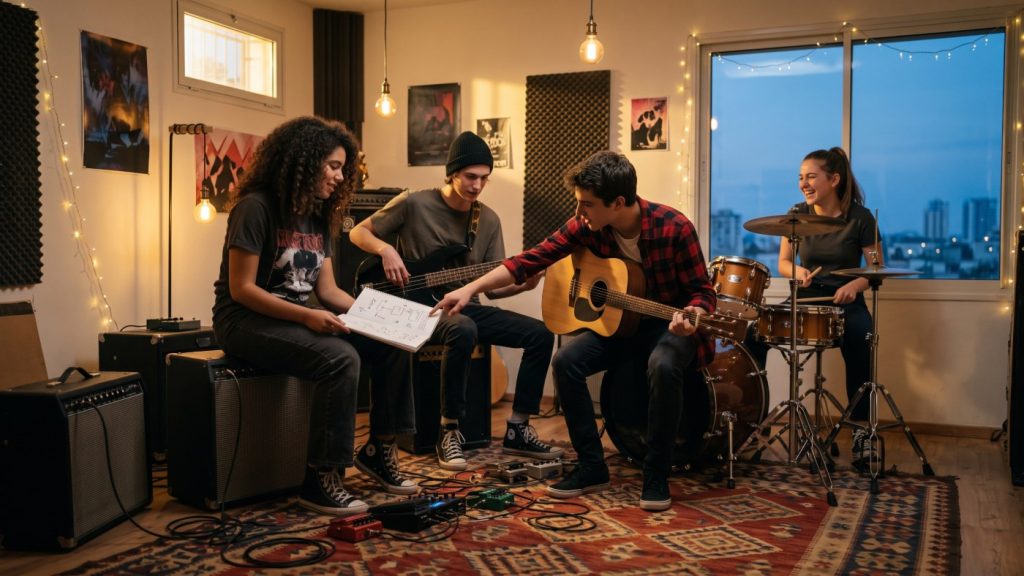
Every band starts with covers, and almost every band hits the same wall: everyone plays the right parts, yet the song sounds like a karaoke version of the original. Playing a song and arranging it are two different things. An arrangement is a series of decisions: which key, which tempo, who plays when, where the song breathes and where it explodes. Once you start making those decisions on purpose, the cover stops being an imitation and becomes yours.
We wrote this guide for the bands we meet in North Tel Aviv – 16- and 17-year-olds from Azorei Chen and Tel Baruch preparing for a first gig, and adults in Tzahala who started a band with friends from work. Whether you already play in one of our band and ensemble programs for teens and adults or are just thinking about starting one, here’s a step-by-step process for turning someone else’s song into a version people remember.
Step 1: Pick a song that fits your band
Don’t choose a song just because it’s cool – choose one that suits your lineup. Before you vote, ask:
- Do we have the instruments? A song built on horns or layered synths needs serious re-arranging. Know that going in.
- Can our singer really sing it? Not just the top note, but the whole chorus, three times, live.
- Do we have something to add? The best covers dress a strong melody in new clothes. A song whose appeal is mostly its production is harder to make your own.
- Is it the right level? One stretch song is great; a whole set above your level is frustrating.
Tip: each member brings two songs and you play each once, roughly, without stopping. Within half an hour it’s obvious which ones catch fire.
Step 2: Choose a key for your singer, not for the record
This is the most important arranging decision, and the most overlooked. The original singer chose a key for their voice. If yours has to strain in the chorus, no arrangement will save it.
How to choose a key:
- Find the melody’s highest and lowest notes (usually chorus and verse).
- Play the chorus in the original key while the singer sings it at full volume.
- Move a semitone at a time until the chorus sits comfortably and the verse doesn’t vanish at the bottom.
- Sing the whole song twice in a row. If the voice still feels good, you’ve found your key.
When a female singer covers a male artist (or vice versa), expect to move three to five semitones, or a full octave. Instead of rewriting chords by hand, use our online chord transposer, which also suggests a capo position. To understand why some keys sit better on guitar or piano, read our guide to major scales and keys.
If the chorus is still hard in the new key, work on technique – see how to sing high notes without straining.
Step 3: Tempo, feel and genre – where the cover becomes yours
The fastest way to give a song a new identity is to change its feel. Sometimes slowing it down 15% and dropping the drums from verse one is enough.
Famous reinterpretations worth studying
- “Hurt” – Nine Inch Nails’ industrial original, stripped to acoustic guitar and piano by Johnny Cash.
- “All Along the Watchtower” – Bob Dylan’s folk song, turned electric by Jimi Hendrix.
- “Mad World” – Tears for Fears’ synth-pop, reborn as a piano ballad by Gary Jules and Michael Andrews.
- “With a Little Help from My Friends” – a cheerful Beatles tune slowed into soul-gospel by Joe Cocker.
- “I Will Always Love You” – Dolly Parton’s country song, a power ballad for Whitney Houston.
In every case the melody stayed and everything around it changed.
Recipes for changing the feel
| Change | What you actually do | Works well for |
|---|---|---|
| Slow and strip back | Drop the BPM by 15–25%, open with one instrument and voice | Fast pop songs with strong lyrics |
| Half-time | The snare moves from beats 2 and 4 to beat 3 only – same tempo, twice the weight | Final chorus, heavy rock versions |
| Genre swap | Rock song as funk, ballad as bossa nova, pop as acoustic | Bands with a strong identity |
| Meter change | Move a 4/4 song into 6/8 (or the reverse) | Advanced bands; needs lots of rehearsal |
| Unplugged | Acoustic guitar, cajón or brushes, soft bass | Small gigs, singalong nights |
Tip: measure the original BPM, try three or four tempos in rehearsal and record each on a phone. Listening back, the choice is usually obvious.
Step 4: A form map – the biggest time-saver in rehearsal
Bands waste hours on “wait, chorus or bridge?” The fix is one written form map: sections, bar counts and what happens in each. An example for a mid-tempo rock arrangement:
| Section | Bars | Who plays | Energy (1–10) |
|---|---|---|---|
| Intro | 4 | Guitar alone with the chorus riff | 3 |
| Verse 1 | 8 | Guitar + bass, drums on hi-hat only | 4 |
| Chorus 1 | 8 | Everyone, full drums | 7 |
| Verse 2 | 8 | Full band but soft, keys add a pad | 5 |
| Chorus 2 | 8 | Everyone | 8 |
| Bridge | 8 | Bass and drums only, then a 4-bar build | 4 → 9 |
| Last chorus ×2 | 16 | Everyone, second guitar an octave up | 10 |
| Ending | 4 | Intro riff, stop on the drummer’s cue | 6 |
The energy column is the secret: if every row is 7 or above, the song has nowhere to go.
Step 5: Every instrument needs a role and its own space
Young bands rarely lack notes – they have too many. Everyone plays all the time in the same register, and the result is mud. Divide the space:
- Drums set the feel and energy. A closed hi-hat versus an open ride matters more than any fill, and drum lessons with a teacher who gigs in bands focus a lot on what not to play.
- Bass links the kick to the harmony. Usually the root, locked to the kick, is plenty.
- Guitars – two guitars should never double the same part. One plays open chords, the other high voicings – or sits out the verse.
- Keys – keep the left hand out of the bassist’s range; stay in the middle register.
- Vocals are the star. When there are words, instruments make room.
Rule of thumb: at any moment only one element is “talking” – voice, riff or solo. For more on band chemistry, see our golden rules for playing in a band.
Step 6: Dynamics and builds – tell the song like a story
A great live song is a wave: it rises, dips and peaks. Tools for shaping it:
- Adding layers: two instruments in verse 1, four in verse 2. The song grows without anyone playing louder.
- Drop-outs: two bars before the last chorus, everyone stops but the voice. The re-entry hits hard.
- Drum builds: move from hi-hat to toms or ride, or play eighth notes then sixteenths on the snare over four bars.
- Stops: the band cuts out together on one accent – only if it’s perfectly tight.
- A key change in the last chorus: up a semitone or whole tone. Use sparingly, and check the singer can still reach it.
Step 7: Intros and endings
Audiences remember intros and endings – the parts bands rehearse least.
Intros
- The chorus riff on one instrument, then the full band comes in.
- A cold open – the singer sings the first line alone, then the band enters.
- A four-bar drum groove, then bass, then everyone else.
Endings
- Tag: repeat the last line of the chorus three times, then finish.
- Hard stop on a cue: the drummer or guitarist raises a hand and everyone cuts on the final chord.
- Ritardando: slow down over the last two bars and hold a long final chord.
A fade-out works on a record, not on stage. Every song needs a real ending.
A four-rehearsal process
This works for bands that meet weekly, and in coached band rehearsals with a teacher, where the teacher keeps things moving.
| Rehearsal | Goal | What you do |
|---|---|---|
| 1 | Get to know the song | Set key and tempo, write the form map, play top to bottom without stopping |
| 2 | Define roles | Each instrument decides what it plays in every section; work section by section, slowly |
| 3 | Dynamics and transitions | Drill builds, stops, intro and ending separately, five times each |
| 4 | Gig-style run | Play the song three times in a row without stopping, record it, listen together and fix only two things |
Between rehearsals, practise along with the latest rehearsal recording, not the original – so you all practise your version.
Common mistakes
- Copying the record note for note. Ask what a part does for the song and recreate that feeling with what you have.
- Keeping the original key “because that’s how it sounds”. The right key is the one where your singer sounds best.
- Everyone playing all the time. Silence is an arranging tool.
- Changing everything at once. Pick one or two main changes, or the song becomes unrecognisable.
- Not recording rehearsals. The recording doesn’t lie.
- Neglecting intros and endings. They’re what falls apart on stage.
How we arrange covers at Rockstar in North Tel Aviv
In Rockstar’s ensembles, at our music school in Ramat Aviv Gimel, arranging is part of the learning. The teacher – a working musician – doesn’t hand out a ready-made arrangement but guides the band through the decisions: testing keys, trying tempos, writing a form map and recording. Students learn to think like arrangers and find where their own playing needs work – for example through one-on-one bass guitar lessons. If you’re a teen or an adult who wants to play with others, come and meet our bands and ensembles in North Tel Aviv with a free intro lesson.
FAQ
How many rehearsals does one cover take?
Usually three or four rehearsals of 90 minutes to two hours, if everyone practises at home. Complex arrangements take longer.
Should we learn the original first and change it later?
Usually, yes. Knowing the original shows you why the song works, which makes it easier to decide what to keep and what to change.
What if our band has two singers with different ranges?
Give each song to the singer whose key suits it, split verses and chorus between them, or harmonise a third apart.
Do we need to read music to arrange a song?
No. Most bands work from chord charts, a form map and recordings. Reading helps but isn’t required.
Can we join an ensemble if we live in Azorei Chen, Tel Baruch or Tzahala?
Absolutely. Our ensembles meet at the music school in Ramat Aviv Gimel, a short drive from Azorei Chen, Tel Baruch, North Tel Baruch and Tzahala. There’s more detail on our page about music lessons in Azorei Chen. Private lessons at home are available in some neighborhoods through Rockstar Home, subject to teacher availability in your area.
Read also: Playing in Time: Groove and Metronome Practice for Drums & Bass · Funk Rhythm Guitar Like Nile Rodgers · Saturation and Distortion in Mixing
Ensembles & bands · All lessons · Contact us · Book a free intro lesson