Most chart hits come and go within a couple of weeks. Avi HaTahol by Roei Adam has now spent 16 weeks on Spotify’s weekly Israel chart and sits at number two this week. For guitarists that is a gift: a song everyone knows, built on one four-chord loop, that teaches barre chords, a clean minor-to-major switch and a slow, heavy groove. This guide walks you through the Avi HaTahol chords, the song map and the strumming, step by step.
The key facts in one line: the song is in E-flat minor, 87 BPM, in 4/4, with four chords – Ebm, Db, Abm and Bb – and an easy capo option at the 6th fret. It suits players who already know their open chords and are ready for the next step, which is exactly the step we work on in our guitar lessons in North Tel Aviv, with high schoolers and adults from Ramat Aviv Gimel, Neve Avivim and Green Ramat Aviv.
Avi HaTahol chords: the song at a glance
| Fact | Value |
|---|---|
| Key | E-flat minor |
| Tempo | 87 BPM |
| Time signature | 4/4, one chord per bar |
| Capo | Not required; easy version with a capo at the 6th fret |
| Difficulty | Intermediate (2 of 3) – four barre chords |
| Chords | Ebm, Db, Abm, Bb |
| Main progression | i–VII–iv–V |
You can also open the song in the Rockstar song analyzer, which shows the chords, the structure and the tempo together, and play along while you read.
The chords and how to play them
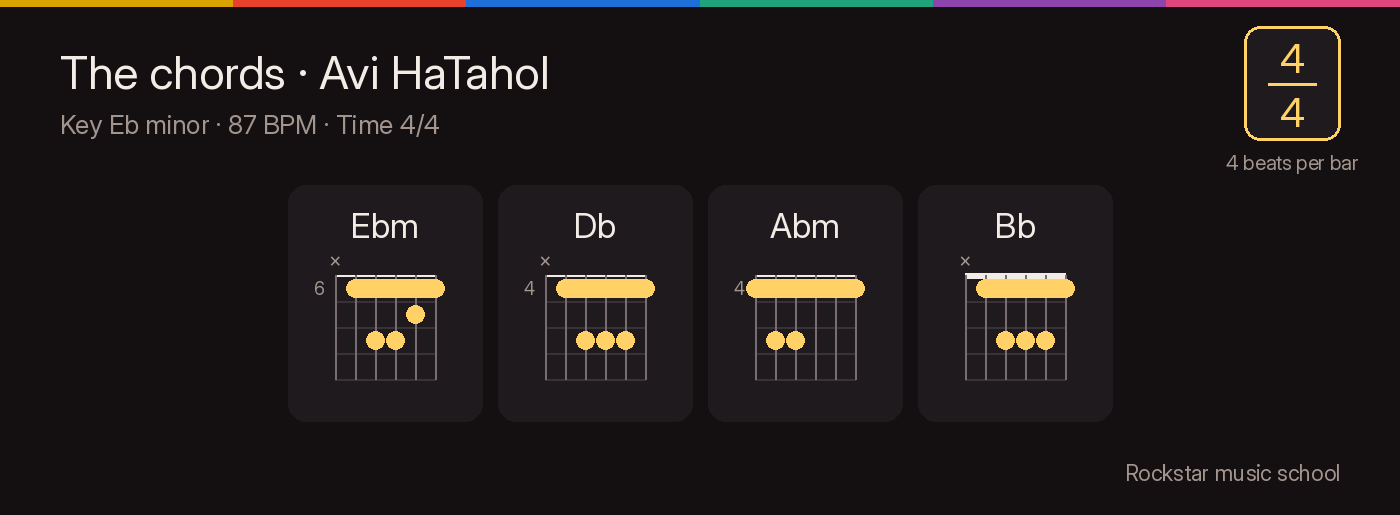
All four chords live in E-flat minor, and each has a clear job. Ebm is home, the tonic (i) – where your ear wants to land. Db is a major chord on the seventh degree (VII), one whole step below the tonic; it opens the loop with a sense of stepping downward. Abm is the fourth degree (iv), a soft minor chord that darkens the mood. Then comes Bb – the fifth degree, but major rather than minor. A Bb major chord contains the note D, a half step below Eb, and that note is what pulls the music back home. Put that D next to the Cb inside Abm and you get the sound of the harmonic minor scale, the colour Israeli ears know from Mizrahi music. That is the tension you hear just before the loop drops back onto Ebm.
The shapes on the neck
- Ebm – Am-shape barre at the 6th fret: x68876. Your first finger covers five strings.
- Db – A-shape barre at the 4th fret: x46664. Three fingers in a row on the 6th fret, or one third-finger mini barre across all three.
- Abm – full Em-shape barre at the 4th fret: 466444. The hardest of the four, because the barre covers all six strings.
- Bb – A-shape barre at the 1st fret: x13331, right next to the nut.
One detail helps: going from Db to Abm, your first finger stays on the 4th fret. Only the other fingers change, from the A shape to the Em shape. Practise this change without lifting the barre off the strings at all.
The hard change: Bb back to Ebm
The jump from the 1st fret to the 6th at the end of every pass is where most students arrive late. There are two ways to fix it. The first is a focused drill: one minute of nothing but Bb and Ebm, four clicks each on the metronome, counting how many clean changes you make. The second is to play Bb as an E-shape barre at the 6th fret: 688766. Now Bb and Ebm sit on the same fret, and the change becomes a new hand shape instead of a leap along the neck. If these shapes are still new to you, the guitar chord chart shows each one in several positions, and our guide on how to play barre chords explains how to build strength and the right pressure.
The song section by section
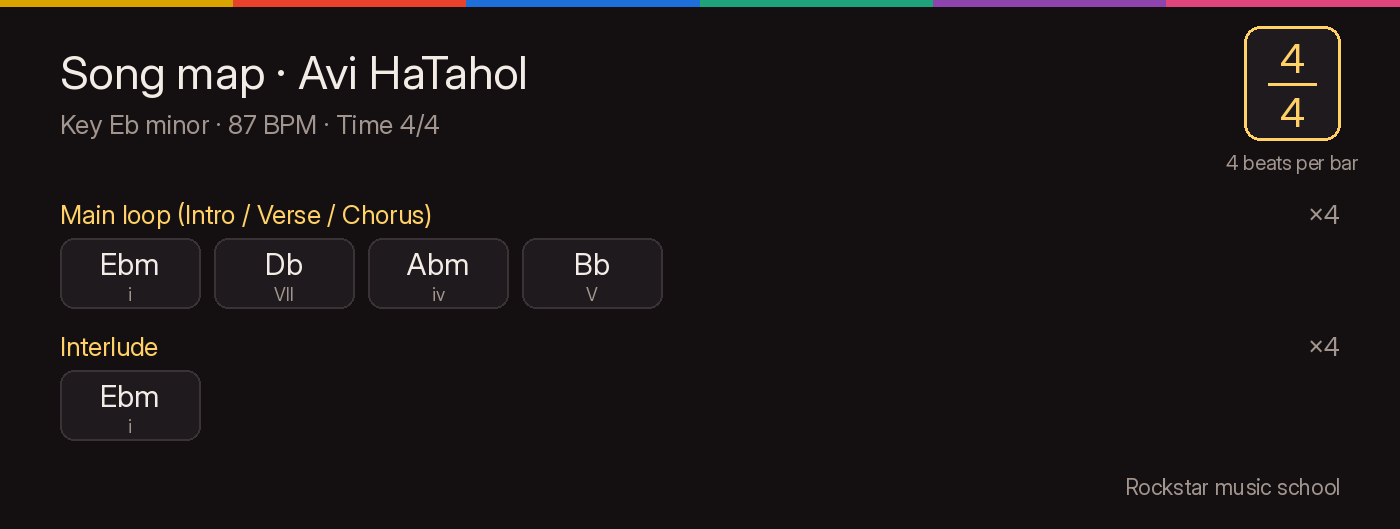
The good news: almost the whole song is the same loop. The intro, verse and chorus all run on Ebm – Db – Abm – Bb, one chord per bar, so four bars per pass. On the map above the loop repeats four times in a row, sixteen bars, followed by an interlude that stays on Ebm alone for four bars.
The main loop: i–VII–iv–V
The bass line steps down from Eb to Db and then to Ab, and finally climbs to Bb. The descent gives the song its weight, and the rise to a major Bb pulls the string tight before the return. Because the chords do not change between verse and chorus, the energy has to come from your strumming hand: play the verse softer, perhaps favouring the lower strings, then open up all six strings and dig in for the chorus.
The interlude: Ebm on its own
The four bars on Ebm are a breath after the repeated tension of Bb. Play them quieter, or with one long strum per bar, so the loop’s return lands. Worth knowing: one of the sources we checked shows the bridge differently, as Bb – Abm6 – Db6, and adds colours like Db6 and Abm6 inside the loop as well. Let the recording decide.
Strumming and groove
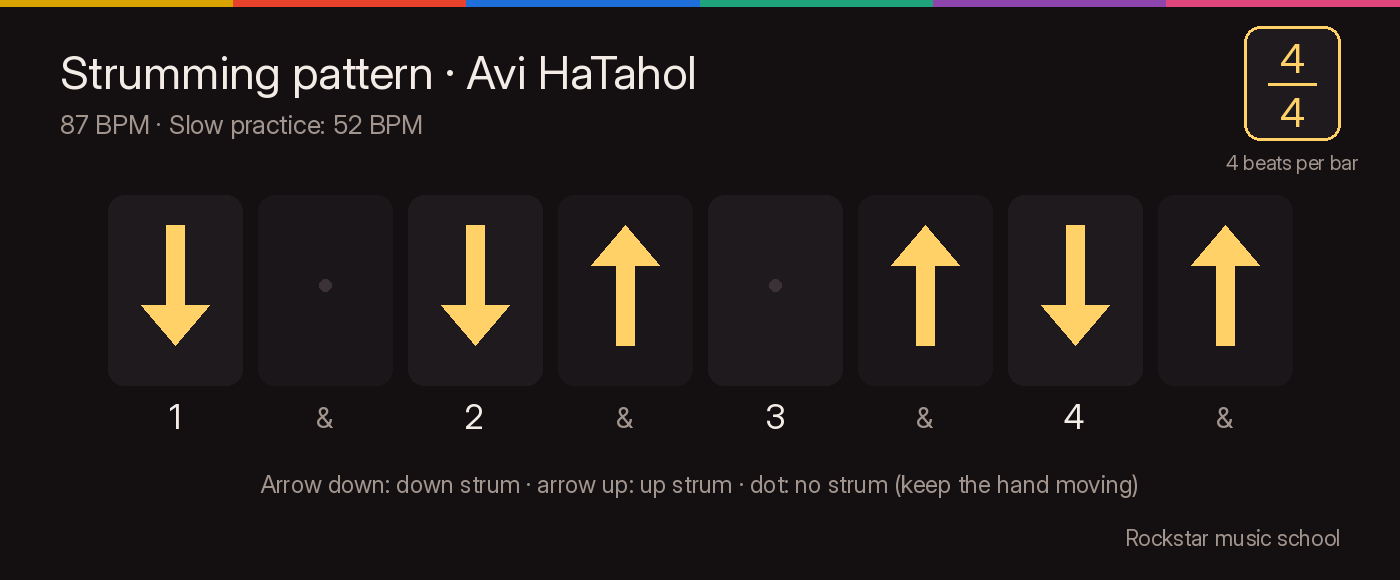
The song is in 4/4, so you count “1 and 2 and 3 and 4 and” – eight slots per bar. The pattern: a long down strum on 1, then down on 2, up on the “and” after it, skip beat 3, up on the “and” of 3, down on 4 and up on the last “and”. In short: down, (miss), down, up, (miss), up, down, up.
The secret is that your hand never stops. It moves down on every number and up on every “and”, and on the empty slots it simply misses the strings. The long down strum on 1 is what makes the song feel slow and heavy: let the chord ring and do not hurry into the next stroke. Skipping beat 3 creates the swing – the up strum that follows falls between the clicks and feels like a push forward.
The practice tempo ladder
Do not start at 87 BPM. Open the free online metronome and climb in steps:
| Step | Tempo | Goal |
|---|---|---|
| 60% | 52 BPM | The pattern without mistakes on Ebm alone, then every chord change landing exactly on 1 |
| 75% | 65 BPM | The full loop four times without stopping, every barre clean |
| 90% | 78 BPM | Add the dynamics: soft verse, full chorus |
| 100% | 87 BPM | Play along with the recording from start to finish |
Move up a step only after three clean passes in a row. This is exactly the kind of feedback a teacher gives in real time: in a free intro guitar lesson you see straight away whether your strumming hand keeps moving or freezes before a change.
An easier version: capo at the 6th fret
If barre chords still tire your hand, there is an excellent shortcut. Put a capo on the 6th fret and play the open shapes Am, G, Dm and E. The capo raises each shape by six half steps, so the sound comes out exactly as Ebm, Db, Abm and Bb – the same key as the recording. Another option is a capo at the 1st fret, with mostly open shapes; you can check every conversion with the chord transposer.
| Capo | Shapes you play | What sounds |
|---|---|---|
| No capo | Ebm, Db, Abm, Bb (barre) | E-flat minor, as on the record |
| 1st fret | Dm, C, Gm, A (only Gm is a barre) | E-flat minor |
| 6th fret | Am, G, Dm, E (all open) | E-flat minor |
In the capo 6 version the E major shape does the job of Bb: its G sharp plays the same leading-tone role, pulling back to the Am shape. So even the easy version keeps that Mizrahi tension before the loop comes home.
A 7-day practice plan
- Day 1 (15 minutes): the four shapes, one at a time. Check that every string rings, and fix your thumb position behind the neck.
- Day 2 (15 minutes): changes in pairs – Ebm to Db, and Db to Abm keeping the barre on the 4th fret. One minute per pair, counting changes.
- Day 3 (20 minutes): the hard change from Bb to Ebm, both ways. Pick the shape that works for your hand.
- Day 4 (15 minutes): the strumming pattern on Ebm alone at 52 BPM, then the full loop with one strum per bar.
- Day 5 (20 minutes): the loop with the full pattern at 65 BPM, four passes in a row.
- Day 6 (20 minutes): 78 BPM, with verse and chorus dynamics and the Ebm interlude.
- Day 7 (20 minutes): play along with the recording at 87 BPM. Record yourself on your phone and listen for where you arrive late.
If you live in Green Ramat Aviv or Tzukei Aviv and practise after a day of work or school, fix a regular quarter of an hour in the evening. Fifteen minutes every day beats two hours once a week.
Common mistakes in this song
- Playing Bbm instead of Bb. If you go by the key signature alone you expect a minor chord on the fifth degree. In this song it is major, and without the D the tension disappears.
- Freezing the strumming hand on the change. Because of the jump from Bb to Ebm, many players stop strumming. Better to drop the last strum of the bar and keep moving than to lose the time.
- Rushing. 87 BPM is a slow tempo, and the heavy feel comes from the long strum on 1.
- A dead string in Abm. In the full barre the third string tends to choke. Roll your first finger slightly onto its bony side and check each string on its own.
- The same volume all the way through. When the chords never change, only the dynamics tell the story.
Frequently asked questions
Is Avi HaTahol good for beginners?
With a capo at the 6th fret, yes, as long as you can already play Am, G, Dm and E. Without a capo it is a great song for the stage after open chords, when you start learning barre chords.
What key is the song in?
E-flat minor. One data site lists a different key, but it does not fit the chords, and the two leading Israeli chord sites agree on E-flat minor with the loop Ebm, Db, Abm and Bb.
How do I play it in my vocal range?
Move the capo: every fret up raises the song a half step, every fret down lowers it. Try a few positions until singing feels comfortable, and if you want to sing and play together with confidence, our vocal lessons work on exactly that.
How long does it take to learn?
It depends on your barre chord experience. The capo version often comes together within a few days; with full barre shapes, start with the seven-day plan above.
Do you offer guitar lessons near Green Ramat Aviv?
Yes. Rockstar music school is in Ramat Aviv Gimel, a short drive away, and Rockstar Home also offers lessons at your home, subject to teacher availability. More on our music lessons in Green Ramat Aviv page.
How we teach chart songs at Rockstar
At Rockstar, the music school in Ramat Aviv Gimel in North Tel Aviv, students bring the songs they are listening to right now, and our teachers – working musicians – turn them into a learning plan: the shapes, the changes, the strumming hand and the dynamics. That way a song like Avi HaTahol becomes a lesson in barre chords and harmonic minor without ever feeling like an exercise. If you want to progress with a teacher, our guitar lessons for teens and adults start with a free intro lesson, and it is worth reading about changing guitar chords fast too.
Read also: How to Play Barre Chords
Guitar lessons · All lessons · Contact us · Book a free intro lesson