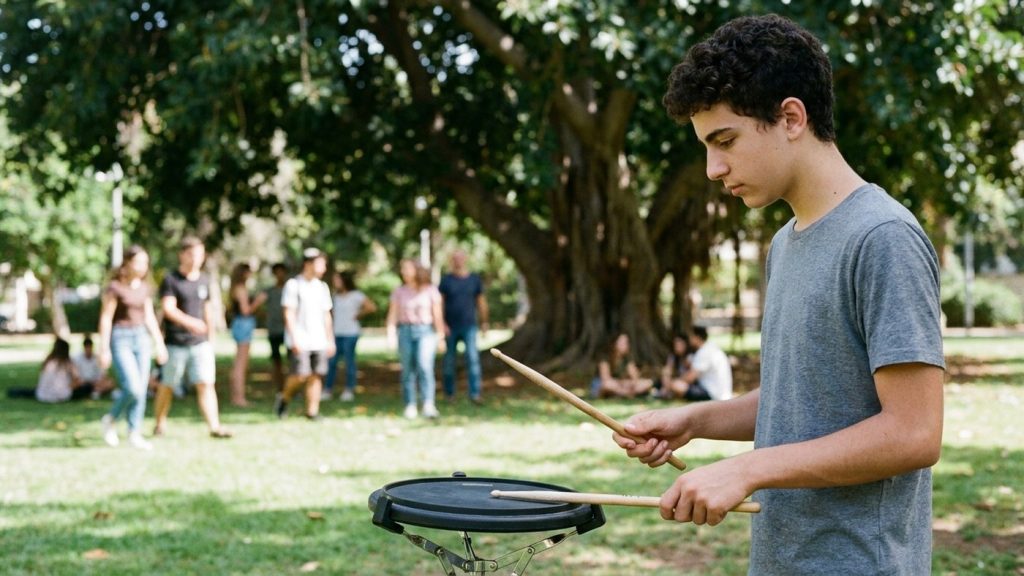
Listen closely to a great drummer and you’ll notice something: the fills that seem impossible, the ghost notes that make a groove breathe, the snare rolls that build into a chorus – almost all of it comes from a small set of sticking patterns. Those patterns are called drum rudiments, and they are to drumming what scales are to a guitarist. You don’t need all of them. You need the right ten, played slowly and evenly, every day.
This guide is for drummers in North Tel Aviv who already hold the sticks with some confidence and want cleaner hands: high schoolers who just joined a band, students around Tel Aviv University, and adults who finally bought a practice pad. It’s the same material we cover early in our drum lessons in North Tel Aviv, because good hands make everything else on the kit easier.
What are drum rudiments?
Drum rudiments are basic sticking patterns that combine single strokes, double strokes, grace notes and accents. They grew out of military and marching drumming, where drummers had to play precise patterns together. The best-known standard is the list of 40 International Drum Rudiments published by the Percussive Arts Society (PAS), grouped into four families:
- Roll rudiments – single stroke, double stroke and multiple bounce (buzz) rolls.
- Diddle rudiments – the paradiddle family, mixing singles and doubles.
- Flam rudiments – a soft grace note just before a main stroke in the other hand.
- Drag rudiments – two quick grace notes before a main stroke.
Why should a rock or pop drummer care? Rudiments give you control of every stroke, evenness between the hands, speed without tension, and a vocabulary for fills and grooves. Know a paradiddle and you can move it between hi-hat, snare and toms to get a dozen ideas from one pattern.
Before you start: pad, grip, stick height and metronome
A practice pad
A rubber practice pad is the best investment a drummer in an apartment can make. It’s quiet enough for an evening session, it’s honest (every uneven stroke is audible), and it fits on a table or a snare stand. If you’re also weighing up a kit for home, read our comparison of electronic vs acoustic drums first.
Grip and fulcrum
Start with matched grip: both hands hold the sticks the same way, palms facing mostly down. The fulcrum – the pivot point – sits between the thumb and the index or middle finger, roughly a third of the way up from the butt of the stick. The back fingers stay relaxed, not clamped. Let the stick bounce off the pad and guide it, rather than driving it down and pulling it back up.
Stick heights
Volume on the pad comes from height, not force:
- Accents: the stick starts high, close to vertical.
- Taps and grace notes: the stick starts just a few centimetres above the pad.
The key habit: after an accent, the stick comes down and stays low for the next tap. Most messy rudiments are really messy stick heights.
Metronome
Always practise with a click – any app, or the free online metronome on our site. Start slower than feels necessary, and practise every rudiment leading with the right hand and then with the left.
The 10 drum rudiments that matter most
Starting tempos assume quarter note = the BPM shown, playing sixteenth notes unless stated otherwise. If that’s too fast, halve it.
| # | Rudiment | Sticking | Where you hear it on the kit | Start at |
|---|---|---|---|---|
| 1 | Single stroke roll | R L R L | Fast fills around the toms | 60–70 BPM |
| 2 | Double stroke roll (open) | R R L L | Smooth rolls, fast hi-hat figures | 60 BPM |
| 3 | Single paradiddle | R L R R L R L L | Grooves between hi-hat and snare | 60–70 BPM |
| 4 | Double paradiddle | R L R L R R L R L R L L | Fills with a triplet or 6/8 feel | 60 BPM (sextuplets) |
| 5 | Paradiddle-diddle | R L R R L L | Triplet fills and linear patterns | 60 BPM (sextuplets) |
| 6 | Five stroke roll | R R L L R (accent the last) | Short rolls into a crash | 60 BPM |
| 7 | Multiple bounce roll | Buzzed strokes, R L R L | Snare swells and build-ups | Slow, even pressure |
| 8 | Flam | lR rL | Fat backbeats, big accents | 60 BPM (quarters) |
| 9 | Flam tap | lR R rL L | Driving snare figures | 60 BPM (eighths) |
| 10 | Drag / single drag tap | llR R rrL L | Marching feel, swung ghost notes | 60 BPM (eighths) |
Lower-case letters are grace notes. A useful extra is the single stroke four (four singles, accent on the last), which shows up in countless quick tom fills.
Rolls: singles, doubles and the five stroke
Singles are simple on paper and hard in practice: the weaker hand usually plays quieter and later. For doubles, the second stroke of each pair is the classic weak spot. At slow tempos play both strokes deliberately from the wrist; only at higher tempos let the second come from a controlled bounce. The five stroke roll is two doubles and an accent, so if your doubles are even, it falls into place.
Diddles: the paradiddle family
The single paradiddle is probably the most useful rudiment for kit players, because the lead hand switches every group without you thinking about it. Accent the first note of each group (R L R R L R L L) and keep the rest as low taps. The classic mistake is rushing the double at the end. The double paradiddle and paradiddle-diddle work the same way in groups of six, perfect for triplet fills.
Flams and drags: grace notes that add weight
A good flam sounds like one fat note – not two separate hits, and not a “flat” hit where both sticks land together. Keep the grace-note stick low and the main stroke high. In a flam tap, the hand that plays the flam also plays the tap right after it, so it must get low again quickly. Drags use two grace notes; let them bounce lightly rather than playing two hard strokes.
Rudiments in a famous groove
One of the best-known examples of rudiments on a kit is Steve Gadd’s groove on Paul Simon’s “50 Ways to Leave Your Lover”, built on marching-style sticking spread across hi-hat, snare and toms.
From the pad to the kit
Rudiments only pay off when they leave the pad:
- Paradiddle groove: right hand on the hi-hat, left on the snare, with the snare accents on beats 2 and 4. Add bass drum on 1 and 3.
- Single and double fills: a bar of sixteenth-note singles moving snare, high tom, mid tom, floor tom, four notes each. Then the same with doubles.
- Flams on two drums: split a flam between snare and floor tom for a wide accent at the end of a fill.
- Accents on the crash: play a five stroke roll and move the final accent to the crash, with the bass drum underneath.
Whatever you play, the fill has to land on the one; our guide to groove, timing and metronome practice goes deeper into subdivisions. And a drummer rarely plays alone: locking in with a bass player is what turns clean hands into a groove, which is why some drummers also take a few bass lessons. This is where private drum lessons make a real difference too: a teacher hears straight away whether a fill is late because of the hands, the feet or the counting.
A daily drum rudiments routine on the pad
| Block | Minutes | What to play | Tempo |
|---|---|---|---|
| Warm-up | 2 | Slow singles, full strokes | 60 BPM, eighths |
| Singles | 3 | Single stroke roll, single stroke four | Your clean tempo |
| Doubles | 3 | Double stroke roll, five stroke roll | Your clean tempo |
| Diddles | 3 | Paradiddle with accents, paradiddle-diddle | Your clean tempo |
| Flams and drags | 3 | Flam, flam tap, single drag tap | Slower than the rest |
| Speed burst | 2 | One rudiment, 20–30 second bursts | Clean tempo + 10 BPM |
| Cool-down | 2 | Buzz roll, very soft to medium and back | Slow, relaxed |
Write down the tempo at which each rudiment was clean today. For more on keeping short sessions focused, see our 20-minute practice routine.
A 4-week plan
| Week | Focus | Goal |
|---|---|---|
| 1 | Grip, stick heights, singles and doubles | Two minutes of even singles and doubles |
| 2 | Accented paradiddle, five stroke roll | Accents clearly louder than taps, both hands leading |
| 3 | Flams, flam taps and drags | Flams that sound like one fat note |
| 4 | Three rudiments on the kit as a groove and two fills | Play them along with a song you like |
Raise the tempo by 4–5 BPM only after a rudiment has been clean and relaxed for two full minutes.
Common mistakes
- Squeezing the sticks. Tension kills speed and sound. If your forearms burn, loosen the back fingers.
- Uneven doubles. The second stroke disappears. Slow down and play it as a deliberate wrist stroke.
- Always leading with the right. The weak hand stays weak. Start with the left just as often.
- Too fast, too early. Fast and messy is just practising mistakes. Clean first; speed follows.
- No metronome. Without a click you rush the easy parts and drag the hard ones.
- Never moving to the kit. A rudiment you can’t use in a groove is only half learned.
- Arms instead of wrists. On the pad, most of the motion comes from the wrists, with fingers helping at higher tempos.
How we teach drum rudiments in North Tel Aviv
At Rockstar music school in Ramat Aviv Gimel, our drum teachers are active, working musicians, and they teach rudiments inside real songs and grooves, not as a dry list. A lesson might open with paradiddles on the pad and end with the same sticking on the kit, in a song the student chose. For drummers in Neve Avivim, North Afeka, Tzukei Aviv and elsewhere in North Tel Aviv, the school is a short drive away, and a pad at home covers the days between lessons. Rockstar Home lessons at your place are also possible, subject to teacher availability. Want to see where your hands are today? Book a free intro drum lesson with no commitment.
Frequently asked questions
How many drum rudiments do I really need?
The PAS list has 40, but the ten here cover most of what rock, pop and funk drummers use. Get these clean first; the rest come much easier later.
Should I practise on a pad or a full kit?
Both. The pad is ideal for daily, focused hand work and quiet enough for an apartment. The kit is where rudiments become grooves and fills.
How long until I see progress?
It varies and depends mostly on how regularly you practise. Short daily sessions usually beat one long weekly session, and a tempo log helps you notice progress you’d otherwise miss.
Matched grip or traditional grip?
Matched grip is the standard for most kit drummers and the easiest start. Traditional grip comes from marching drumming and is still common in jazz; explore it later with a teacher.
Can I take drum lessons near Neve Avivim?
Yes. Rockstar music school is in Ramat Aviv Gimel, a few minutes’ drive away, and Rockstar Home lessons are available subject to teacher availability. Read more about music lessons in Neve Avivim.
Read also: Playing in Time: Groove and Metronome Practice for Drums & Bass
Drum lessons · All lessons · Contact us · Book a free intro lesson