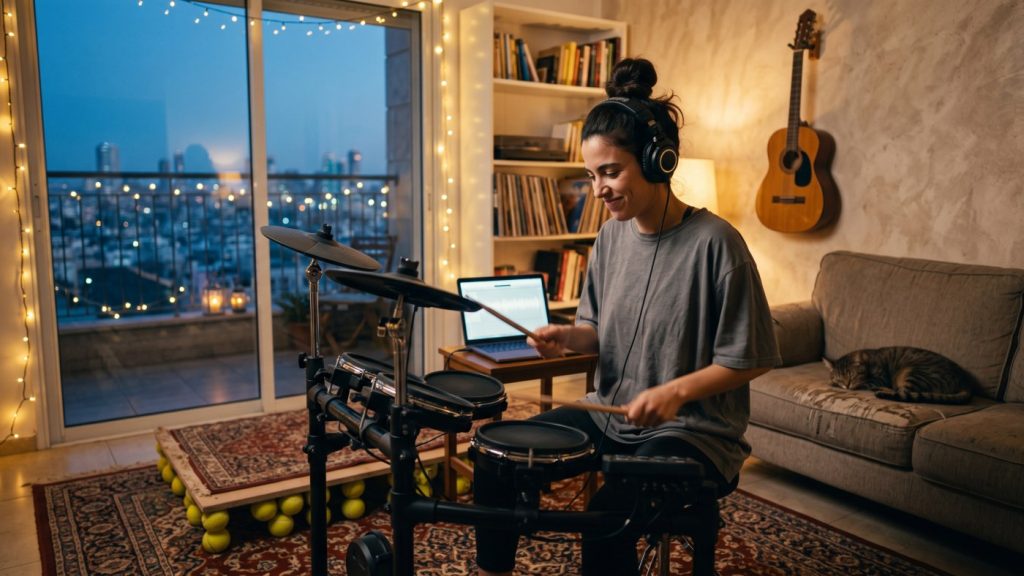
You bought an electronic kit, put on headphones and played until 11 p.m. – nobody can hear a thing, right? Next morning the neighbour below asks you in the lift what that “thud-thud-thud” in their ceiling is every evening. That is the most common myth about electronic drums: that they are silent. They are far quieter than an acoustic kit, but not silent.
In North Tel Aviv, as in most of the city, most of us live in apartment buildings – from older blocks in Neot Afeka A and Neot Afeka B to new towers in HaMishtala. So “acoustic or electronic?” is a question about neighbours, floors and hours, not just sound. This guide is for teens and adults who want to practise seriously at home without going to war with the building. In our drum lessons in North Tel Aviv we hear these questions almost every week.
The noise reality: what actually reaches your neighbours
There are two kinds of noise:
- Airborne noise. The sound coming off the drums and cymbals, travelling through the air, windows and walls. An acoustic kit produces a lot of it – enough to be heard several flats away. An electronic kit genuinely fixes this: what is left is mostly the “tick-tick” of sticks on pads.
- Impact (structure-borne) noise. Vibration that goes straight into the floor and from there into the ceiling below. Its main source is the bass drum pedal: the beater strikes the pad again and again and the hardware passes each hit into the floor. In a concrete building it travels extremely well – sometimes it is louder downstairs than in your room.
So an electronic kit solves most of the airborne problem but barely touches the structural one. The good news: impact noise can be reduced a lot by isolating the kit from the floor.
Acoustic, electronic or something in between? A practical comparison
Here is what matters for practising in an apartment:
| Option | Airborne noise | Impact noise (kick) | Playing feel | Best for |
|---|---|---|---|---|
| Standard acoustic kit | Very high | High | The real thing – full dynamics | A house, an isolated room or a rehearsal space |
| Acoustic kit with mesh heads and low-volume cymbals | Medium–low | High (without isolation) | Close to acoustic, different rebound | Anyone who already owns a kit and wants it quieter |
| Electronic kit with rubber pads | Low–medium (pads “clack”) | Medium–high | Hard and less natural | Starting on a tight budget |
| Electronic kit with mesh heads | Low | Medium (low with isolation) | Good, adjustable rebound | Most apartment drummers |
| Practice pad | Very low | None | Hands only | Technique, warm-ups, travel |
For most apartment drummers the winning combination is a mesh-head electronic kit on an isolated platform, a practice pad for hand work, and regular access to a real acoustic kit outside the home.
What to look for when buying an electronic kit
We won’t quote prices – they change constantly – but the gap between entry-level and mid-range kits is very noticeable, and the second-hand market can save you a fair amount. What really matters:
1. Mesh heads, not rubber
Rubber pads are hard, louder and feel nothing like a real drum. Mesh heads are quieter and their tension is adjustable, like an acoustic head. If you have to compromise, at least get a mesh snare.
2. A snare with at least two zones
A dual-zone snare detects head hits and rim hits separately, so you can practise rimshots and cross-stick.
3. A hi-hat that behaves like a hi-hat
On basic kits the hi-hat is a fixed pad with a separate, unconnected pedal. On better kits it sits on a real hi-hat stand and moves when you press the pedal. For an easy move to acoustic drums, this matters a lot.
4. A stable – and quiet – kick pad
Check that the kick pad is stable, a sensible size and compatible with a double pedal if metal is in your future. Some kick pads and pedals are designed to reduce impact noise – worth a look if someone lives below you.
5. The module: less “a thousand sounds”, more control
Most drummers use a handful of kits. What matters more is per-pad sensitivity, a good headphone output, an aux input for playing along with songs from your phone, and USB/MIDI for connecting to a computer or apps. If you want to record as well, our guide to a home recording setup on a budget has plenty of ideas.
Isolating the kit: tennis-ball platforms and drum risers
This is the step most people skip – and the one your neighbours will thank you for. The idea: decouple the kit from the floor so the kick’s vibration is absorbed before it reaches the concrete.
The well-known DIY solution is the tennis-ball platform:
- A thick board of plywood or MDF big enough for the whole kit, throne included.
- Underneath it, tennis balls cut in half (or whole balls held in a frame), spread evenly to act as springs.
- A thick rug on top so the throne and stands do not slide.
Commercial isolation risers work on the same principle. Either way, test the result: ask a friend to stand in the flat below (or the stairwell on that floor) while you play quarter notes on the kick, and compare with and without the platform.
Also: a felt beater instead of plastic, a pedal that does not bury the beater in the pad, and distance from shared walls.
Already own an acoustic kit? Turn it down
Already have an acoustic kit? Three ways to make it a better neighbour:
- Mesh heads for acoustic drums. Swap the regular heads for mesh ones – the kit becomes very quiet and still feels close to a real drum.
- Low-volume cymbals. Perforated cymbals that produce a fraction of the volume of standard ones, with a similar feel under the stick. Regular cymbals are usually the loudest part of the kit.
- Rods. Bundles of thin dowels that lower the volume and suit quieter styles.
Note that mesh heads do nothing for the kick’s impact noise, so floor isolation matters here too.
Being a good neighbour in North Tel Aviv
Gear is half the job; the other half is communication. In buildings in Revivim, South Afeka or Neot Afeka, one early conversation can save months of tension:
- Talk to the neighbours before you start, especially whoever lives below you. Ask when it bothers them least and give them your number.
- Keep regular hours. Practise at reasonable times, away from the usual afternoon rest hours and late evenings, and check your building’s house rules.
- Keep the kick reasonable. There is no need to stomp at full force in headphones.
- Do “quiet” practice at sensitive times. Practice pad for your hands, and footwork without impact, such as working the pedal against a cushion.
How to practise at home so it transfers to an acoustic kit
The real danger of an electronic kit is not the neighbours – it is habits. E-kits are forgiving: the module evens out volume and every stroke sounds clean. On an acoustic kit you suddenly hear every imbalance. To avoid that:
- Set it up like an acoustic kit. The height, angle and distance of the pads should match a real kit.
- Tension the mesh heads properly. Too tight gives exaggerated rebound that does the work for you. Aim for a bounce similar to an acoustic snare.
- Turn off the module’s “help”. Set sensitivity so there is a clear difference between soft and loud strokes. Practise ghost notes and dynamics – they disappear easily on an e-kit.
- Use a metronome. Most modules have a built-in click, or use our free online metronome. You will find detailed timing drills in our guide to groove and metronome practice.
- Play an acoustic kit regularly. At least once a week – in a lesson, a rehearsal room or with your band.
Sample weekly plan (about 30 minutes a day)
| Day | What to practise | Where |
|---|---|---|
| Sunday | 10 min hand warm-up (single strokes, 60–90 BPM) + 20 min groove with a click | Practice pad + e-kit |
| Monday | Dynamics: the same groove at 3 volume levels, ghost notes on the snare | E-kit |
| Tuesday | Lesson or playing on an acoustic kit – check what has “transferred” | Acoustic kit |
| Wednesday | Feet: kick in quarters and eighths, 70–100 BPM, heel-down and heel-up | E-kit on the platform |
| Thursday | Play along with a favourite song – e.g. “Back in Black” by AC/DC or “Seven Nation Army” by The White Stripes | E-kit + headphones |
| Friday | Fills and transitions, slowly first, then at tempo | E-kit |
| Saturday | Rest, or 10 minutes on the practice pad | – |
A good teacher will spot straight away if your e-kit is teaching you bad habits. That is one of the big advantages of drum lessons for teens and adults on a real kit, alongside your practice at home.
Common mistakes
- Assuming electronic means silent. The kick still travels through concrete. Without isolation, the neighbour below will hear it.
- Buying by number of sounds. Nobody needs 600 kits. Mesh heads, a dual-zone snare and a proper hi-hat matter far more.
- Pushing the kit against a shared wall. The vibration goes straight next door. Leave a gap.
- Playing too loud in headphones. Look after your hearing too – keep the volume sensible, and wear proper musicians’ earplugs on an acoustic kit.
- Never playing an acoustic kit. Drummers who practise only on electronic kits are often surprised at their first band rehearsal.
Drummers don’t play alone
Drums come alive with bass. If there is a bassist in the house (or you are thinking about a second instrument), have a look at our bass guitar lessons – a kick and bass locked together are the heart of every band. And if you are starting at 30 or 45, you are far from alone: we wrote a full guide to learning an instrument as an adult.
How we teach it at Rockstar
At Rockstar – the music school in Ramat Aviv Gimel, North Tel Aviv – drum students play a real kit in their lessons and build a practice plan with their teacher that fits their home: an electronic kit, a practice pad or a mix of both. Our teachers are working drummers who will also help you choose gear and set up your module. Want to see if it is right for you? Book a free intro drum lesson in Ramat Aviv Gimel, with no commitment.
FAQ
Is an electronic drum kit really suitable for an apartment?
In most cases, yes – as long as you combine mesh heads, floor isolation and a conversation with your neighbours.
Can I learn drums on an electronic kit only?
You can make a lot of progress, but you should play an acoustic kit regularly too. Dynamics, cymbals and kick power feel different.
What is better to start with – a full kit or a practice pad?
A practice pad is an excellent, quiet way to build hand technique, but drums are a four-limb instrument. If you have the space and budget, a basic mesh-head electronic kit lets you practise complete grooves from week one.
How do I reduce kick noise for the neighbours below?
Put the kit on an isolation platform (a DIY tennis-ball riser or a commercial one), switch to a felt beater, keep away from shared walls and play at a sensible level. And always test it from the flat below.
Where can I take drum lessons in North Tel Aviv, and do you teach at home?
Lessons take place at our school in Ramat Aviv Gimel, a short drive from Neot Afeka A and B, South Afeka, Revivim and HaMishtala. Home lessons in North Tel Aviv are possible subject to teacher availability in your area. For more about the neighbourhood, see our page on music lessons in Afeka.
Read also: Drum Lessons for Kids: When to Start · How to Use a Compressor · Drum Rudiments: The 10 That Matter
Drum lessons · All lessons · Contact us · Book a free intro lesson