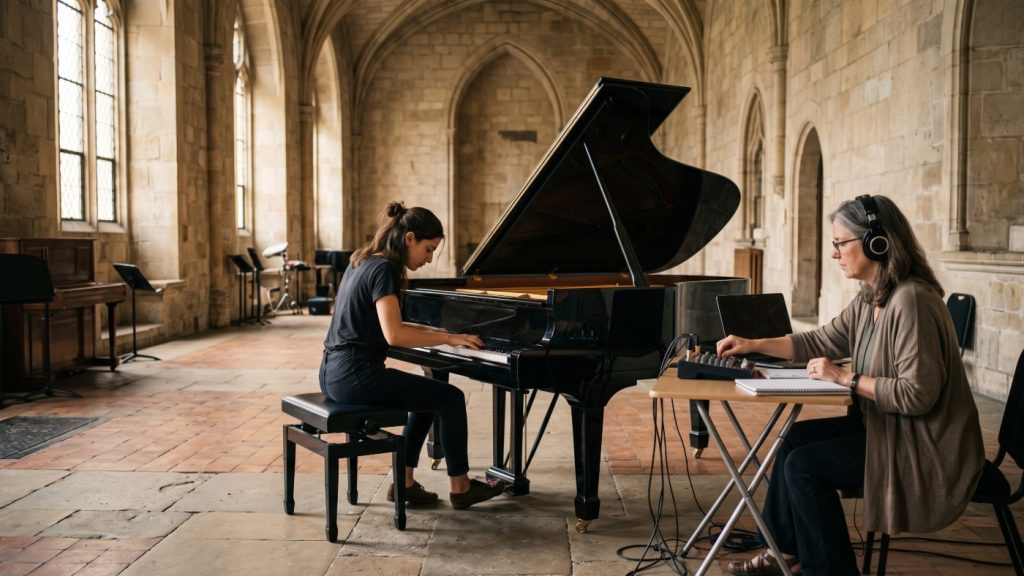
Sing one line in your building’s stairwell, then the same line inside a wardrobe. Same voice, same line – two completely different worlds. In the stairwell your voice sounds big, full and a little distant; in the wardrobe it’s dry, close and intimate. That’s what reverb does in a mix: it decides which space your song lives in, and where each instrument stands inside it – up front, further back, or behind everyone.
This is part three of our studio effects series, written for people recording and producing at home in North Tel Aviv – pianists in the Old North and Bavli recording covers on a digital piano, young singers in Lamed and New Lamed, and songwriters in Yisgav chasing the “big” sound of the records they love. We’ll start with an instrument where reverb is part of the sound itself: in our piano lessons in North Tel Aviv we meet plenty of students who discover that the Reverb button on their digital piano completely changes the way they play.
What reverb is – physics and perception
When a sound happens in a room, it reaches your ears in three stages:
- Direct sound: what travels straight from the source to your ear.
- Early reflections: the first bounces off walls, floor and ceiling, within the first few tens of milliseconds. From these your brain works out how big the room is and what shape it has.
- Late reverb (the tail): thousands of dense reflections that can no longer be told apart, gradually dying away.
Decay time is usually measured as RT60 – the time it takes a sound to drop by 60 dB after the source stops. A furnished room at home may decay in under half a second; a large concert hall in roughly two to three seconds, depending on the hall. Air and surfaces also absorb high frequencies faster than lows, so a “real” tail gets darker as it fades.
How your brain judges distance
Two main cues: the ratio of direct sound to reverb (the more reverb relative to direct sound, the further away the source seems), and the amount of high end (distant sounds are darker). That’s the key to reverb in mixing – you’re not “adding an effect”, you’re placing instruments in depth.
Every control on a reverb
- Decay / RT60: the length of the tail, in seconds.
- Size: the size of the simulated space. It affects the spacing of reflections and the feel, not just the length.
- Pre-delay: the gap between the direct sound and the start of the reverb. A few tens of milliseconds keeps a vocal up front and the words clear, even with a long tail.
- Early reflections: the level of the first reflections relative to the tail. More early reflections, more sense of a “room”.
- Diffusion / density: how dense and smooth the reflections are. Low diffusion can sound grainy or fluttery on percussive sources.
- Damping: how quickly the highs decay relative to the lows. More damping, a warmer and darker reverb.
- Low cut / high cut: filtering on the reverb itself.
- Modulation: gentle movement in the tail that prevents metallic ringing and adds width.
- Width: the stereo width of the reverb.
- Mix (dry/wet): the balance of clean and effect. On a send channel, set it to 100% wet.
Types of reverb: room, hall, plate, spring and more
| Type | What it is | Character | Typical use |
|---|---|---|---|
| Room | A small to medium room | Short, natural, lots of early reflections | Drums, guitars, gluing instruments into one place |
| Hall | A concert hall | Long, wide, gradual build | Piano, strings, ballads |
| Chamber | A dedicated echo room with a speaker and mics, as in classic recording facilities | Rich and dense, between room and hall | Vocals, drums, retro productions |
| Plate | A large metal sheet set vibrating and picked up, like the EMT 140 | Bright, dense, no obvious “room” | Vocals, snare |
| Spring | Springs inside an amp or a unit | “Boingy”, vintage | Guitar – surf, rockabilly, blues |
| Convolution | An impulse response sampled from a real space or device | Very realistic, less flexible | Natural spaces, recreating gear |
| Algorithmic | Reflections calculated mathematically, like the classic Lexicon units | Smooth, flexible, “musical” | Almost everything |
| Gated / non-linear | A reverb that’s cut off abruptly | Aggressive, very 1980s | The 80s snare, as on Phil Collins’ “In the Air Tonight” |
Reverb and piano: when the space is part of the playing
An acoustic piano has reverb built in: the soundboard, the strings that resonate sympathetically when the pedal is down, and the room it stands in. On a digital piano, the Reverb button (often with types like Room, Hall or Stage) tries to recreate that. Here’s a common trap: playing with a long reverb and the pedal held down the whole time, so chords smear into each other. When you record, it’s usually better to switch the internal reverb off or turn it right down and add reverb in the mix, where you can control it.
The more important part happens in your hands. A good teacher in our piano lessons for teens and adults will work with you on clean pedal changes (“legato pedalling” – lift and press again just after the new chord sounds), so the space serves the music instead of blurring it. If you’re still building your harmony basics, our guide to piano chords made simple is a good place to start.
Starting points by instrument
Common starting points only – decide by the song, the tempo and the arrangement.
| Track | Type | Decay | Pre-delay | Return filtering |
|---|---|---|---|---|
| Lead vocal | Plate or chamber | Roughly 1.2–2 s | Roughly 20–80 ms | Low cut around 200–500 Hz, high cut around 6–10 kHz |
| Backing vocals | Hall or plate | A little longer than the lead | Short | Fairly high low cut |
| Snare | Plate or room | Roughly 0.8–1.5 s | 0–20 ms | Low cut around 200–300 Hz |
| Drum kit | Room | Roughly 0.4–1 s | 0–10 ms | Low cut so the kick stays clean |
| Piano | Hall or chamber | Roughly 1.5–2.5 s | Roughly 10–30 ms | Low cut around 150–300 Hz |
| Acoustic guitar | Room or short hall | Roughly 0.8–1.5 s | Roughly 10–30 ms | Low cut around 200 Hz |
| Electric guitar | Spring or room | Depends on style | Short | Low and high cut |
| Bass | Usually none, or very little | Short | – | High low cut |
A handy trick: set pre-delay from the tempo. A quarter note in milliseconds = 60,000 divided by the BPM. At 100 BPM a quarter is 600 ms, a sixteenth 150 ms and a thirty-second 75 ms – a pre-delay that sits inside the groove. Find the exact tempo with our tap tempo BPM counter.
Send, not insert: building a space in the mix
Most of the time reverb lives on a separate send (aux) channel at 100% wet, and each track sends its own amount. The advantages: several instruments share one space and sound like a band in the same room, you can process the reverb return (EQ, compression), and it saves CPU. A simple, effective setup: three reverb channels – short room, medium plate, long hall – and you send to each according to the depth you want.
How to dial in reverb by ear, step by step
- Start from the dry mix. Balance, EQ and compression first – see how to mix your first song.
- Send too much on purpose. That way you clearly hear the colour and the length.
- Set the decay to the tempo. The tail should breathe with the song – usually fading before the next phrase or hit.
- Set the pre-delay. Raise it until the vocal steps forward out of the space, without hearing a separate echo.
- Filter the return. Low cut until the mud is gone, high cut until sibilance and harshness stop blooming.
- Pull it down until you barely hear it. Then mute the reverb: if everything suddenly sounds dry and small, the amount is right.
How reverb interacts with other effects
- EQ: filtering the return is half the job. Mud and masking are covered in our EQ guide.
- Compression: compress before sending to reverb. A compressor on the reverb return keyed from the vocal (“ducking”) lowers the tail while the singer sings and lets it bloom in the gaps – details in our compressor guide.
- Delay: a delay fed into a reverb sounds soft and distant, and sometimes a short delay gives depth with less mud than a reverb.
- Saturation: a little saturation on the reverb return adds vintage colour; reverb after guitar distortion sounds completely different from reverb before the amp.
Common mistakes
- A different reverb inserted on every track. Ten different spaces = a mix with no single clear place.
- Muddy low end. A reverb without a low cut fills the bottom and blurs the kick and bass.
- Tails that are too long. In a fast song, a long tail hides the groove and the diction.
- Clearly hearing the reverb. In most styles, if you “hear reverb”, it’s probably too much.
- Reverb instead of performance. Reverb won’t fix an out-of-tune vocal; sometimes it highlights it.
- Not checking in mono. Very wide reverbs can change a lot in mono. Check before you finish.
Practice: building depth in three layers
Take three tracks – vocal, piano and a drum or percussion part. Goal: vocal in front, piano in the middle, drum at the back.
- Vocal: a little plate with roughly 60–80 ms of pre-delay.
- Piano: more send to the hall, short pre-delay, a lower high cut on the return.
- Drum: the most send, almost no pre-delay, and roll a little top off the track itself.
- Listen with your eyes closed and sketch where each instrument “stands”. Repeat with a different song every day for a week.
Reverb and piano in North Tel Aviv: how we teach it at Rockstar
At Rockstar music school in Ramat Aviv Gimel, students from Neot Afeka B, Bavli and all over North Tel Aviv learn to hear the space their music lives in: how to pedal cleanly, how a vocal sits inside a hall, and how to record at home without a “bad room” sound. If you record vocals, our singing lessons will help, and drummers have plenty to discover about rooms and tone in our drum lessons. No recording corner yet? Start with our home recording studio on a budget guide.
FAQ
What’s the difference between reverb and delay?
Delay is separate, distinct repeats of a sound. Reverb is thousands of dense reflections merging into one tail. In practice, reverb gives space; delay gives echo and rhythm.
Should I record with reverb?
Usually not. Record dry and add reverb in the mix, because you can’t take reverb off a recording. You can put reverb in your headphones while tracking so it feels comfortable to sing or play – without recording it.
My room is echoey. Will mix reverb hide it?
Not really. An echoey room gets “baked into” the recording. Treat it first – blankets, a sofa, bookshelves, a closer mic – and only then add a controlled space.
How many reverb channels does a mix need?
Two or three are usually enough: short, medium and long. Professional mixes sometimes use more, but in your first mixes, less is more.
Where can I learn piano and recording in North Tel Aviv?
At Rockstar music school in Ramat Aviv Gimel, close to Lamed, New Lamed and Yisgav – see our music lessons in Lamed page. You can book a free intro piano lesson in Ramat Aviv, and home lessons in North Tel Aviv are possible subject to teacher availability.
Read also: Piano Chords Made Simple: Build Any Chord from Any Note
Piano lessons · All lessons · Contact us · Book a free intro lesson