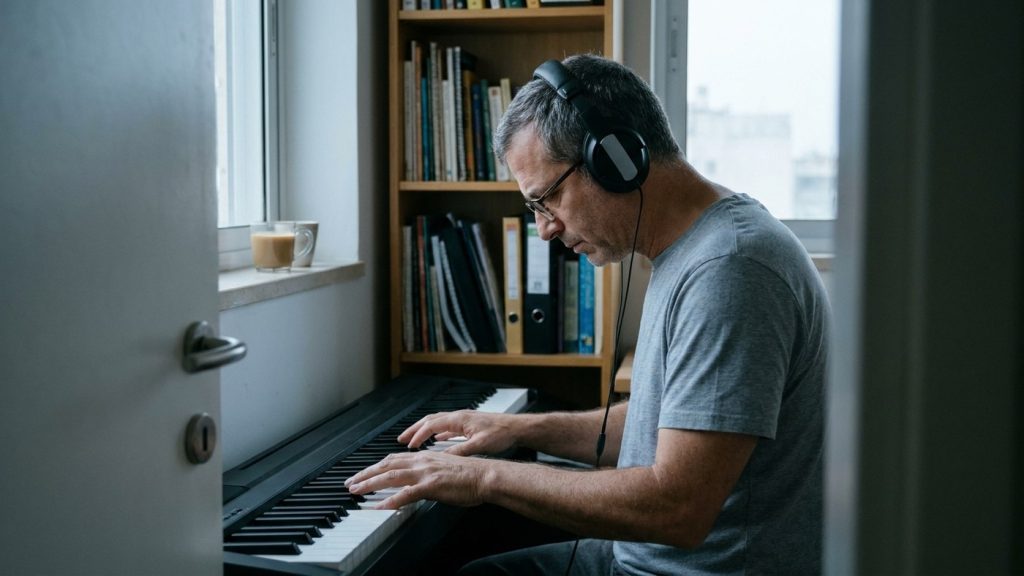
Lots of adults tell a version of the same story. There was a piano at grandma’s, maybe a year of lessons at age eight, and then a gap of twenty or thirty years. Now there is a little more time, there is a song you want to play yourself, and one question keeps you from starting: is it still possible? It is. In a few important ways, adults actually move faster than kids. To learn piano as an adult from zero, you do not need special talent. You need the right plan, an instrument that suits an apartment and honest expectations.
This guide is for beginners aged roughly 25 to 70 in North Tel Aviv: university students in Ramat Aviv, parents in Neve Avivim whose kids have grown up, tech workers in Green Ramat Aviv looking for something without a screen. You will find out how to choose between a digital piano and a keyboard, when to learn notation and when to learn chords, how to practise in a busy week, and a clear 8-week plan. If you would rather have someone guide you from day one, our piano lessons for adults build exactly this kind of plan around the songs you love.
Why learning piano as an adult works better than you think
Kids have time and flexible fingers. Adults bring something just as valuable:
- Understanding. An adult quickly gets why a chord is three notes stacked together, or how a scale is built. What a child learns by imitation, you can also learn by logic.
- A trained ear. You have heard thousands of songs. You know when something sounds right, and that is a powerful tool.
- A clear goal. You know which song you want to play, and that focuses every practice session.
- Grown-up discipline. Fifteen steady minutes a day beat two hours once a week, and adults know how to put things in a calendar.
What is harder: your fingers are less independent at first, and patience with yourself runs short. Adults expect results quickly and get frustrated when they do not show up in week one. That is why the plan matters more than talent. We also wrote a broader guide to learning an instrument as an adult; here we focus on piano only.
Keyboard or piano: what to buy when you live in an apartment
Most of our students in North Tel Aviv live in apartments, and neighbours are part of the equation. The good news: a decent digital piano lets you practise on headphones at any hour, with no tuning and no complaints.
| Instrument | What to know | Who it suits |
|---|---|---|
| Acoustic piano | The most natural sound and touch, but heavy, loud, needs regular tuning and has no headphone option | People with space, patient neighbours and a long-term plan |
| Digital piano (88 weighted keys) | Full-size keys with a hammer-style action, a sustain pedal, a headphone output | The best choice for most adult beginners |
| Portable keyboard (61 unweighted keys) | Light and portable, but the touch is too light and there is little real control over volume | A short trial or chords only, not for learning piano properly |
What to check in a digital piano
- 88 weighted keys (hammer action). This is the difference between learning piano and learning “something with keys”. Without weight your fingers do not build strength, and a real piano later feels foreign.
- Touch sensitivity. Press hard and it should sound loud; press gently and it should sound soft. That is how you learn dynamics.
- A proper sustain pedal. The small square footswitch that slides around is a pain. A piano-style pedal is far more comfortable.
- At least 64-note polyphony. With the pedal down, notes pile up, and too low a number makes notes cut out.
- A stable stand and a bench at the right height. Seated, your forearms should be roughly level with the floor and your shoulders relaxed.
You do not need to buy anything before your first lesson. A good teacher will help you work out what fits your apartment and your goal, and sometimes it makes sense to start simple and upgrade after a few months.
Sheet music or chords: where to start
This is the question adults ask most, and the honest answer is both, in different amounts, depending on what you want.
- If you want to accompany songs, sing or play with friends, start with chords. Within a few weeks you can accompany a whole song with four chords in the right hand and a bass note in the left. Our guide to building piano chords explains the method.
- If you dream of classical pieces, Chopin or Satie, reading music is unavoidable, and it is worth starting slowly in week one.
- If you are not sure, the mix that works for most adults is about 70% chords and songs, 30% basic reading. You enjoy yourself early, and reading builds quietly in the background.
Good first songs for chord playing: Let It Be by the Beatles, Imagine by John Lennon, Someone Like You by Adele and Clocks by Coldplay. Each is built on a few repeating chords, and each sounds good even in a simple version. You do not need the words to practise; knowing the melody and the chord order is enough.
Learn piano as an adult: an 8-week plan from zero
The plan assumes 15 to 25 minutes a day, five days a week. If you have less time, stay an extra week at any step. That is completely fine.
| Week | Goal | What you practise |
|---|---|---|
| 1 | Know the keyboard | Find every C using the group of two black keys, sit properly, fingers 1 to 5 on C-D-E-F-G in each hand |
| 2 | First chords | C, G, Am and F in the right hand, four beats each, metronome at 60 BPM |
| 3 | Changes | Move between chords without stopping the beat, using close inversions so the hand barely moves |
| 4 | The left hand joins | One bass note in the left hand on beat 1 while the right holds the chord. Your first full song, slowly |
| 5 | Rhythm | Right hand plays the chord on every beat, then in eighth notes. Move up to 70 to 80 BPM |
| 6 | Melody | A simple tune in the right hand, single chords in the left. Basic reading in the treble clef |
| 7 | Pedal and dynamics | Change the sustain pedal with every chord, play the verse quietly and the chorus a little louder |
| 8 | A whole song | One song start to finish, record it on your phone, listen back and fix just two things |
Do not measure yourself by speed. After 8 weeks the goal is one song you play confidently at a steady tempo, even if it is slow. This is where a teacher hears in a minute what is holding you back, which is why many students pair the plan with weekly piano lessons in North Tel Aviv. To keep time, use our free online metronome and add 5 BPM only after three clean run-throughs in a row.
What a good 20-minute session looks like
- 3 minutes warm-up: five fingers up and down slowly in each hand, shoulders loose.
- 7 minutes technique: this week’s hard change or passage, with the metronome. Always the hard part, not the part that already works.
- 7 minutes song: the section you are working on, then once from the top without stopping for mistakes.
- 3 minutes free play: noodle, improvise over the chords, enjoy it. This is the part that brings you back tomorrow.
Fitting practice into a busy working week
Adults rarely quit because piano is hard. They quit because life gets in the way. A few habits that help:
- Keep the piano open and ready. When the instrument is on with the headphones next to it, you are far more likely to sit down. A cover, a cupboard or a cable to plug in is a small obstacle that wins in the end.
- A fixed slot in your calendar. Before work, or straight after dinner. Habit beats motivation.
- Micro-sessions count. Five minutes on a single chord change is real practice. On a crazy day, a little beats nothing.
- A practice log. One line: what you worked on and at what BPM. After a month you will see progress that is hard to feel day to day.
When you want to work on both hands more systematically, we have a full set of piano hand independence exercises.
Common mistakes adult beginners make
- Playing too fast. Adults want the song to sound like the record. Slow, clean playing builds the right muscle memory; fast playing with mistakes locks the mistakes in.
- Tension in the shoulders and wrists. If your hand hurts after ten minutes, something is off in your posture or how hard you press. Stop, relax and ask a teacher. Pain that lasts is a reason to see a doctor.
- Skipping the left hand. It is easy to fall in love with the right hand and leave the left for later. It will stay behind. Bring it in by week four, even with one note.
- Learning only from falling-notes videos. They are fun at first, but without understanding chords or notation it is hard to learn the next song on your own.
- Buying an unweighted keyboard “just to see if I like it”. On the wrong instrument it is harder to succeed, and then it feels like the problem is you.
- Comparing yourself to kids or to online videos. Everyone has their own pace. Compare yourself only to you a month ago.
Learning piano as an adult in North Tel Aviv at Rockstar
At Rockstar music school in Ramat Aviv Gimel, adults of every age learn piano, many of them with no background at all. Our teachers are working musicians, and each lesson is built around your goal: accompanying songs, reading music, singing while you play, or simply having time that is yours. If you want to add singing, you can also take vocal lessons. It always starts the same way: a free intro piano lesson with no commitment, where we get to know you, hear what you love and map out your first few months.
Frequently asked questions
I am 60 and have never played. Is it too late?
No. Adults of every age learn to play whole songs. Progress depends far more on steady practice and a good plan than on age.
How much do I need to practise to improve?
Fifteen to 25 minutes on most days of the week is a good starting point. Short, regular practice beats one long hour once a week.
Do I need a piano at home before the first lesson?
Not necessarily. In the first lesson you play the piano at the school, and afterwards it is easier to decide what to buy. To make progress between lessons you do need an instrument at home, ideally a digital piano with 88 weighted keys.
Can I learn chords only, without sheet music?
Yes, if your goal is accompanying songs. Most adults enjoy adding basic reading over time, because it opens up many more songs and pieces.
Do you offer piano lessons near Neve Avivim?
The music school is in Ramat Aviv Gimel, a short drive from Neve Avivim, North Afeka and Tzukei Aviv. Rockstar Home lessons at your place are also possible, subject to teacher availability, as long as you have a piano or digital piano at home. Read more about music lessons in Neve Avivim.
Read also: Learning an Instrument as an Adult: A Realistic Starter Guide
Piano lessons · All lessons · Contact us · Book a free intro lesson