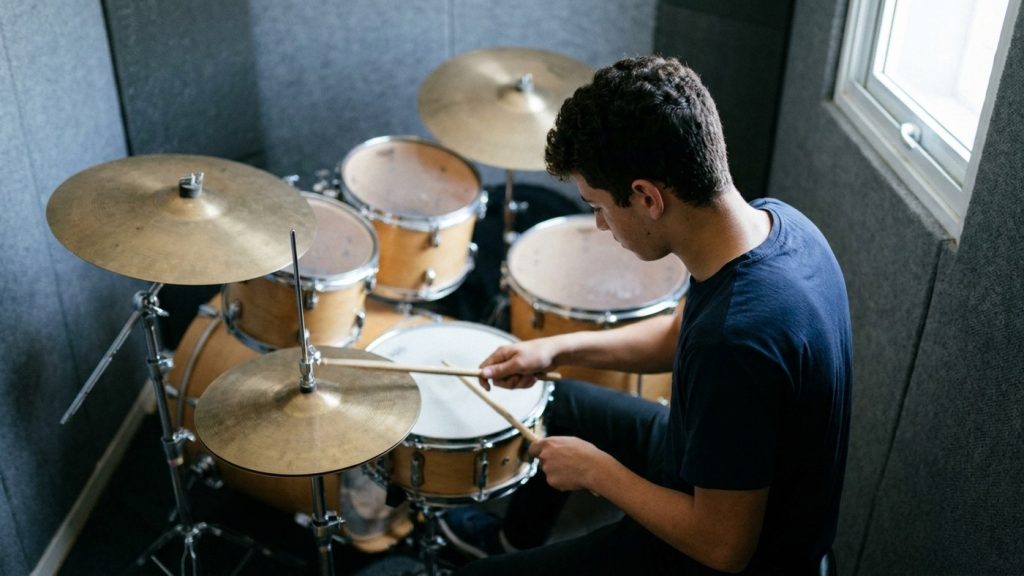
The moment drums start to feel like music isn’t your first fill or your first solo. It’s the moment you play a simple, steady beat for three minutes straight and the song suddenly stands up on its own. Most of the songs you love, from classic rock to whatever is on the radio this week, sit on four or five basic drum beats. If you can play those cleanly, in time and with the right dynamics, you can join a band long before you can do anything flashy.
This guide is for beginner drummers in North Tel Aviv: high schoolers who want to play with friends, university students, and adults who have always wanted to sit behind a kit. We’ll build a rock beat, a pop beat, a half-time beat and a first funk groove step by step, with starting tempos, target tempos and a four-week plan. In our drum lessons in North Tel Aviv these are exactly the beats students start with, because everything else grows out of them.
Before the first beat: counting, hands and feet
Every beat here is written in one bar of 4/4, split into eighth notes. Count out loud: “1 and 2 and 3 and 4 and”. Each number is a beat; each “and” sits halfway between two beats. It sounds almost too basic, but drummers who don’t count out loud in the first weeks nearly always rush without noticing.
- Right hand (for right-handed players) plays the closed hi-hat with the tip of the stick on the top cymbal.
- Left hand plays the snare, one clear stroke near the middle of the head. Your hands cross, right over left. That’s the standard setup; some drummers play “open handed” with the left hand on the hi-hat. Pick one and stay consistent.
- Right foot plays the bass drum (kick) pedal, and the left foot keeps the hi-hat closed.
Sit at a height where your thighs slope slightly downward, with the snare low enough that the stick lands almost parallel to the head. Keep your shoulders loose. If your shoulders or forearms ache after five minutes, something in the height or the grip is off, and that’s the kind of thing a teacher fixes in a minute.
Beat 1: the basic rock beat
This is the most played beat on the planet and the foundation of all basic drum beats: eighth notes on the hi-hat, kick on 1 and 3, snare on 2 and 4.
| Count | 1 | & | 2 | & | 3 | & | 4 | & |
|---|---|---|---|---|---|---|---|---|
| Hi-hat | X | X | X | X | X | X | X | X |
| Snare | X | X | ||||||
| Kick | X | X |
Build it in four steps
- Hi-hat alone, eighth notes, 60 BPM, counting out loud. One full minute without stopping.
- Add the snare on 2 and 4. Make sure the hi-hat hand doesn’t freeze when the other hand strikes.
- Drop the snare and play hi-hat with kick on 1 and 3. Kick and hi-hat should sound like one note, not two notes close together.
- Put it all together. Once it holds for three minutes at 60, go up 5 BPM at a time. First target: 100 to 110 BPM.
You can hear this beat in a very bare form on AC/DC’s Back in Black, a great song to play along with once the pattern is steady, because it exposes every bit of rushing.
Beat 2: the rock variation with an extra kick
Once the basic beat feels settled, add a kick on the “and” of 3. Suddenly it sounds like a real song, with a push forward into the snare on 4.
| Count | 1 | & | 2 | & | 3 | & | 4 | & |
|---|---|---|---|---|---|---|---|---|
| Hi-hat | X | X | X | X | X | X | X | X |
| Snare | X | X | ||||||
| Kick | X | X | X |
The challenge is two kicks in a row without the second one going weak or late. Practise just foot and hi-hat first, then bring the snare back. Another variation worth knowing: kick on 1, the “and” of 2, and 3. Try both and notice how much each one changes the feel of the same song.
Beat 3: four on the floor, the pop and disco beat
Kick on every beat, snare on 2 and 4, and an open hi-hat on every “and”. This is the beat of disco and a lot of pop and dance music; think of Stayin’ Alive by the Bee Gees.
| Count | 1 | & | 2 | & | 3 | & | 4 | & |
|---|---|---|---|---|---|---|---|---|
| Hi-hat | X | O | X | O | X | O | X | O |
| Snare | X | X | ||||||
| Kick | X | X | X | X |
O means open hi-hat: lift your left foot slightly as you hit the “and”, then close it again on the next beat. The “chick” of the closing hi-hat is part of the groove. Start with no opening at all, and only add the left foot once the kick on every beat is solid. Start at 70 BPM and aim for 110 to 120.
Beat 4: half time, when the song needs space
In a half-time beat the snare lands only on 3, with the kick on 1. The tempo of the song doesn’t change, but the feel becomes wider and slower. Drummers reach for it in ballads, quiet intros and choruses that need to breathe.
| Count | 1 | & | 2 | & | 3 | & | 4 | & |
|---|---|---|---|---|---|---|---|---|
| Hi-hat | X | X | X | X | X | X | X | X |
| Snare | X | |||||||
| Kick | X | X |
The kick on the “and” of 4 leads you back to the top of the bar. The most useful drill here: four bars of the basic rock beat, four bars of half time, and repeat, without the tempo moving. That’s how you learn to switch between song sections without falling apart, which is exactly a band drummer’s job. If you want to hear where this can go, Toto’s Rosanna features one of the most famous half-time grooves ever recorded, at a far more advanced level.
Beat 5: your first step into funk
Funk lives on sixteenth notes (four notes per beat: “1 e and a”) and on a kick that doesn’t land where you expect. To keep it manageable, start with eighth notes on the hi-hat and a syncopated kick:
- Hi-hat: eighth notes, as in the rock beat.
- Snare: 2 and 4, strong and clear.
- Kick: 1, the “and” of 2, and the “and” of 3.
Once that sits, add ghost notes: very quiet snare strokes, barely a touch, on the “and” of 3 or of 4. The stick height for a ghost note is a few centimetres; for the accent it’s much higher. That contrast is the whole secret of the funk sound. This is where rudiments pay off: if you’ve worked through our drum rudiments and daily pad routine, ghost notes come far faster. For listening, James Brown’s Funky Drummer, with Clyde Stubblefield on drums, is one of the best known and most sampled grooves in funk history.
How to practise basic drum beats with a metronome
You can learn the pattern itself in ten minutes. What takes weeks is playing it well enough that a band can build a song on it. A few principles:
- Start slower than seems reasonable. If there’s a single mistake in the bar, the tempo is too fast.
- Time before speed. Three unbroken minutes at 80 BPM are worth more than thirty seconds at 120.
- Dynamics. The hi-hat should sit below the snare. Many beginners hit the hi-hat just as hard and the beat sounds flat.
- Record yourself. Phone on a chair, one minute of the beat, then listen. You’ll hear things you never notice while playing.
Use our free online metronome, and if you want to go deeper into time feel, our guide to groove and metronome practice shows how to move the click to 2 and 4 and test yourself without a safety net. When the beats are steady, play them over our jam backing tracks; that’s the step between the practice room and a band.
A four-week plan, 20 minutes a day
| Week | What to practise | Tempo | Ready to move on when |
|---|---|---|---|
| 1 | Counting out loud, basic rock beat in steps | 60 to 80 | 3 minutes with no mistakes |
| 2 | Kick variation, four on the floor without opening | 70 to 90 | Switching between the two without stopping |
| 3 | Open hi-hat, half time, 4+4 bar switch | 70 to 100 | The tempo holds through the switch |
| 4 | Funk beat with ghost notes, playing along with a recording | 70 to 100 | A whole song from start to finish |
If you practise in an apartment, an electronic kit or a pad with a pedal covers most of your practice time; we compare the options in electronic vs acoustic drums for apartments. When a teacher hears you play these beats, they can usually tell within a minute whether the problem is the kick, the hi-hat or the counting. That’s why our drum lessons for teens and adults keep coming back to these patterns months later, at new tempos and in new styles.
Common mistakes
- Rushing without noticing. Fix: count out loud, use a metronome and make one recording a week to compare.
- Kick and hi-hat not landing together. It sounds like a two-note flam. Practise right hand and right foot alone, very slowly, until they become one sound.
- The hi-hat hand stops when the snare comes in. Your brain is still coordinating. Go back to the hi-hat and snare stage.
- Hitting too hard. Loud isn’t better. A controlled stroke that lets the stick bounce off the head sounds better and protects your hands.
- Jumping to funk before rock is solid. Each beat here rests on the one before it. There’s no shortcut.
- Skipping hearing protection. An acoustic kit in a small room is very loud. Musicians’ earplugs are part of the gear, not an extra.
Learning basic drum beats at Rockstar in North Tel Aviv
At our music school in Ramat Aviv Gimel, students play these beats from the first lesson and move quickly to songs they actually like, because a beat is best learned inside a song. Our teachers are working musicians who play in bands, so they show you not only what to play but how it sounds in a rehearsal room. Students come from all over North Tel Aviv, including Green Ramat Aviv and Neve Avivim, both a few minutes’ drive away, as well as North Afeka and Tzukei Aviv. Once you have a few beats down you can join an ensemble and lock in with a bass player, and if you’re torn between the two instruments, read why bass guitar holds the band together or look at our bass lessons.
Frequently asked questions
How long does it take to learn a first drum beat?
Most beginners can play the basic rock beat slowly in their first lesson. Playing it steady and clean through a whole song usually takes a few weeks of regular practice.
Do I need a full drum kit to start?
No. At first you can practise your hands on a pad and the counting with your foot on the floor. An electronic kit with headphones works well in an apartment. In lessons you play a full kit, so you also learn the real feel.
I’m left-handed. Does it matter?
You can flip the kit (kick on the left foot, hi-hat on the right), and some left-handed drummers play a standard kit. It’s worth deciding with a teacher in the first lessons, before habits set in.
Do I need to read drum notation?
Not to get started. The grids in this guide are already a simple kind of notation. Drum notation is relatively easy to read and helps a lot with more complex beats, so we bring it in gradually.
Are there drum lessons near Green Ramat Aviv?
Yes. The school is in Ramat Aviv Gimel, a few minutes’ drive away. You can also look into music lessons in Green Ramat Aviv through Rockstar Home, at your place, subject to teacher availability. The easiest way to begin is a free intro drum lesson with no commitment.
Read also: Drum Rudiments: The 10 That Matter
Drum lessons · All lessons · Contact us · Book a free intro lesson