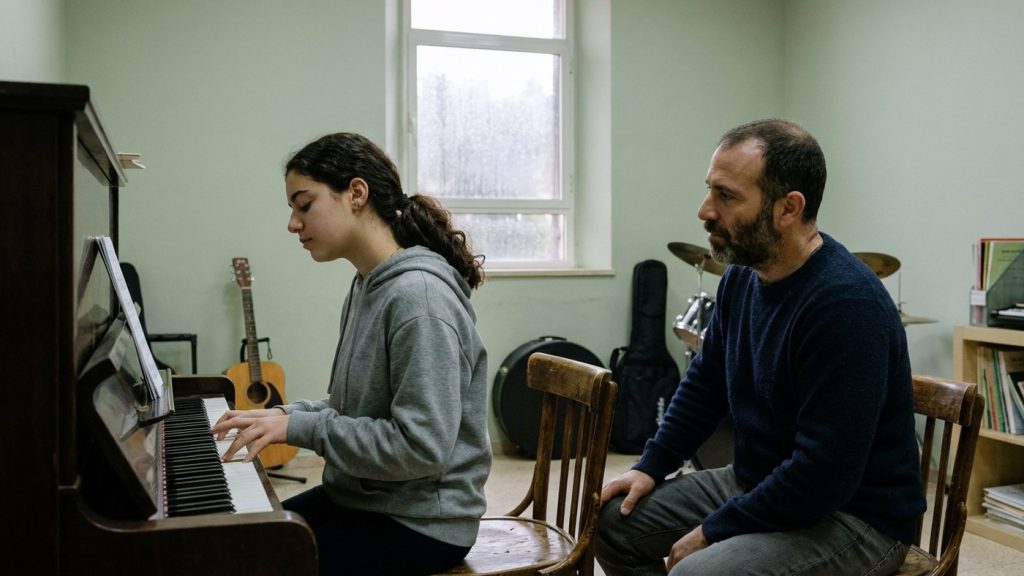
You hear a song on the radio, want to play it, and immediately open a chord website. But what happens when the chords online are wrong, when the song is too new to be listed, or when your bandmate says “it’s just I–V–vi–IV in G” and expects you to join in? That is where ear training comes in. It is not a gift you either have or don’t – it is a skill you build, just like finger technique, and a few minutes a day make a real difference.
This guide is for players in North Tel Aviv – pianists, guitarists and bassists, teens and adults – who want to recognize intervals and chords, find a melody on their instrument by ear and work out the chords of a song they know. Singers have their own guide, how to sing in tune; here the focus is on the hands on the instrument. In our piano lessons in North Tel Aviv, ear training starts in the first weeks, because it makes almost everything else faster.
What ear training is, and why players need it
Ear training is the ability to hear sounds and understand what they are: how far one note is from another, whether a chord is major or minor, where the bass is going and where the “home” of the song is. Most musicians do not rely on perfect pitch – naming a single note with no reference at all – but on relative pitch: hearing one note in relation to another. Relative pitch can be developed at any age.
What it gives you in practice:
- Playing songs without hunting for chord charts, or fixing the wrong ones you find online.
- Improvising and soloing over the harmony, because you can hear where it is going.
- Learning faster from your teacher and your band – less “show me again”, more “got it”.
- Reading music better, because you hear what is written before you play it.
Step 1: Intervals, the building block of ear training
An interval is the distance between two notes, measured in half steps (semitones). On the piano a half step is the very next key, black keys included; on the guitar it is one fret. The fastest way to recognize an interval is to link it to the opening of a tune you already know. The table uses well-worn references – if one does not work for you, pick another song that starts with the same jump.
| Interval | Half steps | Ascending reference | Character |
|---|---|---|---|
| Minor second | 1 | The theme from Jaws | Tense, tight |
| Major second | 2 | Happy Birthday (the move to the second, different note) | An ordinary melodic step |
| Minor third | 3 | The Smoke on the Water riff | Dark, minor |
| Major third | 4 | When the Saints Go Marching In | Bright, major |
| Perfect fourth | 5 | Wagner’s Bridal Chorus from Lohengrin | Open, like a call |
| Tritone | 6 | The opening of The Simpsons theme | Unstable, wants to resolve |
| Perfect fifth | 7 | The Star Wars main theme | Strong, hollow, heroic |
| Major sixth | 9 | My Bonnie Lies over the Ocean | Wide, warm |
| Octave | 12 | Somewhere Over the Rainbow | The same note, higher |
Drill: interval, voice, instrument – 4 minutes
- Play a starting note, say C. Sing or hum the reference for the interval you chose.
- Find the second note you sang on your instrument and count the half steps between them.
- Repeat from different starting notes, so the interval is tied to the sound, not to a hand position.
Start with only three intervals – major third, perfect fourth and perfect fifth – and add another only when you name those without hesitating. Our free ear and rhythm trainer lets you choose exactly which intervals to drill and gives instant feedback.
Step 2: Major and minor chords
“Major is happy, minor is sad” is a starting point, not a method. Plenty of minor songs are full of energy, and plenty of quiet ballads are in major. Instead of guessing the mood, listen to the middle note – the third. In a major chord it sits four half steps above the root; in a minor chord, three. If you want the full recipe for building chords, see Piano Chords Made Simple.
Drill: chord, then arpeggio – 3 minutes
- Play C major and then C minor, first as a block chord and then note by note. Notice only the middle note moving by a half step.
- Ask a friend, a teacher or a practice app to play one of the two at random, and answer before you look.
- Once that is solid, add the diminished chord and the dominant seventh – the two colours you will meet most after major and minor.
Step 3: Finding a melody on your instrument
This is where ear training stops being a quiz and becomes a working tool. Choose a simple tune you know well – a childhood song, a jingle, a catchy chorus – and work in this order:
- Sing the first phrase away from the instrument a few times, until it is steady in your head.
- Find the first note on the instrument. Play notes until one “matches” the one in your head.
- For each move ask: up or down? Step or leap? Most melodies move in small steps and only leap now and then.
- Name the leaps using the intervals from Step 1.
- Play the whole phrase and fix whatever sounds “almost right”.
A tip for pianists: try the same phrase from several starting notes. If you can play it from G and from F, you are hearing intervals, not just remembering keys.
Step 4: Working out the chords of a song you know
Figuring out chords by ear sounds daunting, but most pop and rock songs lean on a small set of progressions that keep coming back. The method:
1. Find “home”
Listen and hum the note that feels like a place to rest, usually at the end of the chorus. That is the tonic. Find it on your instrument – it is most likely the key of the song. For how scales and chords fit together, read Major Scales and Keys Explained.
2. Follow the bass
The bass usually plays the root of each chord. Listen only to it (headphones help) and play it with your left hand on piano or on the low strings of a guitar.
3. Decide: major or minor
Over each bass note, play a major and a minor chord and keep the one that blends with the recording. In a major key the chords on degrees I, IV and V are major, and ii, iii and vi are minor – which cuts the guessing down a lot.
4. Check with the circle
The chords of a song usually sit close to each other on the interactive circle of fifths. If you end up with a chord far away, listen again – sometimes it is a deliberate colour, sometimes a mistake.
This is also where feedback from a teacher saves weeks. In piano lessons for teens and adults or in guitar lessons, the teacher can stop you exactly where your ear “jumped” to the wrong chord and show you what to listen for.
Three progressions worth knowing by ear
- I–V–vi–IV (in C: C, G, A minor, F) – heard in countless pop songs. The minor vi chord is the “darker moment” that is easy to spot.
- vi–IV–I–V – the same four chords starting on the minor one, so the song feels more melancholic.
- I–IV–V – the backbone of blues and rock and roll. Listen for the bass moving from the first degree to the fourth and fifth.
When you hear a new song, first ask whether it is one of these. Often it is, and all that is left is finding the key.
A 10-minute daily plan
Ten minutes every day beats an hour once a week. The ear learns from short, regular repetition. Here is a typical split:
| Minutes | What you do | Note |
|---|---|---|
| 0–3 | Intervals: three to five of them, up and down | In the trainer or with a friend |
| 3–5 | Chords: major or minor, later diminished and seventh | Answer before you check |
| 5–9 | The melody or chords of one song | One phrase a day is enough |
| 9–10 | Play what you found from the top | Write down what worked |
The first four weeks
- Week 1: major third, fourth, fifth and octave, ascending only. The melody of a childhood song.
- Week 2: add the minor third and the major second, and descending intervals. Major versus minor.
- Week 3: the bass line of a simple four-chord pop song, then the chords themselves.
- Week 4: a whole song – melody in the right hand, chords in the left, all by ear.
Common mistakes
- Checking the answer too soon. Let yourself guess and be wrong. The guess is the training.
- Only practising ascending intervals. Real melodies go down as often as up, and a descending interval sounds quite different.
- Trying everything at once. Twelve intervals on day one is confusing. Three you know for sure are worth more.
- Not singing. Even players who never sing should hum. If you can sing it, you can find it on the instrument.
- Giving up on a hard song. If a song is too busy, pick a simpler one. Experienced players also start with the bass and the chorus.
- Trusting chord sites blindly. Use them as a check, after you have tried on your own.
Ear training in North Tel Aviv: how we teach it at Rockstar
At the Rockstar music school in Ramat Aviv Gimel, ear training is not a separate, dry theory class. It lives inside the playing: working out the chords of a song the student chose together with the teacher, a few minutes of intervals at the start of the lesson, and a steady habit for home practice. Our teachers are working musicians who do this every week in rehearsals and on stage. Students come to us from North Afeka, Neve Avivim, Azorei Chen and all over North Tel Aviv, and you can start with a free intro piano lesson with no commitment.
Frequently asked questions
Can I train my ear if I “have no ear for music”?
Almost always, yes. Most people who say they have no ear simply never trained it. Relative pitch is a learnable skill, and people improve at any age with short, regular practice.
What is the difference between perfect pitch and relative pitch?
Perfect pitch is naming a single note with no reference, and it is rare. Relative pitch is recognizing notes in relation to each other, and it is the skill most professional musicians work with.
Is this relevant for guitarists and bassists too?
Very much. Every drill here works on any instrument. For bassists, following the bass is already half the job of working out chords; for guitarists it is the base for improvising and soloing.
How long before I notice a difference?
It varies and depends mostly on consistency. Most players who practise a few minutes a day find that basic intervals and chords feel more natural after a few weeks.
Are there piano and ear training lessons near North Afeka?
Yes. The music school is in Ramat Aviv Gimel, a few minutes’ drive from North and South Afeka. You can also learn at home with Rockstar Home, subject to teacher availability. See music lessons in Afeka for details.
Read also: A Minor Scale Guide: Natural, Harmonic and Melodic Minor
Piano lessons · All lessons · Contact us · Book a free intro lesson