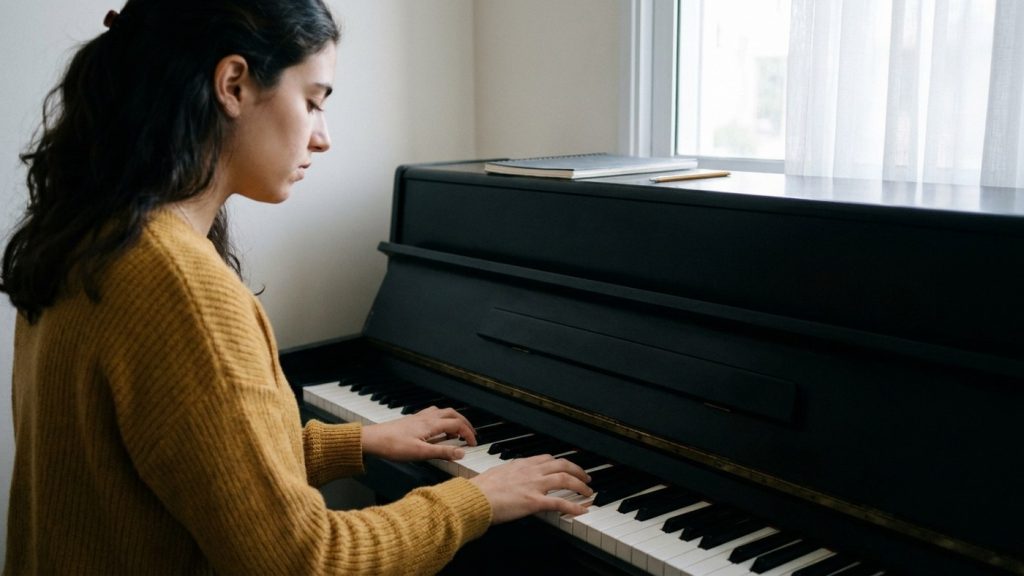
Play A, C and E together, then A, C sharp and E. One note moved by a half step, and the same chord goes from bright to serious, sad or dreamy. That is the whole magic of minor, and it is waiting for you in half the songs you love: “Stairway to Heaven” by Led Zeppelin, “Smooth” by Santana, “Losing My Religion” by R.E.M. and “Hit the Road Jack” by Ray Charles all live in a minor key. Learn the A minor scale and the chords in those songs start to make sense.
This guide is for high schoolers, university students and adults in North Tel Aviv who already know the major scale and want the next step: the three kinds of minor scale (natural, harmonic and melodic), the relative minor, how to find Am and Em on guitar and piano, and a few simple improvising drills. If the major scale still feels shaky, start with our guide to major scales and keys and come back. In piano lessons in North Tel Aviv, this is exactly the stage where theory starts to sound like music.
What is a minor scale, and how is it different from major?
Every scale is a formula of distances: a whole step (W) or a half step (H) between neighbouring notes. The major scale is W–W–H–W–W–W–H. The natural minor scale is W–H–W–W–H–W–W. Compared with the major scale built on the same root, three notes are a half step lower: the 3rd, the 6th and the 7th.
The 3rd decides whether the home chord is major or minor; the 6th and 7th set how dark the scale feels.
| Degree | 1 | 2 | 3 | 4 | 5 | 6 | 7 |
|---|---|---|---|---|---|---|---|
| A natural minor | A | B | C | D | E | F | G |
| E natural minor | E | F# | G | A | B | C | D |
| A major (to compare) | A | B | C# | D | E | F# | G# |
Notice that A minor uses only white keys, exactly like C major, and E minor has a single sharp, F#, exactly like G major. That is no accident, and it leads to the next idea.
The relative minor: same notes, different home
Every major key has a relative minor that shares its notes and its key signature. To find it, go down three half steps from the major root. From C you go down to B, B flat and A: A minor. From G you go down to F#, F and E: E minor.
If the notes are the same, what is different? Home. In a song in A minor, Am is the chord the song rests on and ends on, and melodies lean towards A. In C major, the very same notes lean towards C.
Do not confuse this with the parallel minor: C major and C minor share a root, but C minor has three flats. To see every major and relative minor pair at a glance, open our interactive circle of fifths, where the relative minors sit on the inner ring.
Three kinds of minor: natural, harmonic and melodic
Natural minor
This is the scale in the table above, and it is the backbone of most rock, pop and ballads in a minor key. “Hit the Road Jack” is built on a four-chord descent that, in A minor, is played Am, G, F, E. That descent is often called the Andalusian cadence, and it runs through flamenco, rock and a lot of Mediterranean music.
Harmonic minor
Raise the 7th by a half step. In A minor, G becomes G#. What do you gain? A note a half step below the root that pulls hard into it, and a major dominant chord: E (E, G#, B) instead of Em. Listen to the last chord of that “Hit the Road Jack” descent: it is E major, and its G# is the harmonic minor note. The same thing happens in “Smooth”: Am, F, E.
The price is a step and a half between F and G#. That wide gap gives harmonic minor its exotic flavour, familiar from Middle Eastern and Mediterranean music and from neoclassical metal.
Melodic minor
To smooth out that gap, raise the 6th as well: going up you play A, B, C, D, E, F#, G#, A. In classical music the descending form usually returns to natural minor, so G and F come back down. Jazz players typically use the raised form in both directions. For now, just know the sound.
| Type | A minor | E minor | Where you hear it |
|---|---|---|---|
| Natural | A B C D E F G | E F# G A B C D | Rock, pop, ballads |
| Harmonic | A B C D E F G# | E F# G A B C D# | The major V chord, Mediterranean music, metal |
| Melodic (ascending) | A B C D E F# G# | E F# G A B C# D# | Classical and jazz |
A minor and E minor on the piano
On the piano, A minor is the friendliest starting point: all white keys. The fingering matches C major:
- Right hand, ascending: 1-2-3-1-2-3-4-5. The thumb tucks under finger 3 to reach D.
- Left hand, ascending: 5-4-3-2-1-3-2-1. Finger 3 crosses over the thumb to reach F.
E minor uses the same fingering in both hands, with one black key (F#). The harmonic version adds a second black key, D#, the raised 7th.
Start hands separately, one octave, at 60 BPM in quarter notes. Then eighth notes, then hands together. If playing with two hands is still a challenge, our guide to piano hand independence has a full set of exercises.
A chord drill: hold Am in the left hand, then E major, and over each chord play the scale from A to A in the right hand, first natural, then harmonic. Notice how G# settles beautifully over E and sounds wrong over Am.
A minor and E minor on the guitar
On guitar, the quickest route to A minor is a fifth-position shape that starts on A at the 5th fret of the low string:
| String | Frets | Notes |
|---|---|---|
| 6 (low E) | 5, 7, 8 | A, B, C |
| 5 (A) | 5, 7, 8 | D, E, F |
| 4 (D) | 5, 7 | G, A |
| 3 (G) | 4, 5, 7 | B, C, D |
| 2 (B) | 5, 6, 8 | E, F, G |
| 1 (high E) | 5, 7, 8 | A, B, C |
If you already know the pentatonic scale on guitar, you will recognise its first shape in exactly the same spot. Natural minor simply adds two notes, B and F. That is the most useful way to think about it: the pentatonic plus two extra colours.
E minor sits comfortably in open position: on strings 6 and 1, frets 0, 2 and 3; on string 5, frets 0, 2 and 3; on string 4, frets 0, 2 and 4; on string 3, frets 0 and 2; on string 2, frets 0, 1 and 3. The open strings make it a favourite key for acoustic guitar.
For both: play with a metronome at 70 BPM, one note per beat, up and down, then two notes per beat, keeping one finger per fret. Our guitar lessons tie these shapes to chords you already play.
The chords of the minor key
Build a chord on every degree of A natural minor and you get Am, Bdim, C, Dm, Em, F and G. In harmonic minor, Em becomes E (often E7), the chord that pulls hardest back to Am.
Three progressions to practise, all in A minor:
- Am – F – C – G: the four chords behind countless pop songs, simply started from the minor.
- Am – G – F – E: the Andalusian descent. The last chord is major thanks to harmonic minor.
- Am – Dm – E7 – Am: the classic minor cadence, where the pull from G# to A is clearest.
On piano, these progressions are a great workout for building chords from any note; if you need a refresher, piano chords made simple shows how each one is built.
Simple improvising drills in A minor
Improvising is the fastest way to turn a scale into a language. Open our jam backing tracks in A minor, or record Am – G – F – E on your phone, and try:
- Three notes only: A, C and E. Improvise for a full minute with nothing else.
- Question and answer: a short phrase that ends on an unstable note (B or D), then a phrase that ends on A.
- Land on G# over E: every time the backing reaches E, play G# and step up to A. That is the harmonic minor moment.
- Add the F: F over Am sounds tense and lovely when it falls to E. Use it like a short sigh.
To train your ear to tell major from minor, a few minutes a day with our ear and rhythm trainer makes a big difference.
A weekly plan: 15 minutes a day
| Day | Scale (7 minutes) | Apply it (8 minutes) |
|---|---|---|
| Sunday | A natural minor, hands separately or the 5th-fret shape, 60 BPM | Write out A and E minor from memory |
| Monday | A natural minor in eighth notes | Progression Am – F – C – G |
| Tuesday | A harmonic minor | Am – G – F – E with G# over E |
| Wednesday | E natural and harmonic minor | Find the relative minor of C, G, D and F |
| Thursday | A melodic minor up, natural down | Three-note improvising over a backing track |
| Friday | Round-up: all three types, record yourself | Pick a favourite minor-key song and find its home note |
| Saturday | Rest or active listening | Hear three songs and decide: major or minor? |
Common mistakes
- Thinking minor just means “sad”. Minor can be energetic, heavy and danceable. Rhythm shapes the mood as much as the scale does.
- Playing the right notes but hearing them as major. Practise over an Am chord or a sustained A, or your ear will settle on C.
- Using harmonic minor over every chord. G# belongs to the E chord. Over Am or C it sounds out of place.
- Forgetting the way down in melodic minor. In classical settings, the descent returns to natural minor.
- Practising too fast. A scale played fast with mistakes stays fast with mistakes. Clean at 60 BPM beats messy at 120.
Learning theory and playing in North Tel Aviv
At the Rockstar music school in Ramat Aviv Gimel we do not teach theory as a separate subject. The minor scale comes into a lesson through a song the student picked, and from there we move to the shape, the chords and improvising. Many of our students come from Green Ramat Aviv, Neve Avivim and North Afeka, high schoolers alongside adults returning to music, and many choose piano lessons for teens and adults with a teacher who links theory to the songs they love.
Frequently asked questions
What is the difference between a minor and a major scale?
In natural minor, the 3rd, 6th and 7th are a half step lower than in the major scale on the same root. The 3rd is what gives the home chord its minor colour.
Which minor scale should I learn first?
The A minor scale. On piano it is all white keys, and on guitar it sits on a shape most players already know from the pentatonic. E minor, very comfortable on guitar, comes right after.
When do you use harmonic minor?
Mainly when the V chord is major, such as E or E7 in A minor. Over that chord the raised 7th sounds natural and pulls back to the root.
Are there piano lessons near Green Ramat Aviv?
Yes. The music school is in Ramat Aviv Gimel, a few minutes’ drive away, and Rockstar Home offers lessons at your place, subject to teacher availability. See music lessons in Green Ramat Aviv, or book a free intro piano lesson with no commitment.
Read also: Learn Piano as an Adult · How to Play Housewife on Guitar · How to Play Papit on Guitar
Piano lessons · All lessons · Contact us · Book a free intro lesson