“Housewife” by Canadian singer Tate McRae has spent two weeks at number one on Spotify’s weekly global chart, and for guitarists it is a gift: a three-chord loop that carries almost the whole song, and a chorus that adds just one more chord. Learn it and you learn how three minor-key chords make a complete pop record, and how your strumming hand alone turns a quiet verse into a full chorus. Here are the Housewife chords, the structure, the strumming and an easy capo version.
In one line: the song is in G# minor, 133 BPM, in 4/4, with five chords – Emaj7, G#m, F#, C#m and D#m – and with a capo on the 4th fret it sits on comfortable open shapes. It is exactly the kind of song teens and adults bring to our guitar lessons in North Tel Aviv, where a chart hit becomes a lesson in harmony, rhythm and dynamics.
Housewife chords: the song at a glance
| Fact | Value |
|---|---|
| Key | G# minor |
| Tempo | 133 BPM |
| Time signature | 4/4 |
| Capo | Optional on fret 4, with E minor shapes: Cmaj7 (or C), Em, D, Am and Bm |
| Difficulty | Easy (1 of 3) with the capo |
| Chords | Emaj7, G#m, F#, C#m, D#m |
| Main progression | VI–i–VII |
You can also open the song in the Rockstar Song Analyzer, which shows the chords, the structure and the tempo together, and play along while you read.
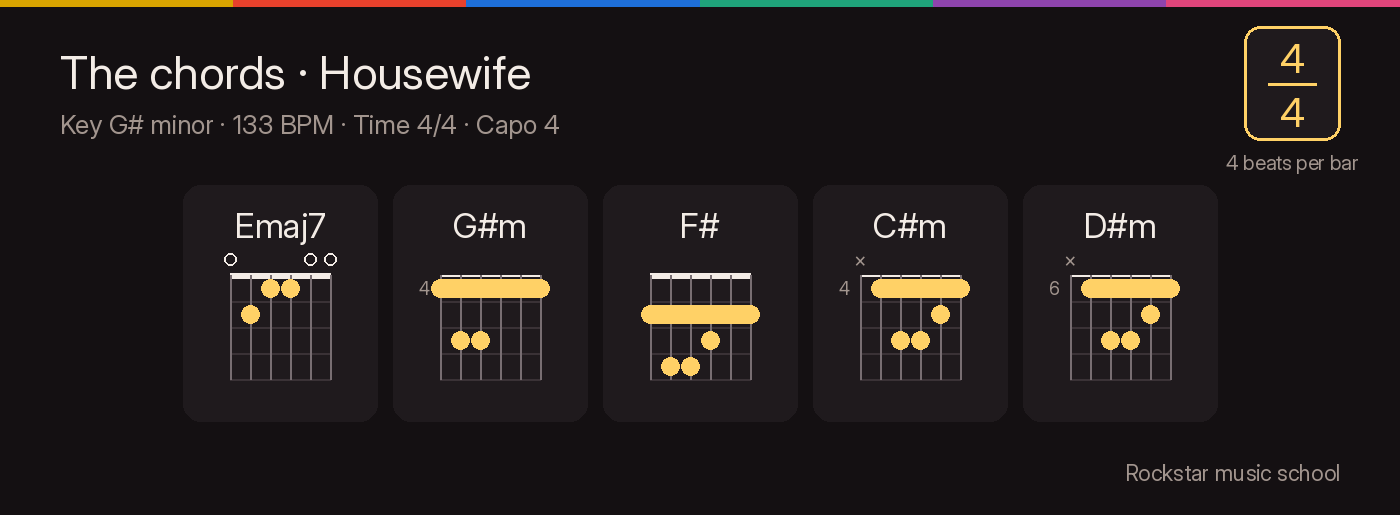
The chords and how to play them
All five chords come from the G# natural minor scale (G#, A#, B, C#, D#, E, F#). G#m is home, the tonic (i). Emaj7 is the sixth degree (VI), F# the seventh (VII), C#m the fourth (iv) and D#m the fifth (v).
The loveliest detail is Emaj7. It is built from E, G#, B and D#, which means it contains the entire G#m triad (G#, B, D#) with an E in the bass. So from Emaj7 to G#m only the bass really moves, from E up to G#, which gives the intro its floating feel. F#, on the other hand, shares no notes at all with G#m, so it is the moment the loop “leaves home”. The return to G#m is a whole step up in the bass with no leading tone – a soft landing, typical of minor-key pop.
Shapes without a capo
- Emaj7 – open: 021100. An open E with the D-string note dropped to fret 1.
- G#m – E minor shape barre at fret 4: 466444.
- F# – E shape barre at fret 2: 244322.
- C#m – A minor shape barre at fret 4: x46654.
- D#m – A minor shape barre at fret 6: x68876.
The hardest shape is G#m: a full barre at the 4th fret where your index finger has to hold down the G string on its own. The hardest change is Emaj7 to G#m: from an open chord near the nut to a barre at fret 4, within a single beat. The good news: G#m and F# are exactly the same barre shape, two frets apart. From G#m to F# you slide the whole hand down two frets and add your middle finger on the G string.
A focused drill: one minute of nothing but Emaj7 and G#m, four metronome clicks per chord, counting how many clean changes you make. Beat it tomorrow. If the barre still buzzes, our guide to changing guitar chords fast helps, and the guitar chord chart shows every shape here.
The song section by section
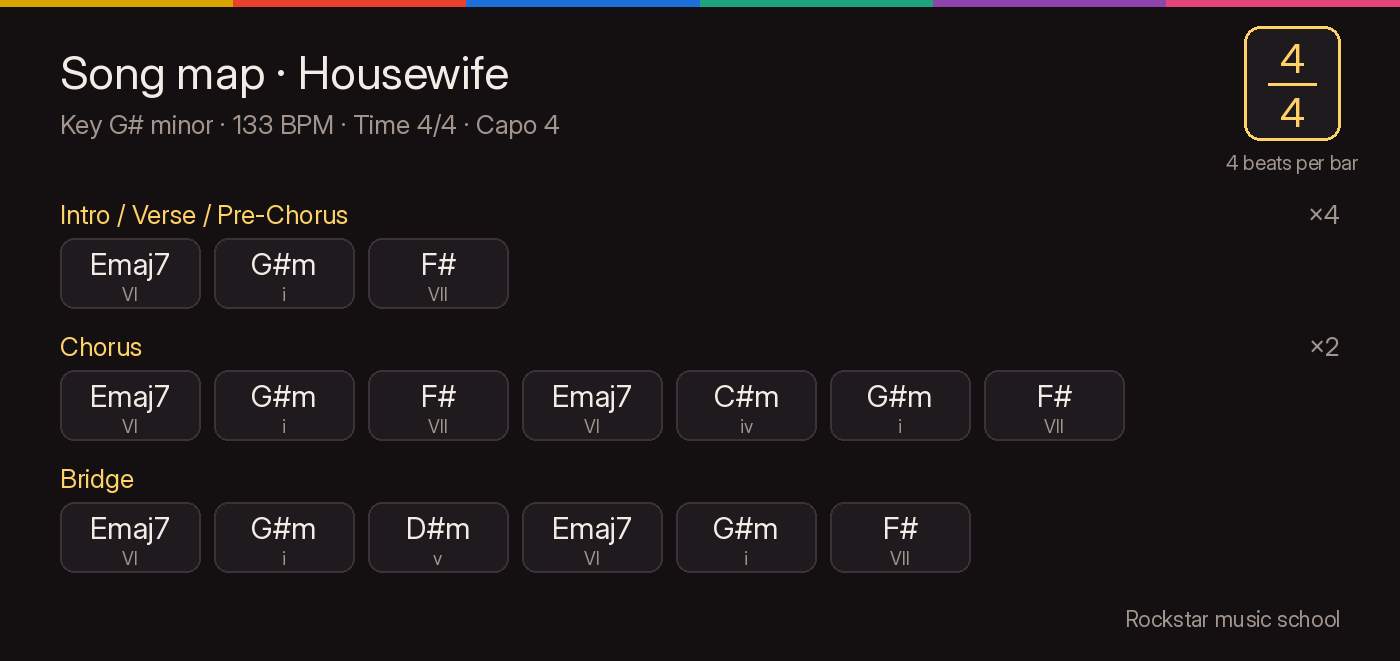
The sources show three harmonic worlds: one loop for intro, verse and pre-chorus, an extended loop in the chorus, and a bridge with a new chord. Bar lengths per chord were not confirmed, so mark them as you hear the recording.
Intro, verse and pre-chorus: VI–i–VII
Emaj7, G#m, F#, and around again – four times. The bass climbs from E to G#, steps down to F#, and steps down again to E as the loop restarts. Because the pre-chorus uses the same loop, the difference between sections has to come from your hands: verse muted and small, pre-chorus gradually opening up.
Chorus: VI–i–VII–VI–iv–i–VII
The chorus starts like the verse, but in its second half, after the second Emaj7, C#m arrives (iv). It shares E and G# with Emaj7, so the change is smooth, but it is darker: a minor chord where the ear expected the loop to repeat. Then G#m and F# close the phrase. Play the two choruses full and open.
Bridge: VI–i–v–VI–i–VII
The bridge brings in D#m, the minor fifth. With no leading tone, it adds a wistful colour instead of pushing home. D#m shares D# with Emaj7, so it falls easily back into Emaj7, and the F# at the end of the bridge hands the song back to the chorus. The outro differs between the sources we checked, so it is left off the map: listen to the recording and end the way it ends.
Strumming and groove: short eighth notes
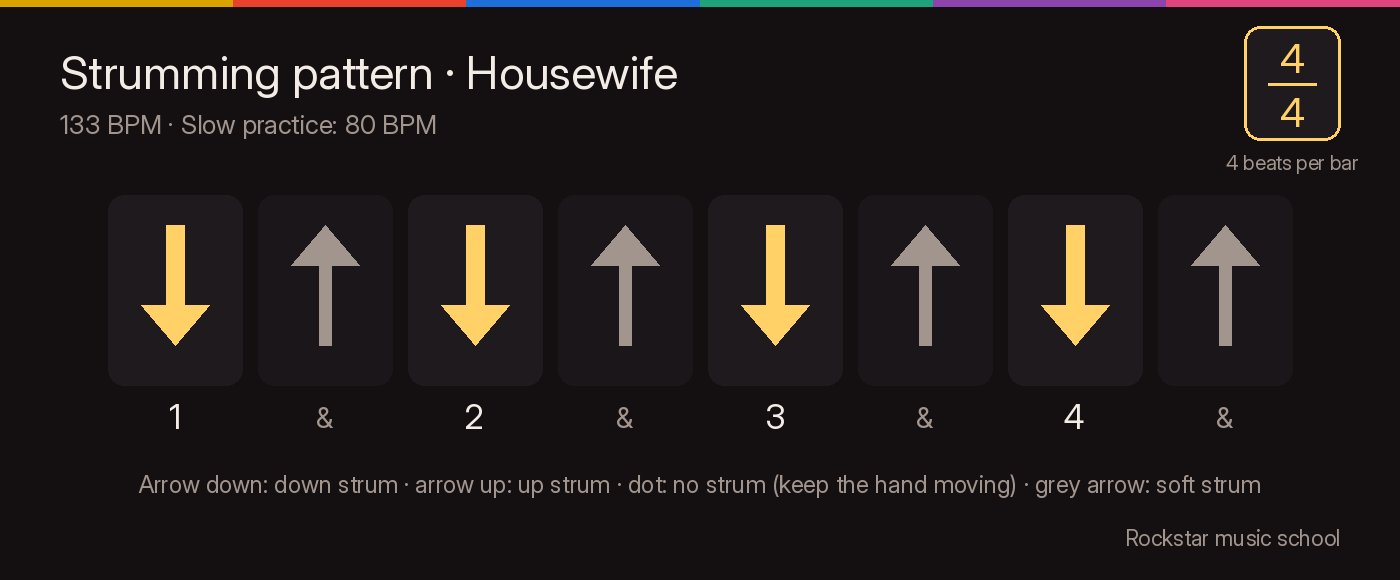
The song is in 4/4, so you count “1 and 2 and 3 and 4 and” – eight slots per bar. According to the sources, the foundation is short eighth-note strums: a downstroke on every number and an upstroke on every “and”. Downs are the anchor, ups lighter on the top strings. The muting is what makes it tight pop.
In the verse, rest the outer edge of your strumming hand on the strings right next to the bridge and strum through it. It sounds short and percussive, leaving room for the vocal. In the chorus, lift the palm off the strings, and the very same eighth notes suddenly sound wide and full. Same pattern, open hand. Practise both on G#m alone until you switch without stopping.
At 133 BPM eight strums a bar tires the arm: keep the motion small, from the wrist, and never stop the hand.
Practice tempo ladder
Do not start at 133 BPM. Open the free online metronome and climb in steps:
| Step | Tempo | Goal |
|---|---|---|
| 60% | 80 BPM | Even eighth notes on G#m alone, then each chord change landing exactly on 1 |
| 75% | 100 BPM | The verse loop four times in a row, palm-muted |
| 90% | 120 BPM | The full chorus with C#m, and the switch from muted to open |
| 100% | 133 BPM | Play along with the recording from start to finish without rushing the chorus |
Move up a step only after three clean run-throughs in a row. This is exactly the kind of feedback a teacher gives in real time: in a free intro guitar lesson you hear straight away whether your eighth notes are even or your strumming hand speeds up at the chord changes.
An easier version: capo on fret 4
A capo on the 4th fret raises every shape by four half steps, so you play E minor shapes and it sounds in G# minor, exactly like the recording:
- Cmaj7 (x32000) for Emaj7. If you do not know it yet, a plain C works, and one of the sources writes it that way.
- Em (022000) for G#m.
- D (xx0232) for F#.
- Am (x02210) for C#m, in the chorus.
- Bm (x24432) for D#m, in the bridge only. If the barre is hard, play just four strings: xx4432.
| Capo | Shapes you play | Sounding key |
|---|---|---|
| No capo | Emaj7, G#m, F#, C#m, D#m (four barre chords) | G# minor, as recorded |
| Fret 4 | Cmaj7, Em, D, Am, Bm (one barre, in the bridge) | G# minor, as recorded |
With the capo, the three loop chords – Cmaj7, Em and D – are open and comfortable, and the change to drill is Em to D until it happens without thinking. Cmaj7 and Em share three open strings, so that change is short too. You can check the conversions yourself with the chord transposer.
A 7-day practice plan
- Day 1 (15 minutes): capo on fret 4 and the three loop shapes. Check every string rings.
- Day 2 (15 minutes): the Em to D change. One-minute drill, then the loop slowly.
- Day 3 (15 minutes): strumming hand only: eighth notes on Em, once muted and once open, at 80 BPM.
- Day 4 (15 minutes): the verse loop palm-muted at 100 BPM, four times around without stopping.
- Day 5 (20 minutes): the chorus with Am. Play a verse into a chorus and notice the moment your palm leaves the strings.
- Day 6 (20 minutes): the bridge with Bm, then the whole song at 120 BPM.
- Day 7 (20 minutes): play along with the recording at 133 BPM. Record yourself and check the verse is quieter.
Students from Neve Avivim who come after school or work often tell us the hard part is finding a fixed time. Fifteen minutes every evening beats two hours once a week.
Common mistakes in this song
- Playing E instead of Emaj7. Without the D# the floating feel of the intro disappears, and the move to G#m sounds heavier. With the capo, Cmaj7 beats C once you have it under your fingers.
- Playing the verse as loud as the chorus. If your palm does not mute the verse, the chorus has nowhere to go.
- Playing G#m instead of C#m in the chorus. Count it: after the second Emaj7 comes C#m.
- Stopping the strumming hand at chord changes. Keep it moving even while your fretting hand looks for the next chord. One muffled strum is better than a hole in the groove.
- Rushing. 133 BPM pulls forward, especially in the chorus.
Frequently asked questions
Is Housewife good for beginners?
With a capo on fret 4, yes. The three loop chords are open, and the only barre chord, Bm, appears just in the bridge and has a four-string version. The real challenge is the strumming hand: even eighth notes at 133 BPM.
Why Emaj7 and not a plain E?
Because Emaj7 contains the notes of G#m, so it sounds like a natural extension of the tonic rather than a separate chord. A plain E works, but the intro loses some of its softness.
How do I play it in my vocal range?
Move the capo. Each fret raises or lowers the song by a half step, and with the E minor shapes it is easy to try several positions. If you want to sing and play together with confidence, our vocal lessons work on exactly that coordination.
Which scale should I know to improvise over it?
G# natural minor, the same seven notes every chord in the song is built from. With the capo on fret 4 you can think of it as E minor. Our guide to minor scales on guitar and piano shows how to play it across the neck.
Do you offer guitar lessons near Neve Avivim?
Yes. Rockstar music school is in Ramat Aviv Gimel, a few minutes’ drive from Neve Avivim, and Rockstar Home also offers lessons at your home, subject to teacher availability. More on the music lessons in Neve Avivim page.
How we teach chart songs at Rockstar in North Tel Aviv
At Rockstar, the music school in Ramat Aviv Gimel in North Tel Aviv, students bring the songs they are listening to right now, and our teachers – working musicians – turn them into a lesson plan. Students come to us from Green Ramat Aviv, Azorei Chen, Tzahala and other neighbourhoods across the north of the city, and a song like “Housewife” becomes a lesson in minor-key harmony, palm muting and building energy without changing chords. If you would like to move forward with a teacher, our guitar lessons for teens and adults start with a free intro lesson, no commitment.
Read also: How to Play Nicole Kidman on Guitar
Guitar lessons · All lessons · Contact us · Book a free intro lesson