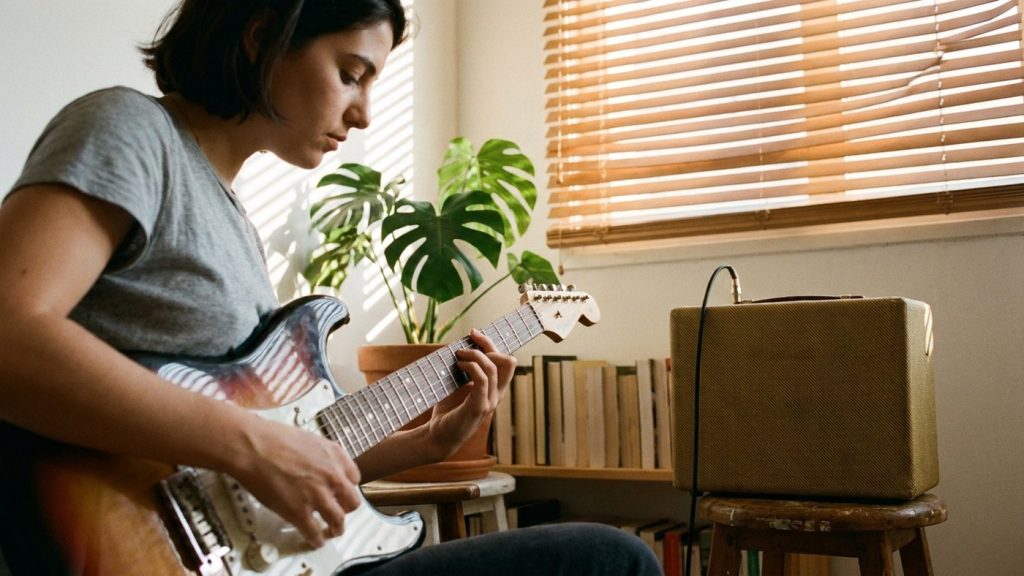
At number two on Spotify’s global weekly chart, six weeks in, sits “Nicole Kidman” by ADÉLA – a fast dance-pop track with company one place below, her own “Ain’t In LA”. For guitarists it is an unusually clean lesson: three chords, one loop from start to finish, and the whole challenge moves to your strumming hand. Learn it and you learn to play short, sharp and steady at a high tempo, a skill many players lack even when they know dozens of chords. Here are the Nicole Kidman chords, the structure, the choked strumming and an easier capo version.
The short version: G minor, 141 BPM, 4/4, three chords – Cm7, Dm7 and Gm7 – in a single loop through every section. It suits the stage where you know your open chords and are starting on barre shapes and rhythm, exactly what we work on in our guitar lessons in North Tel Aviv, with high schoolers and adults from Ramat Aviv Gimel, Neve Avivim and New Ramat Aviv.
Nicole Kidman chords: the song at a glance
| Detail | Value |
|---|---|
| Key | G minor |
| Tempo | 141 BPM |
| Time signature | 4/4 |
| Capo | Not needed; an almost barre-free version with a capo on fret 3 |
| Difficulty | Medium (2 of 3) – two barre shapes and a fast tempo |
| Chords | Cm7, Dm7, Gm7 |
| Main progression | iv7–v7–i7 |
You can also open the song in the Rockstar Song Analyzer to see chords, structure and tempo together while you play.
The chords and how to play them
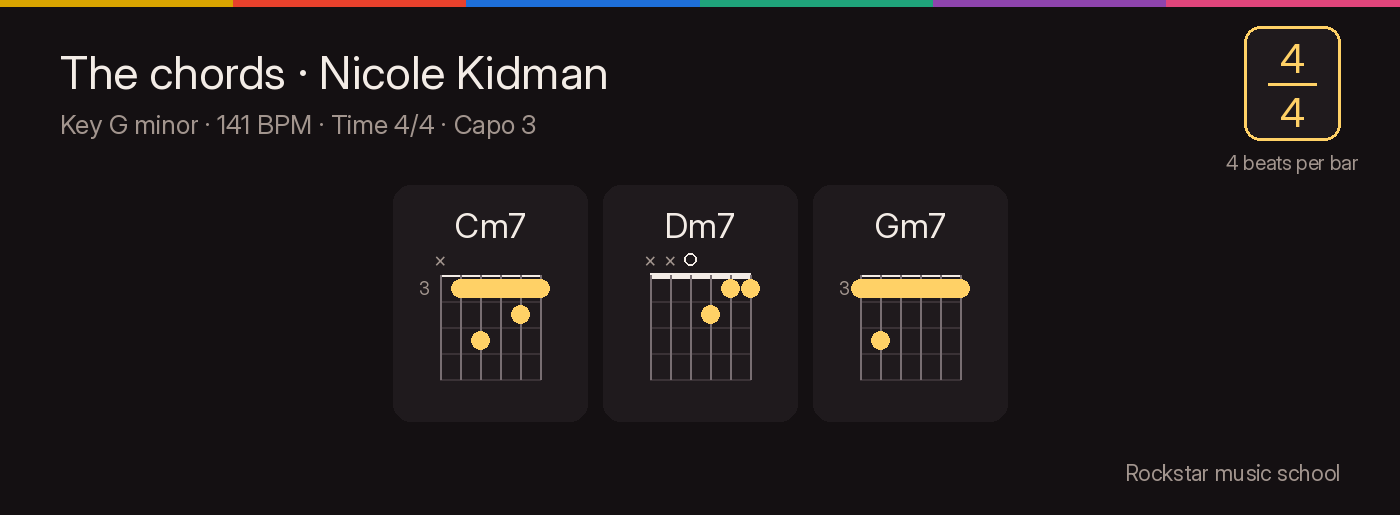
All three chords come from G minor, and all three are minor sevenths: a minor triad plus the minor seventh. Gm7 is home, the tonic (i7), Cm7 is the fourth degree (iv7) and Dm7 the fifth (v7). Minor sevenths have a soft, slightly cloudy colour, less dramatic than plain minor chords, which is why they sit so well under a dance-pop beat.
The interesting detail is that v7. In a “classical” minor key you would expect D7, whose F# pulls hard up to G and creates clear tension and release. Dm7 has F instead, so the return to Gm7 is gentle: your ear knows it is home, but there is no full stop. That is what lets the loop go round without ever sounding finished. Cm7 and Gm7 share G and Bb; Dm7 and Gm7 share D and F, so every change links close relatives.
The shapes on the neck
- Cm7 – A-shape barre at fret 3: x35343. Index across fret 3 from the A string, ring finger on fret 5 of the D string, middle finger on fret 4 of the B string.
- Dm7 – open: xx0211. Index on fret 1 of the top two strings, middle finger on fret 2 of the G string.
- Gm7 – full E-shape barre at fret 3: 353333. Index across all six strings, ring finger on fret 5 of the A string.
Cm7 and Gm7 both live on fret 3. Between them the barre stays put and extends to the low string, the ring finger drops from the D string to the A string, and the middle finger lifts. That is the easy change, a good place to start.
The hard change: Dm7 to Gm7
The real difficulty is leaving the barre for the open Dm7 and returning to the full Gm7 barre within one beat at 141 BPM. Keep your hand anchored: on Dm7, leave your thumb behind the neck where it sits for the barre, and on the way back place the ring finger on fret 5 of the A string first, then lay the barre down.
A focused drill: one minute of Dm7 and Gm7 only, four clicks each, counting your clean changes. Write the number down and beat it every day. If your Gm7 still buzzes, our guide on how to play barre chords covers strength and pressure, and the guitar chord chart shows these shapes in several positions.
A favourite of more advanced students: play Dm7 as a barre too, the Cm7 shape two frets higher (x57565). Then the loop is one moving shape, and with no open strings it becomes much easier to cut the sound short.
Song structure: one loop, changing energy
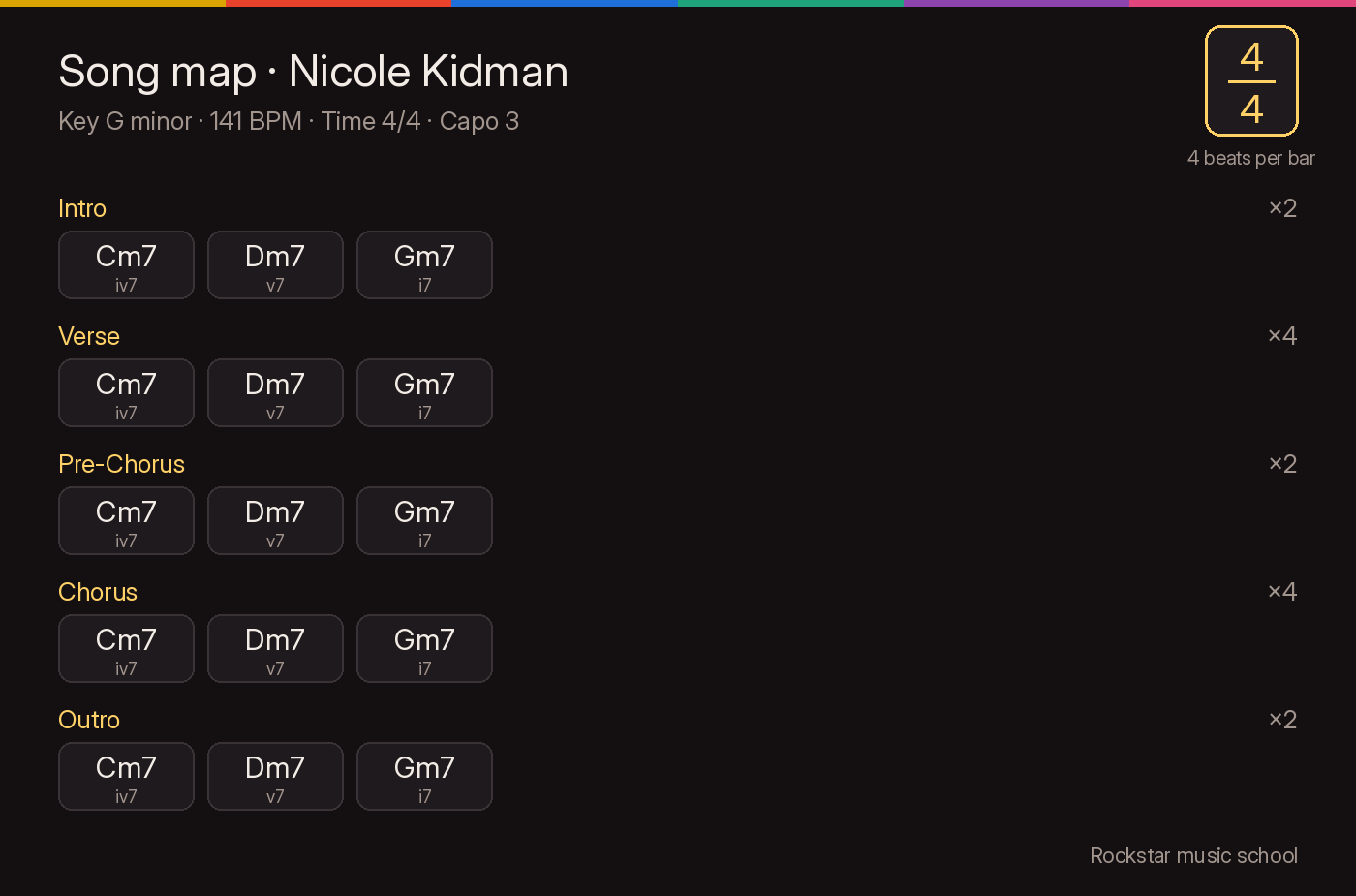
According to the sources we checked, the same loop runs through every section. The map shows how often it repeats: twice in the intro, four times in the verse, twice in the pre-chorus, four times in the chorus and twice in the outro. To be honest: how many bars each chord lasts has not been confirmed, so do not memorise bar counts. Listen with the guitar in your hands, count the beats on each chord and mark the split as you hear it.
The loop: iv7–v7–i7
The bass climbs from C to D, then jumps to G. Cm7 to Dm7 is a whole step up, a feeling of lift. Dm7 to Gm7 moves by a fifth, the most natural way home, but without the F# it is a soft landing. Then Gm7 opens back out to Cm7. Two chords that leave home and one that returns, over and over.
What changes between verse and chorus
With identical harmony everywhere, the difference has to come from your hands. In the intro and verse, play only the top four strings at medium volume. In the pre-chorus, bring in the lower strings gradually. In the chorus, play the full chords and keep the cut-offs sharp. In the outro, return to the intro’s level. One guitar can build a full arc of energy without changing a chord.
Strumming and groove: short and sharp
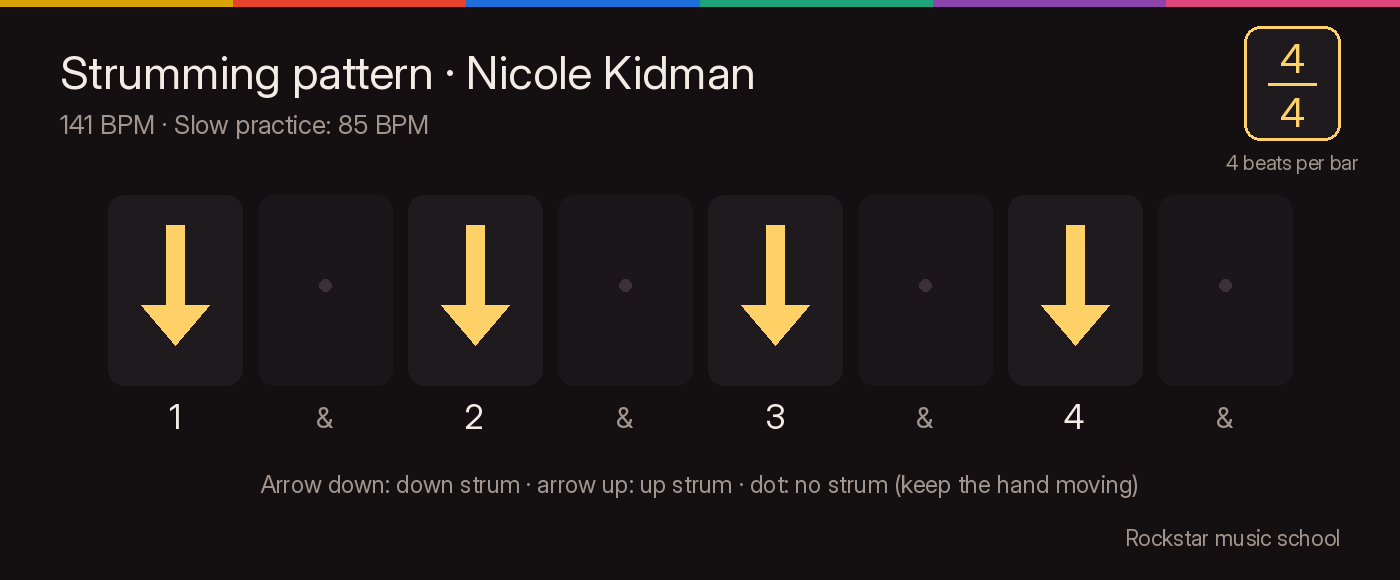
The song is in 4/4, so you count “1 and 2 and 3 and 4 and” – eight slots per bar. The pattern: one downstroke on every beat and silence on every “and”. That silence is the groove. According to the sources, every hit is a short staccato, and right after it you stop the strings with your strumming hand, so the chord never rings into the next beat. It sounds like a tight “chk”, almost percussion.
How: strum down, and in the same motion let the outer edge of your palm settle on the strings near the bridge. The “and” is the moment your palm rests there. On the barre shapes you can also release a little fretting-hand pressure right after the hit, fingers still touching the strings. On the open Dm7 the D string keeps ringing, so you need the palm. For more of this choked rhythm, see our guide to funk rhythm guitar like Nile Rodgers.
At 141 BPM each beat lasts less than half a second, but it is only one stroke per beat. The challenge is consistency, not speed: four equal hits, and no rushing as you change chords.
A practice tempo ladder
Do not start at 141 BPM. Open the free online metronome and climb in steps:
| Step | Tempo | Aim |
|---|---|---|
| 60% | 85 BPM | A clean hit and cut-off on every beat on Gm7, then each change landing on 1 |
| 75% | 106 BPM | The full loop four times without stopping, cut-offs all the same length |
| 90% | 127 BPM | Add dynamics: verse on the top strings, chorus on all six |
| 100% | 141 BPM | Play along with the recording without rushing the changes |
Move up only after three clean passes in a row. This is the feedback a teacher gives in real time: in a free intro guitar lesson you hear straight away whether the cut-off lands on time.
An easier version: capo on fret 3
The sources suggest a capo on fret 3 with three simple shapes – Am7, Bm7 and Em7. The capo raises each shape three semitones, so they sound as Cm7, Dm7 and Gm7, in the recording’s key. Check it with the chord transposer.
- Am7 – x02010: two fingers.
- Bm7 – x20202: no barre, fingers on fret 2 of the A, G and high E strings.
- Em7 – 022030: the familiar open shape.
| Capo | Shapes you play | What you hear |
|---|---|---|
| No capo | Cm7, Dm7, Gm7 (two barre shapes) | G minor, as recorded |
| Fret 3 | Am7, Bm7, Em7 (almost no barre) | G minor, as recorded |
One cost: with open strings the fretting hand cannot help choke the sound, so your palm does all the work. Go slowly and check every “and” is silent.
A 7-day practice plan
- Day 1 (15 minutes): the three shapes, one at a time, string by string, especially the third string on Gm7.
- Day 2 (15 minutes): Cm7 to Gm7 on the same fret, then Dm7 to Gm7 with the ring finger as anchor. Count and write it down.
- Day 3 (15 minutes): the cut-off alone: hit and stop on Gm7 until the silence is completely clean.
- Day 4 (15 minutes): the full loop, a choked hit on every beat at 85 BPM.
- Day 5 (20 minutes): 106 BPM, four rounds in a row. Try the Dm7 barre at fret 5 too.
- Day 6 (20 minutes): 127 BPM with dynamics: quiet verse, full chorus.
- Day 7 (20 minutes): along with the recording at 141 BPM. Record yourself and check the cut-offs and the tempo.
Students from New Ramat Aviv who come after school or work often tell us the hardest thing is a fixed practice time. Fifteen minutes every evening beats two hours once a week, because your hands remember the shapes and the groove.
Common mistakes in this song
- Letting the chord ring. Without the cut-off the dance-pop groove is gone.
- Rushing. 141 BPM pulls you forward, especially in the chorus. Use a metronome until the tempo holds.
- Playing D7 or Dm instead of Dm7. D7 brings in F# and changes the colour; plain Dm loses the softness of the seventh.
- Lifting the whole hand on the change to Gm7. Thumb stays, ring finger first, then the barre.
- Waiting for new chords in the chorus. The change here is in volume and texture, not harmony.
Frequently asked questions
Is Nicole Kidman good for beginners?
With a capo on fret 3, yes, if you know a few open chords. The real challenge is the tempo and the cut-off, so start on the first step of the ladder.
Why Dm7 and not D7 if the song is in minor?
The song uses the natural minor scale, where the fifth degree is a minor chord. D7 would pull harder back to Gm7 but sound more dramatic. Dm7 keeps the loop soft and circular.
How do I play it in my vocal range?
Move the capo: each fret raises the song a semitone, and the Am7, Bm7 and Em7 shapes make it easy to try positions. To sing and play together with confidence, our vocal lessons work on exactly that.
How long does it take to learn?
With the capo, many players have the loop within days. A precise cut-off at full tempo takes longer; the 7-day plan is a good start.
Do you offer guitar lessons near New Ramat Aviv?
Yes. Rockstar music school is in Ramat Aviv Gimel, a few minutes’ drive away, and Rockstar Home offers lessons at your home, subject to teacher availability. See music lessons in New Ramat Aviv.
Learning chart songs at Rockstar in North Tel Aviv
At Rockstar, the music school in Ramat Aviv Gimel in North Tel Aviv, students bring the songs they are listening to now, and our teachers – working musicians – turn them into a plan: shapes, changes, the strumming hand and dynamics. Students come from North Afeka, Tzukei Aviv and across the north of the city, and a song like “Nicole Kidman” becomes a lesson in barre chords, minor sevenths and choked rhythm. To progress with a teacher, our guitar lessons for teens and adults start with a free intro lesson, no commitment; you might also like our guide to changing guitar chords fast.
Read also: How to Play BbY WOW on Guitar · How to Play Housewife on Guitar
Guitar lessons · All lessons · Contact us · Book a free intro lesson