Odeya’s “Papit” sits at number four on Spotify’s weekly chart in Israel, its eighth week in a row there. For guitarists it is a compact lesson in minor-key playing: a three-chord loop that carries verse and chorus, one section built on a dark half-step move, and an urban-pop groove that asks for a steady strumming hand. Here are the Papit chords, the harmony behind them, the strumming, an easier capo version and a week-long plan.
The short version: C minor, 4/4, 118 BPM, no capo on the recording, and the main chords are Ab, Fm and Cm, all barre chords. That is exactly the stage we work on in our guitar lessons in North Tel Aviv with high schoolers and adults from Ramat Aviv Gimel, Neve Avivim and North Afeka: open chords feel solid, barre chords are still a fight.
Papit chords: the song at a glance
| Detail | Value |
|---|---|
| Key | C minor |
| Tempo | 118 BPM (one source measures 120) |
| Time signature | 4/4 |
| Capo | Not needed; easy version with a capo on fret 3 |
| Difficulty | Intermediate (2 of 3): the main loop is all barre chords |
| Chords | Ab, Fm, Cm, Db, G7, Eb, Bb |
| Main progression | VI–iv–i (Ab, Fm, Cm) |
You can also open the song in the Rockstar Song Analyzer, which shows the chords and the structure together, and play along as you read.
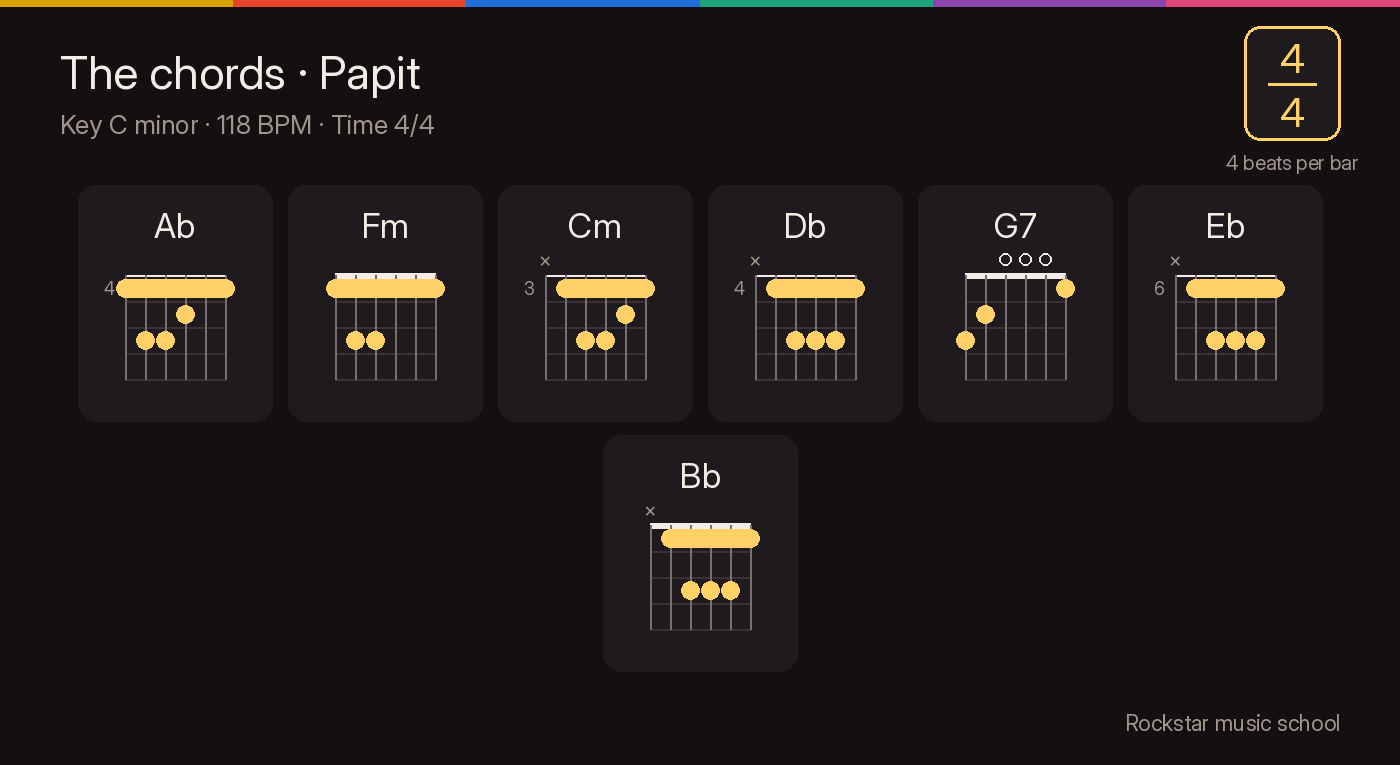
The chords and how to play them
The song lives in C natural minor: C, D, Eb, F, G, Ab, Bb. Cm is home (i), Fm is the fourth degree (iv) and Ab the sixth (VI). The loop feels smooth because of one note, C, which sits inside all three chords: Ab (Ab, C, Eb), Fm (F, Ab, C) and Cm (C, Eb, G). So the changes sound like the lighting shifting, not like jumps.
There is also no dominant (V) chord in the loop. The iv–i move from Fm to Cm lands home without a strong pull, which is why it feels melancholic rather than dramatic. The song saves that pull for the outro.
The shapes
- Ab – 466544: E-shape major barre at fret 4; third and fourth fingers on A and D at fret 6, second finger on G at fret 5.
- Fm – 133111: E-shape minor barre at fret 1, the same shape minus the second finger.
- Cm – x35543: A-shape minor barre at fret 3, low E muted.
- Db – x46664: A-shape major barre at fret 4, low E muted.
- G7 – 320001: open, the only chord without a barre.
- Eb – x68886 and Bb – x13331: the A-shape major barre at frets 6 and 1.
The hard change: Ab to Fm
This change comes on every pass of the loop, and it is the hardest because your hand drops three frets with a full barre at both ends. The good news: Ab is the E-shape major and Fm the E-shape minor, so your first, third and fourth fingers keep the same structure. Slide down and lift the second finger on the way. Release, slide, press.
A focused drill: one minute of Ab and Fm back and forth, four metronome clicks per chord, counting the clean changes where every string rings on time. Write the number down and beat it tomorrow. If the barre itself is not there yet, our guide to playing barre chords covers strength and pressure, and the guitar chord chart shows every chord here in several positions.
Fm to Cm: switching shape families
Now the hand moves from fret 1 to fret 3 and from the E shape to the A shape. Keep the first finger flat, move it two frets, and land the third and fourth fingers together on D and G at fret 5, as one block.
Song structure, section by section
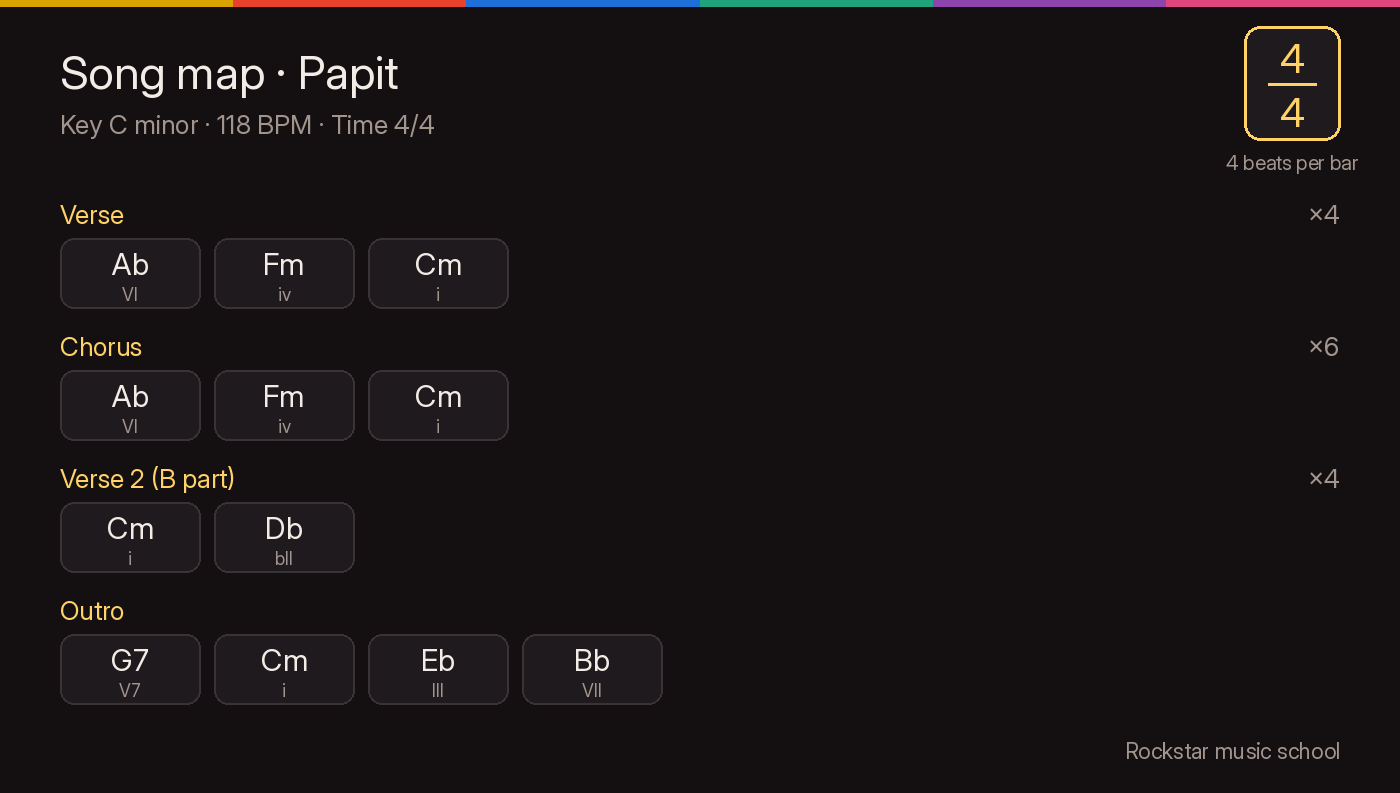
According to the chord sources we checked, the song has four sections, and the first two share the same loop.
Verse and chorus: VI–iv–i
Ab, Fm, Cm, round and round: per the source, about four times in the verse and six in the chorus. Every pass ends at home on Cm, which gives the song its circular, almost hypnotic feel, with no tension demanding a resolution. Since the chords stay the same, your hands make the difference: a softer verse, even on the top four strings, then all six strings in the chorus with an accent on beat 1. Check the exact bar count against the recording.
The second verse: i–bII, the dark half step
Here the song changes colour: Cm and Db back and forth, about four times. Db is not in C natural minor; it sits a half step above the tonic (bII). Its notes barely move from Cm: C rises to Db, G to Ab, and Eb a whole step to F. The result is dark and slightly menacing, and it is the hook of this section. On the neck it is simple: Cm at fret 3 in the A-minor shape, Db at fret 4 in the A-major shape. One fret up, minor to major. Play it with intent.
The outro: V7–i–III–VII
According to one source, the song closes on G7, Cm, Eb and Bb, the first dominant chord in the song. G7 contains B natural, borrowed from the harmonic minor, and pulls hard towards C, so the Cm after it sounds like a full stop. Eb (III) and Bb (VII) then leave the song hanging in the air. Our minor scales guide explains natural and harmonic minor. As these chords come from one source only, check them against the recording.
Strumming and groove
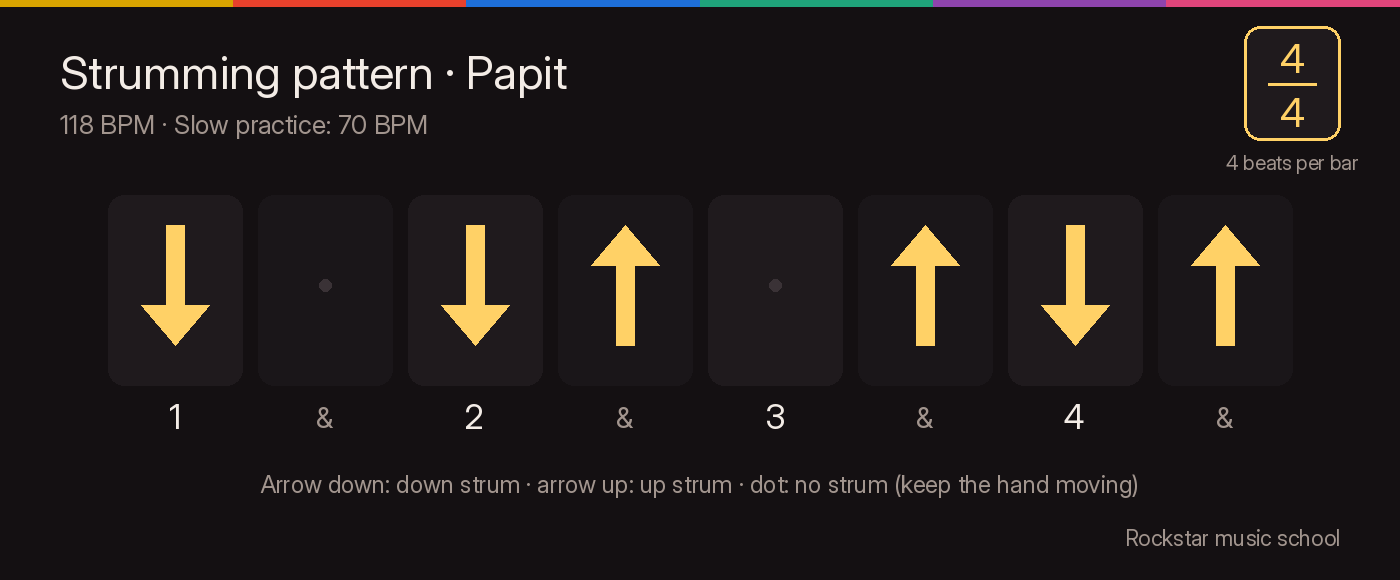
The song is in 4/4, so you count “1 and 2 and 3 and 4 and”: eight slots per bar. The pattern: down on 1, down on 2, up on the “and” of 2, nothing on 3, up on the “and” of 3, down on 4, up on the last “and”. In shorthand: D . D U . U D U.
The urban-pop feel comes from the chuck on 2 and 4, a muted downstroke that works like a snare drum. Your fretting hand releases its pressure for a split second without leaving the strings, and the strum comes out as a dry “chk”. With barre chords this is natural: your first finger already lies across every string, so you only relax it. Beats 1 and 3 ring, 2 and 4 become percussion.
Practice tempo ladder
118 BPM is moderate, but with a barre on every chord it feels fast at first. Climb in steps with the free online metronome:
| Step | Tempo | Goal |
|---|---|---|
| 1 (about 60%) | 70 BPM | The pattern on Cm only, chuck on 2 and 4, gap on 3, until automatic |
| 2 (about 75%) | 88 BPM | The loop Ab, Fm, Cm, one bar per chord, four passes without stopping |
| 3 (about 90%) | 106 BPM | Add the second verse (Cm, Db) and dynamics: soft verse, full chorus |
| 4 (100%) | 118 BPM | Play along with the recording from start to finish |
Move up only after three clean passes. In a free intro guitar lesson, a teacher will hear straight away whether your chuck lands on 2 and 4 or rushes.
An easier version: capo on fret 3
If three barre chords in a row are still heavy going, the source suggests a capo on fret 3. It raises every shape three semitones, so F, Dm and Am sound exactly like Ab, Fm and Cm, in the recording’s key. Dm and Am are open, and F can be a small F on the top four strings (xx3211, counted from the capo). The rest follows: Db becomes a Bb shape, G7 an E7, Eb a C and Bb a G. Check it with the chord transposer.
| Capo | Shapes you play | What you hear |
|---|---|---|
| No capo | Ab, Fm, Cm / Cm, Db / G7, Cm, Eb, Bb | C minor, as on the recording |
| Fret 3 | F, Dm, Am / Am, Bb / E7, Am, C, G | C minor, as on the recording, with open shapes |
The Bb shape in the second verse stays a small barre (try xx3331), but only in one section.
A 7-day practice plan
- Day 1 (15 minutes): Ab, Fm and Cm one at a time; pick each string to check it rings. If not, use the capo version.
- Day 2 (15 minutes): one minute of Ab to Fm, count and write it down, then Fm to Cm.
- Day 3 (15 minutes): the pattern on Cm at 70 BPM. Drill the chuck: press on 1, release on 2, press on the “and”, release on 4.
- Day 4 (15 minutes): the full loop at 88 BPM, counting out loud for the first two passes.
- Day 5 (20 minutes): Cm and Db at 88 BPM, then both sections back to back. Make Db sound deliberate.
- Day 6 (20 minutes): 106 BPM with dynamics, plus the outro: G7, Cm, Eb, Bb.
- Day 7 (20 minutes): 118 BPM with the recording. Record yourself and check that the chucks land on time.
Whether you are a high schooler practising after classes or a Tel Aviv University student, a fixed fifteen minutes a day beats two hours once a week.
Common mistakes in this song
- Playing Db as if it were a mistake. The i–bII move is deliberate; it is the colour of that section. Play it with confidence.
- Hitting the low E on Cm and Db. Both chords start on the A string, and the low E muddies the landing.
- Lifting the hand for the chuck. It is a release of pressure, not a lift; otherwise open strings ring instead of a dry “chk”.
- Verse and chorus at the same volume. With identical chords, dynamics are the whole difference.
- Swapping G7 for Gm. Without the B natural there is no pull towards Cm, and the ending loses its full stop.
Frequently asked questions
Is Papit good for beginners?
With a capo on fret 3, yes, if you know Dm and Am. Without a capo it suits the stage right after your first barre chord.
Why do some apps say the song is in Db major?
Spotify’s automatic key analysis does show C#/Db major, but the two chord sources we checked agree on C minor, and the loop lands on Cm again and again. On the guitar, C minor is the reading that works.
Is it the same song as “Papi”?
No. “Papi” is an earlier Odeya song in a different key and tempo. When you look for chords elsewhere, make sure the title is “Papit”.
How do I sing and play it at the same time?
Make the loop and the chucks automatic first, then sing over a soft verse and add the full chorus last. Our vocal lessons work on exactly that coordination.
Do you offer guitar lessons near North Afeka?
Yes. Rockstar music school is in Ramat Aviv Gimel, a few minutes’ drive from Afeka, and students from Tel Baruch and nearby neighbourhoods come to us too. There are also lessons at home through Rockstar Home, subject to teacher availability. More on our music lessons in Afeka page.
For another chart song in the same key, our guide to Natati Lecha Bayit on guitar is also in C minor, with the Ab and Cm you will already have under your fingers.
Learning chart songs at Rockstar in North Tel Aviv
At Rockstar, the music school in North Tel Aviv, students bring the songs they are listening to right now, and our teachers, all working musicians, turn them into a lesson plan: shapes, changes, strumming hand and dynamics. A song like “Papit” becomes a lesson on barre chords in both shape families, on the degrees of the minor scale and on a chuck you will use in dozens of pop songs. Our guitar lessons for teens and adults start with a free intro lesson, no commitment.
Read also: How to Play Cut Ladavar Haba on Guitar
Guitar lessons · All lessons · Contact us · Book a free intro lesson