Nadav Hanetsis’s “Cut Ladavar Haba” jumped six places this week to number one on Spotify’s weekly chart in Israel, only its second week on the chart. For guitarists it is a gift: three chords, one loop that carries the entire song, and one strumming pattern from start to finish. Play that loop cleanly and in the pocket, and you are playing the song. Here are the Cut Ladavar Haba chords, the harmony behind them, the strumming and an easier version.
The short version: the song is in B minor, in 4/4, with no capo, and uses only G, A and Bm. It is the perfect song for the stage where your open chords feel solid and your first barre chord is waiting, which is exactly the stage we work on in our guitar lessons in North Tel Aviv with high schoolers and adults from Ramat Aviv Gimel, Neve Avivim and Green Ramat Aviv.
Cut Ladavar Haba chords: the song at a glance
| Detail | Value |
|---|---|
| Key | B minor, read from the chords (D major is a possible reading too) |
| Tempo | No reliable source found; measure it against the recording (see below) |
| Time signature | 4/4 |
| Capo | Not needed; easy version with a capo on fret 7 |
| Difficulty | Intermediate (2 of 3): one barre chord, Bm |
| Chords | G, A, Bm |
| Main progression | VI–VII–i–VII (G, A, Bm, A) |
You can also open the song in the Rockstar Song Analyzer, which shows the chords and the structure together, and play along as you read.
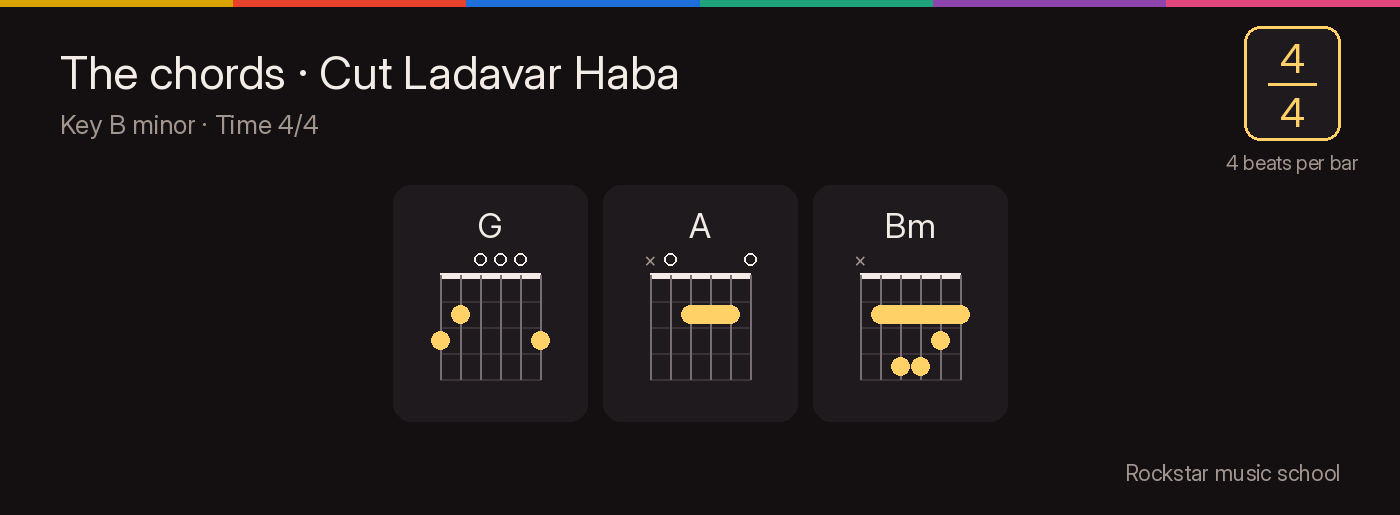
The chords and how to play them
All three chords come from the B natural minor scale: B, C#, D, E, F#, G, A. Bm is home, the tonic (i). G is the sixth degree (VI) and A is the seventh (VII). One detail shapes the whole colour: the A here is a plain A major chord, without the A# that would pull hard towards B. So the landing on Bm is not dramatic but soft and natural. The bass simply climbs G, A, B in whole steps, and you are home.
G (G, B, D) and Bm (B, D, F#) share two notes, which is why they sit so comfortably together. A is the odd one out and the hinge of the loop: it appears twice per pass, on the way up to Bm and on the way back to G.
The shapes
- G – 320003.
- A – x02220: three fingers at fret 2 on D, G and B; low E out.
- Bm – x24432: first finger barres fret 2 from the A string down, third and fourth fingers at fret 4 on D and G, second finger at fret 3 on B; low E out.
The hard change: A to Bm
This change happens twice per pass (A to Bm and Bm back to A), so it is both the hardest and the most important move in the song. The good news is that both chords live around fret 2. In A, three fingers press at fret 2; in Bm, the first finger lies flat across that same fret and the other three land above it at frets 3 and 4.
A focused drill: one minute of A and Bm back and forth, four metronome clicks per chord, counting how many clean changes you make, meaning every string rings on time. Write the number down and try to beat it every day. If the barre itself is not there yet, our guide to playing barre chords explains how to build strength and the right pressure, and the guitar chord chart shows Bm in several positions. For G to A, let the first finger lead (both chords use fret 2); more on that in our guide to changing guitar chords fast.
Song structure: one loop all the way
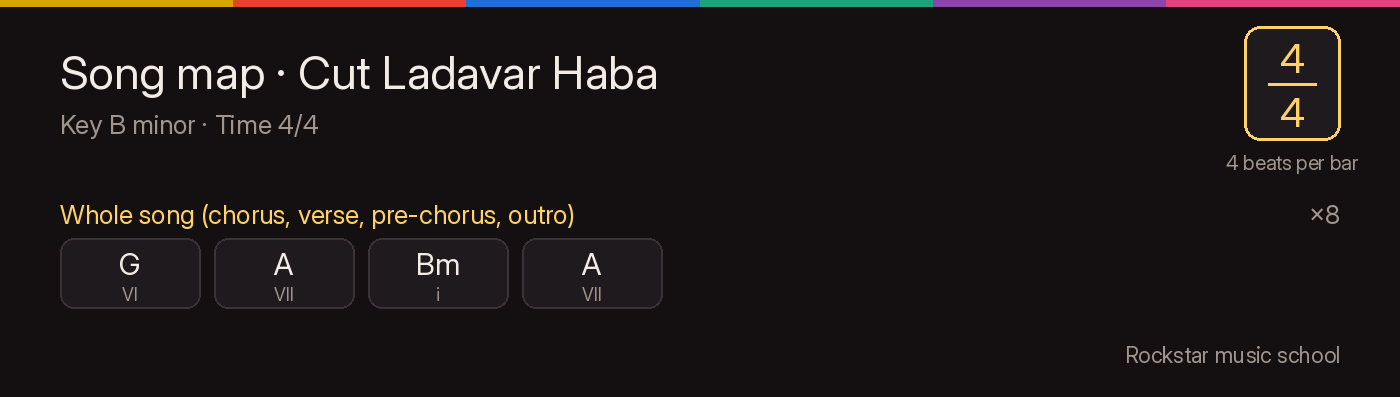
The two chord sources we checked, each a separate transcription, agree on the same picture: one loop, G, A, Bm, A, carries the chorus, the verses, the pre-chorus and the outro. One of them adds an Em at two isolated moments, in the opening chorus and late in the song, where the other has A. It is a single source’s reading, so it is not in the diagram; if you hear it, Em (022000) is the iv chord of the key.
Chorus and verses: VI–VII–i–VII
The loop rises G, A, lands on Bm, and then A sends it back to G. Bm is a moment of rest and the A that follows reopens the tension, so the song keeps moving forward. The song opens straight on the chorus, so you hear the loop from the very first second.
Pre-chorus: same chords, fewer changes
In the pre-chorus the chords stay the same but change more slowly, one chord per line according to the sources. Strum less and let each chord ring: the slower harmonic rhythm builds anticipation, so the chorus sounds bigger when it returns. Check the exact bar count against the recording.
Building energy
With one loop throughout, the sections differ only in your hands: soft verses (even on the top four strings), a few long strums in the pre-chorus, the full pattern with an accent on 1 in the chorus.
Strumming and groove
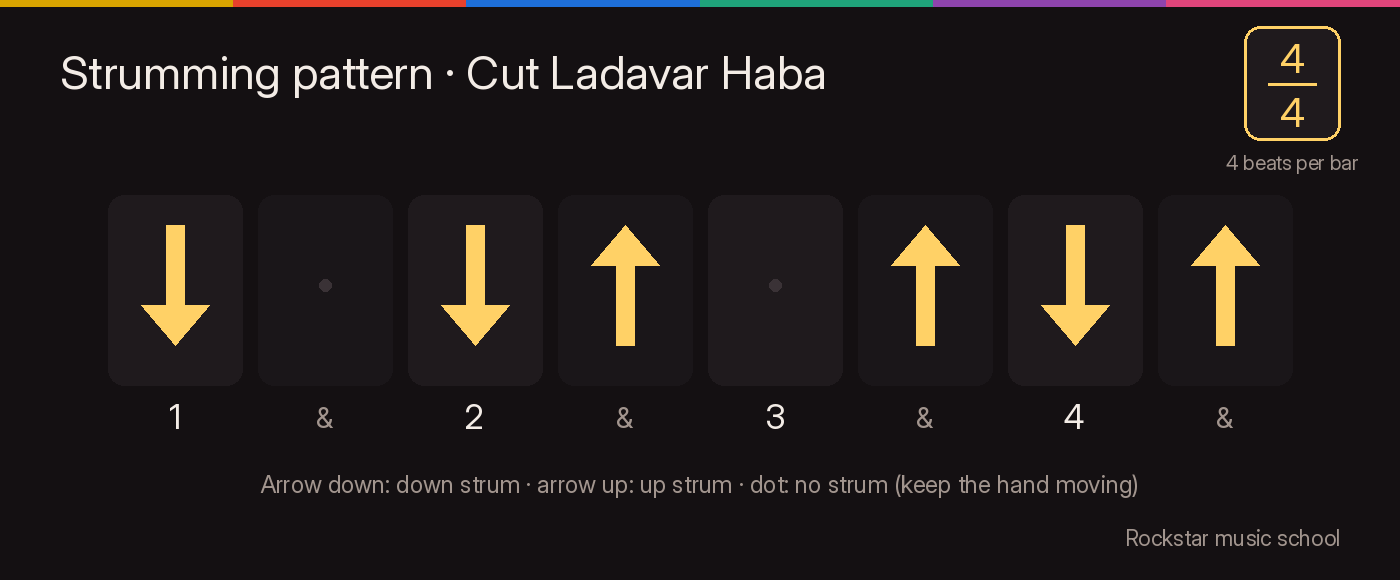
The song is in 4/4, so you count “1 and 2 and 3 and 4 and”: eight slots per bar. The pattern the sources describe is D D U U D U, one of the most useful acoustic patterns there is: down on 1, down on 2, up on the “and” of 2, nothing on 3, up on the “and” of 3, down on 4 and up on the last “and”.
The heart of the pattern is the missing strum on 3. Your strumming hand still moves down there, it just passes over the strings without touching them. Because of that gap, the upstroke right after it sounds accented and lifts, and the pattern gets a sway that pushes the song forward.
The key rule: your strumming hand never stops, even when it does not hit the strings.
Practice tempo ladder
We found no reliable source for the exact tempo, so measure it yourself: put the song on, tap along with the tap tempo BPM counter and you have the recording’s BPM. Get there step by step with the free online metronome:
| Step | Tempo | Goal |
|---|---|---|
| 1 | 60 BPM | The pattern on Bm only, with the gap on 3, until it is automatic |
| 2 | 70 BPM | The full loop G, A, Bm, A, one bar per chord, four passes without stopping |
| 3 | 80 BPM | Add dynamics: soft verse, ringing pre-chorus, full chorus |
| 4 | The tempo you measured | Play along with the recording from start to finish |
Move up a step only after three clean passes. In a free intro guitar lesson, a teacher will hear straight away whether the upstroke after the gap lands on time or rushes.
An easier version: short Bm or a capo on fret 7
The only chord that makes this song harder is Bm, and there are two ways around it. The first, which the sources themselves suggest: a short Bm on the top four strings, xx4432. Your first finger presses only the high E string at fret 2, with no full barre, and the other three stay where they are. Thinner, but the same chord, and the rhythm stays steady.
The second: a capo on fret 7. The capo raises every shape by seven semitones, so the open shapes C, D and Em sound exactly like G, A and Bm, in the same key as the recording, with no barre at all. You can check the conversion yourself with the chord transposer.
| Capo | Shapes you play | What you hear |
|---|---|---|
| No capo | G, A, Bm (barre), A | B minor, as on the recording |
| No capo, no barre | G, A, short Bm (xx4432), A | B minor, thinner sound |
| Fret 7 | C, D, Em, D | B minor, in a brighter register |
With the capo, the changes become C to D and D to Em, among the first changes every guitarist learns.
A 7-day practice plan
- Day 1 (15 minutes): the three shapes, one at a time. Pick each string of Bm to check it rings.
- Day 2 (15 minutes): A to Bm and back. One minute of changes, count and write it down, then the same with G to A.
- Day 3 (15 minutes): the pattern alone on Bm at 60 BPM, with a strumming hand that keeps moving through beat 3.
- Day 4 (15 minutes): the full loop at 70 BPM, one bar per chord.
- Day 5 (20 minutes): 80 BPM, then the pre-chorus: same chords, one long strum each, let them ring.
- Day 6 (20 minutes): measure the recording’s tempo with tap tempo and play the loop a little below it with full dynamics: soft verse, full chorus.
- Day 7 (20 minutes): play along with the recording from start to finish. Record yourself and check the change into Bm.
Whether you are a Tel Aviv University student or a high schooler fitting practice in after homework, a fixed fifteen minutes a day beats two hours once a week.
Common mistakes in this song
- Strumming on 3. The gap on 3 is what gives the pattern its sway. A downstroke there makes it flat and heavy.
- Hitting the low E string on Bm and A. In both chords the bass starts on the A string. The low E muddies the landing on Bm.
- Adding a D chord because it “fits”. Neither source has one, and it pulls the song towards a different home.
- Stopping the strumming hand at every change. A muted string on time beats a clean chord that lands late.
- Playing the pre-chorus like the chorus. A busy pattern there kills the build.
Frequently asked questions
Is Cut Ladavar Haba good for beginners?
Yes, if you already know G and A. With the short Bm or a capo on fret 7 it is one of the friendliest songs on the chart, and without a capo it is a great song for your first barre chord, because there is only one.
Is the song in B minor or D major?
You could read the loop as IV–V–vi–V in D major, but the phrases land on Bm and there is no D chord, so B minor is the natural reading – a conclusion from the chords, not from an official database.
How do I sing and play it at the same time?
Make the loop automatic first, then sing over a soft verse, and add the full chorus last. If you want to work on that coordination properly, our vocal lessons do exactly that.
Do you offer guitar lessons in Ramat Aviv Gimel?
Yes. Rockstar music school is in Ramat Aviv Gimel, and students from Tzukei Aviv and the nearby neighbourhoods reach us in a few minutes. There are also lessons at home through Rockstar Home, subject to teacher availability. More on the music school in Ramat Aviv Gimel page.
If you want another chart song built on the same idea, our guide to Natati Lecha Bayit on guitar uses the same VI–VII–i–VII movement, in C minor and with barre chords.
Learning chart songs at Rockstar in North Tel Aviv
At Rockstar, the music school in North Tel Aviv, students bring the songs they are listening to right now, and our teachers, all working musicians, turn them into a lesson plan: the shapes, the changes, the strumming hand and the dynamics. A song like “Cut Ladavar Haba” becomes a lesson on your first barre chord and a strumming pattern you will use in dozens of songs. If you want to move forward with a teacher, our guitar lessons for teens and adults start with a free intro lesson, no commitment.
Read also: How to Play Avi HaTahol on Guitar
Guitar lessons · All lessons · Contact us · Book a free intro lesson