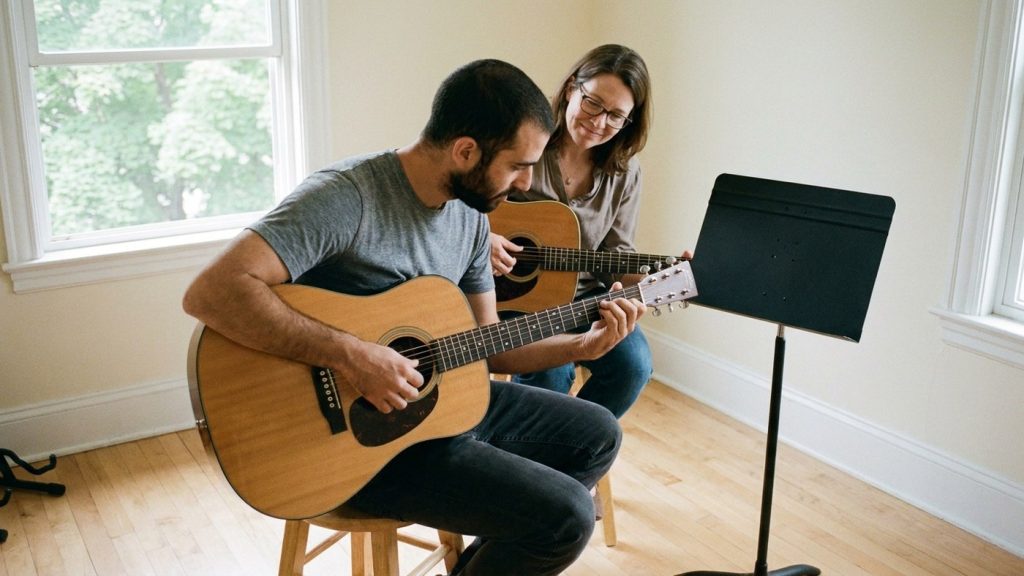
The song sitting at number one on Spotify’s weekly Israel chart this week, now in its sixth week on the chart, is “Natati Lecha Bayit” by Ofek Adanek. Behind the relaxed production sits a great guitar lesson: four chords, one loop that runs through almost the whole song, and a laid-back hip-hop groove that teaches your strumming hand the value of space. Here are the Natati Lecha Bayit chords, the song map, the strumming and an easier capo version, step by step.
In short: C minor, 106 BPM, 4/4, four chords – Ab, Bb, Cm and Gm. It suits the stage where open chords feel solid and barre chords are next, exactly what we work on in our guitar lessons in North Tel Aviv, with high schoolers and adults from Ramat Aviv Gimel, Neve Avivim and South Afeka.
Natati Lecha Bayit chords: the song at a glance
| Detail | Value |
|---|---|
| Key | C minor |
| Tempo | 106 BPM |
| Time signature | 4/4 |
| Capo | Not needed; an easier version with a capo on fret 3 |
| Difficulty | Medium (2 of 3) – all four chords are barre shapes |
| Chords | Ab, Bb, Cm, Gm (the recording also uses the colours Abmaj7 and Gm7) |
| Main progression | VI–VII–i–VII–v |
You can also open the song in the Rockstar Song Analyzer and play along.
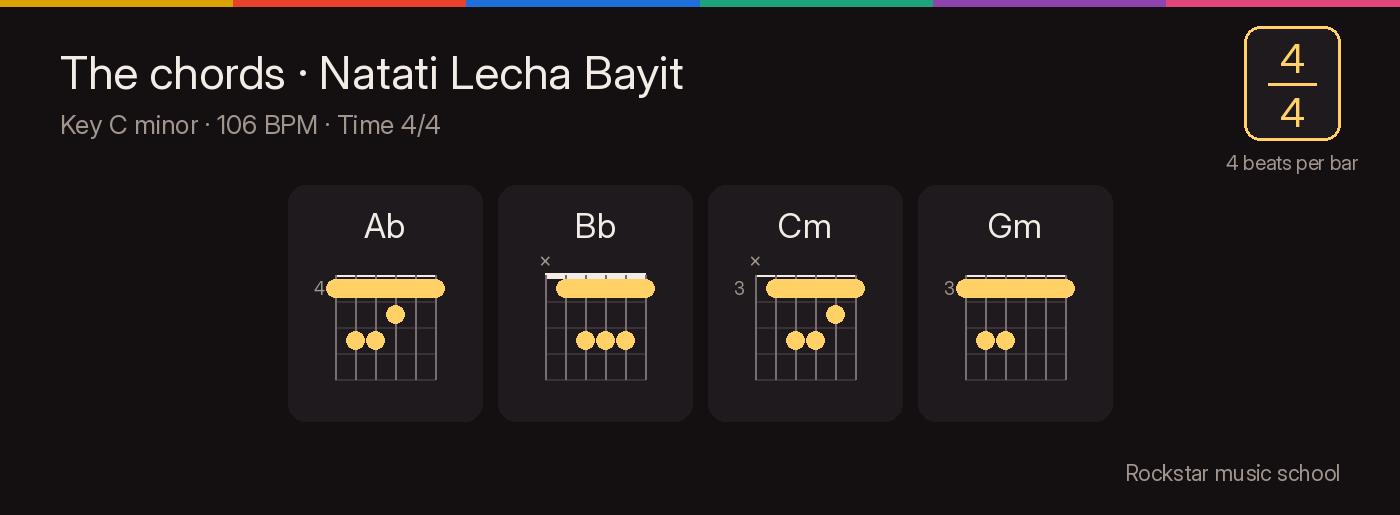
The chords and how to play them
All four chords come from the C natural minor scale: C, D, Eb, F, G, Ab, Bb. Cm is home, the tonic (i). Ab is the sixth degree (VI), Bb the seventh (VII) and Gm the fifth (v). The defining detail is that Gm. Many minor-key songs play the fifth chord as G major, whose B pulls hard back to C. Here it stays minor, so the loop never pushes you home; it rolls along calmly, which is the song’s mellow, slightly melancholy colour.
Tension and release come from the bass instead: it climbs Ab, Bb, C and lands on Cm, the moment your ear says “we’re here”. Bb and Gm then let the energy settle, and the next round starts with the bass rising just a half step, G to Ab, so the loop has no seam.
The shapes on the neck
- Ab – an E-shape barre at fret 4: 466544. Your first finger covers all six strings.
- Bb – an A-shape barre at fret 1: x13331. First finger on fret 1, and your third (or fourth) finger covers the D, G and B strings at fret 3.
- Cm – an Am-shape barre at fret 3: x35543.
- Gm – an Em-shape barre at fret 3: 355333.
Cm and Gm both sit on a barre at fret 3: your first finger stays put while the other fingers change shape. Bb to Cm is the same A-string barre two frets higher, major turning into minor.
The hard change: Ab to Bb
Ab and Bb share one bar, so this change comes mid-bar with no time to think. In the diagram’s shapes it is a jump from fret 4 to fret 1 with a new shape. Either drill the jump, looking at the target fret before the hand moves, or follow the chord sources: play all three chords as one E-shape barre moving up two frets at a time – Ab at fret 4 (466544), Bb at fret 6 (688766) and Cm at fret 8 (8-10-10-8-8-8). From Bb to Cm you slide the whole hand up two frets and lift only your second finger, because major turns into minor.
Drill: one minute of Ab and Bb only, two clicks per chord, counting clean changes. Write the number down and beat it daily. If the barre itself is not there yet, our guide to playing barre chords explains how to build strength and the right pressure, and the guitar chord chart shows each of these shapes in several positions.
The colour on the record: Abmaj7 and Gm7
One chord source writes Abmaj7 and Gm7, the colour on the recording. Abmaj7 adds a G, a note shared with Cm and Gm, so it sounds softer and blends into the loop. A handy shape: 4x554x (Ab bass on the low E string, A string muted). Gm7 adds an F, and the shape is almost the same as Gm: 353333, simply lift the finger off fret 5 on the D string.
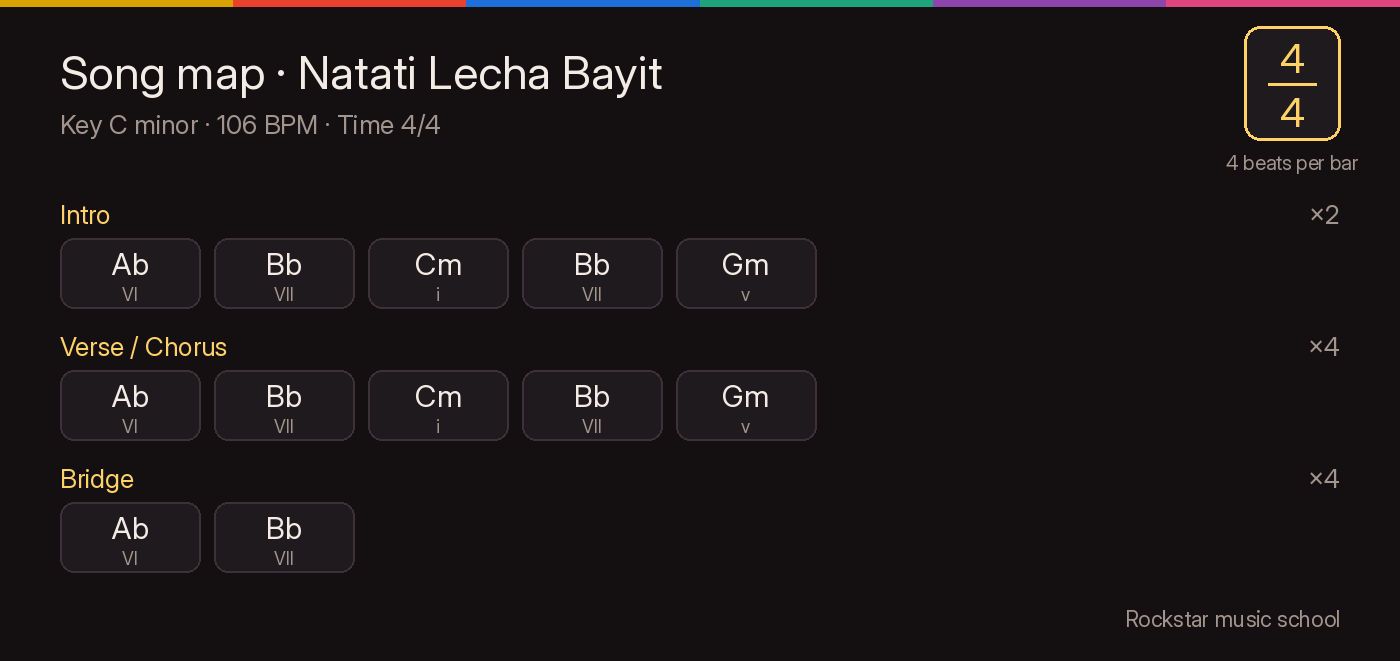
Song structure: one loop and one bridge
Per our sources, one loop carries the intro, verses and choruses, and one bridge changes direction. Learn the loop and you know almost the whole song.
Intro, verses and choruses: VI–VII–i–VII–v
The loop is Ab, Bb, Cm, Bb, Gm. The intro plays it twice, and the verses and choruses repeat it again and again. In bars: Ab and Bb share one bar, half a bar each, and Cm and Gm get two bars each. The Bb between Cm and Gm is a passing chord; check its exact length against the recording. The feel: a quick climb, a long landing on Cm, a soft step down to Gm.
Verse versus chorus
Verse and chorus use the same progression, so the difference is in your hands: in the verse play gently on the top four strings, or one long strum per chord; in the chorus bring in the full pattern and the low strings. The song opens up without a single new chord.
The bridge: VI–VII four times
Only Ab and Bb remain, four times. These are the chords that lead to Cm, but the landing never comes, so your ear wants Cm more with every repeat, and the return home feels bigger. Grow louder with each repeat and let the next Cm ring.
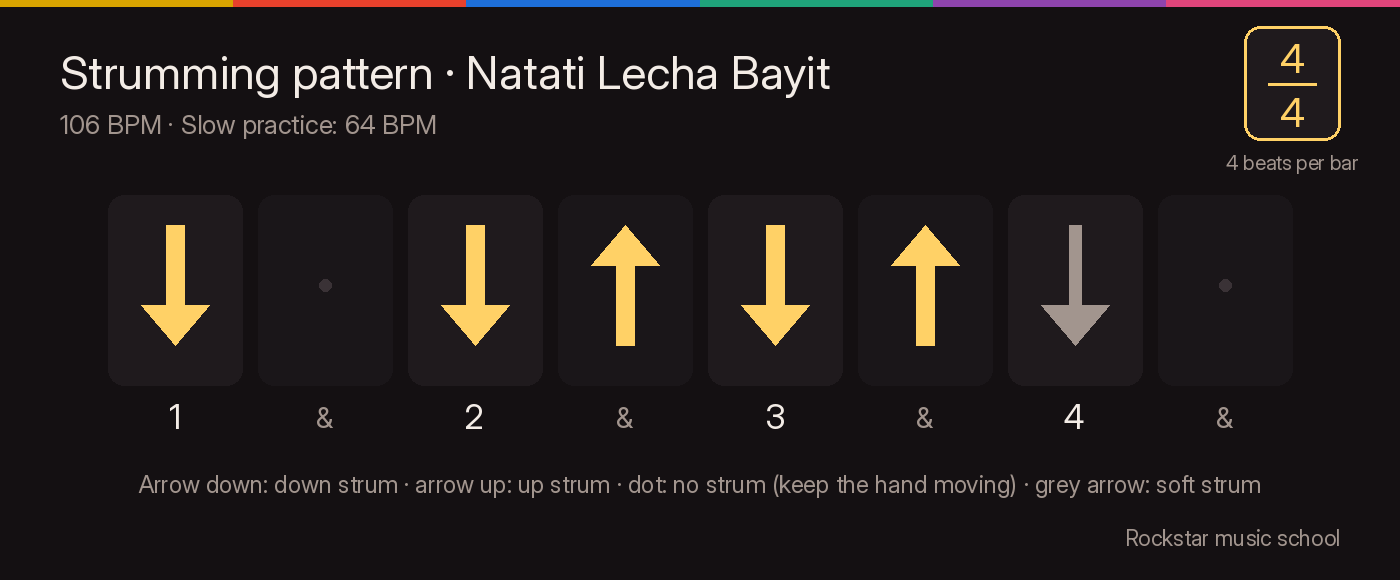
Strumming and groove
The song is in 4/4, so you count “1 and 2 and 3 and 4 and” – eight slots per bar. The sources describe a laid-back hip-hop groove: down on 1, down-up on 2 and on 3, and a muted chuck on 4. In the diagram: down, space, down-up, down-up, a muted down strum on 4 (the grey arrow), space.
The chuck is the heart of the groove, standing in for the snare: a short, dry click instead of a ringing chord. On 4, release your fretting hand’s pressure without lifting off the strings, and strum down. Barre shapes make it easy, since your first finger already covers every string. The half beat of space after it is where you change chords.
Keep the strumming hand moving, down on numbers and up on “ands”, missing the strings in the empty slots. Soft strums, a light accent on 1, a clear chuck on 4.
Practice tempo ladder
Do not start at 106 BPM. Open the free online metronome and climb in steps:
| Step | Tempo | The goal |
|---|---|---|
| 60% | 64 BPM | The pattern with the chuck on Cm only, then the Ab–Bb change exactly mid-bar |
| 75% | 80 BPM | The full loop four times without stopping, every chord on time |
| 90% | 95 BPM | Add the dynamics: soft verse, full chorus, a bridge that grows |
| 100% | 106 BPM | Play along with the recording from start to finish, relaxed |
Move up only after three clean repeats. In a free intro guitar lesson a teacher hears at once whether your chuck is really dry.
An easier version: capo on fret 3
Every chord is a barre, so the simplest way in is a capo on fret 3: it raises each shape three half steps, so F, G, Am and Em sound as Ab, Bb, Cm and Gm, in the recording’s key. You can check the conversion yourself with the chord transposer.
Bonus: swap the F for an open Fmaj7 (xx3210) and it sounds as Abmaj7, the recording’s own colour; an open Em7 (022030) sounds as Gm7. The easy version is also the closest to the record.
| Capo | Shapes you play | What you hear |
|---|---|---|
| No capo | Ab, Bb, Cm, Bb, Gm (all barre) | C minor, as on the recording |
| Fret 3 | F, G, Am, G, Em | C minor |
| Fret 3, no barre at all | Fmaj7, G, Am, G, Em7 | C minor, with the Abmaj7 and Gm7 colour |
The hard Ab–Bb change becomes a short, open Fmaj7–G.
A 7-day practice plan
- Day 1 (15 minutes): the four shapes one at a time, with or without the capo. Check that every string rings.
- Day 2 (15 minutes): the Ab to Bb change. One minute of changes, count and write it down, then the same with Cm to Gm on the fret 3 barre.
- Day 3 (15 minutes): the chuck on its own: Cm ringing on 1, 2 and 3, chuck on 4. Ten bars in a row without the chord leaking into the chuck.
- Day 4 (15 minutes): the full pattern over the loop at 64 BPM, with the Ab–Bb change mid-bar.
- Day 5 (20 minutes): the loop at 80 BPM, four rounds in a row, then the bridge: Ab–Bb four times and back to Cm.
- Day 6 (20 minutes): 95 BPM with dynamics: soft verse on the top strings, full chorus, a bridge that grows.
- Day 7 (20 minutes): play along with the recording at 106 BPM. Record yourself on your phone and listen: relaxed, or rushing?
Students from South Afeka who come to lessons after a long day find that a fixed fifteen minutes every evening beats two hours once a week.
Common mistakes in this song
- Playing the chuck as a normal strum. If the chord keeps ringing on 4, the groove loses its snare and becomes ordinary strumming. Release your fretting hand at that exact moment.
- Playing G major instead of Gm. The B note makes the song dramatic; here the chord is minor.
- Arriving late on Bb. Ab and Bb share a bar, and Bb has to land exactly on 3. Stay on Ab too long and you land late on Cm.
- Landing on Cm in the bridge. The bridge repeats Ab–Bb four times with no Cm.
- Playing loud all the way through. When the chords do not change between verse and chorus, volume is your only tool for building energy.
Frequently asked questions
Is Natati Lecha Bayit a good song for beginners?
With a capo on fret 3 and Fmaj7, yes, if you know a few open chords. Without a capo it is a great barre chord workout.
What key is the song in?
C minor. Both chord sources we checked and Spotify’s track analysis agree on it. The minor Gm is what keeps the song in natural minor, without the strong pull of a G major chord.
How do I play it in a key that suits my voice?
Move the capo. Each fret raises the song a half step, and with the F, G, Am and Em shapes it is easy to try a few positions until your voice sits comfortably. If you want to sing and play together with confidence, our vocal lessons work on exactly that coordination.
Do you offer guitar lessons near South Afeka?
Yes. Rockstar music school is in Ramat Aviv Gimel, a few minutes’ drive from Afeka, and Rockstar Home also offers lessons at your home, subject to teacher availability. More on our music lessons in Afeka page.
And if you want another chart song in a similar style, our Avi HaTahol guitar guide is also built on one minor-key loop of barre chords.
How we teach chart songs at Rockstar in North Tel Aviv
At Rockstar, the music school in Ramat Aviv Gimel in North Tel Aviv, students bring the songs they hear right now, and our teachers – working musicians – turn them into a lesson plan. “Natati Lecha Bayit” becomes a lesson in barre chords, natural minor and the chuck, without feeling like an exercise. If you want to move forward with a teacher, our guitar lessons for teens and adults start with a free intro lesson, no commitment.
Read also: How to Play BbY WOW on Guitar · How to Play Cut Ladavar Haba · How to Play Papit on Guitar
Guitar lessons · All lessons · Contact us · Book a free intro lesson