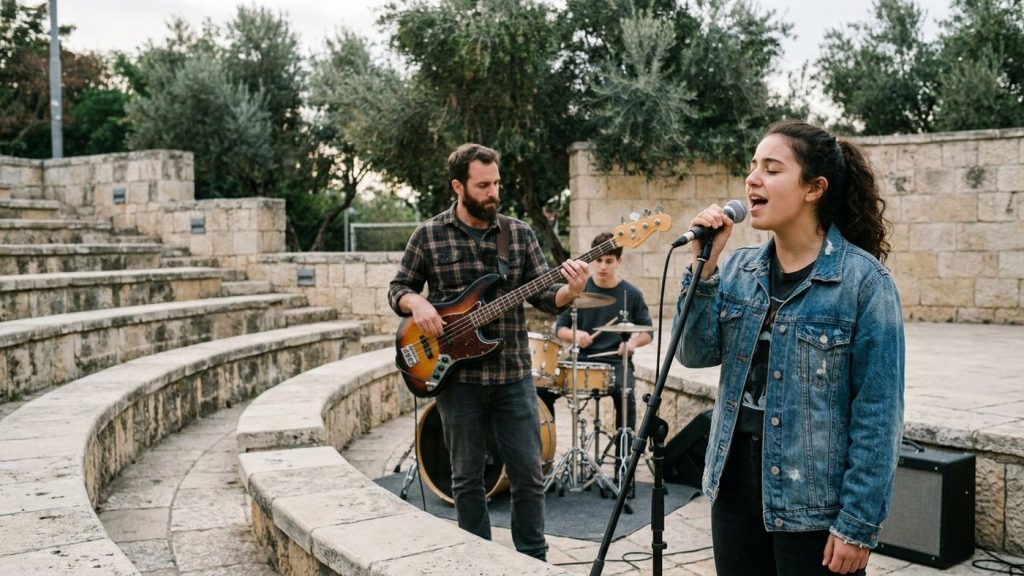
A band can play ten songs well and still walk off stage feeling that something did not land. The crowd drifted in the middle, the singer had nothing left for the last song, and there were long silences between numbers while someone retuned or hunted for a capo. Most of the time the problem is not the playing. It is the order. A good set list is the arrangement of the whole show: it decides when the energy rises, when the audience gets to breathe, and how each song sets up the next.
This guide walks through how to build a set list step by step, for teen and adult bands in North Tel Aviv: from a group of high schoolers in North Afeka getting ready for their first gig to a band of adults from New Ramat Aviv playing a private party. In our bands and ensembles program in North Tel Aviv we build the set with the band from the first rehearsals, because the order changes how you rehearse.
How to build a set list: three questions before you pick songs
Before a single title goes on the page, answer three questions together:
- How much time do you really have? Not “about half an hour”, but the minutes from walking on to walking off, including talking and changeovers.
- Who is the audience and what do they know? A school event, a birthday, an open mic night or a party each needs a different balance of familiar covers and originals.
- What is the goal of the show? Dancing, listening, showcasing your own songs, or simply enjoying a first time on stage. The goal settles it whenever you are torn between two songs.
Do the maths
A pop or rock song usually runs three to four and a half minutes. Add thirty seconds to a minute for each changeover: applause, a line to the crowd, a guitar swap. A 30-minute set therefore holds seven or eight songs, not ten.
| Set length | Songs to plan | Note |
|---|---|---|
| 15 minutes | 3 to 4 | Open mic or opening slot: an opener, a middle song and a closer |
| 30 minutes | 7 to 8 | Room for one quiet moment and one clear peak |
| 45 minutes | 10 to 12 | Plan two waves of energy |
| 60 minutes | 13 to 16 | Prepare a spare song and an encore |
The shape: opener, waves and a peak
The simplest way to think about a set is as one long song. It has an opening that grabs people, a middle with rises and dips, and a peak before the end. The same sense of dynamics we cover in our golden rules for playing in a band works at the level of the whole show.
The opener
Your first song should be one everybody plays with total confidence, at a medium to fast tempo, with a clear and fairly short intro. It does not have to be your best song; it has to be your steadiest. Pick something your hands know by heart. Avoid opening with a quiet ballad or a song that starts with an exposed solo.
Songs two and three
Once the room is with you, the second song keeps the energy up and shows another side of the band: a different groove, a different singer, or a well-known song people recognise from the first note.
The middle: waves, not a flat line
A set of nothing but fast, loud songs wears an audience out just as much as a set of ballads. Plan waves: two or three songs that build, then a deliberate drop, such as an acoustic number, a ballad, or a song with just voice and piano. That quiet moment is what makes the next peak feel big. In a set of 45 minutes or more, plan two of these waves.
The peak and the closer
The last two songs are what people remember. Put your strongest material there, the most familiar, the most danceable or the most moving, and finish with a song that has a clean, rehearsed ending. A ragged ending where everyone stops at a different moment erases part of the impression. If there is an encore, prepare it in advance; never leave it to a song nobody is sure of.
Keys, tempo and transitions
Tempo
Measure the tempo of each song in rehearsal, at the speed you actually play it, with a tap tempo BPM counter, and write it next to the title. Now you can see on paper whether four songs in a row sit around 120 BPM and will blur together. Mix it up: a song at 95, then one at 128, then one at 110 with a different feel. Almost every band rushes on stage, so whoever counts the song in should know the tempo beforehand. If timing is a weak spot, our guide to groove and metronome practice is the place to start.
Keys
Two songs in a row in the same key and the same mid tempo can sound like one long song. On the other hand, jumping straight between distant keys with no break can feel awkward for the singer and the crowd. The practical rule: vary the keys, and use the short gap between songs to reset everyone’s ears. If a song sits too high for your singer, drop it a step without hesitation: a chord transposer does it in seconds, and in our piece on arranging a cover song we explain why the key should suit the singer, not the original record.
Tunings, capos and instrument changes
Every instrument swap, every drop D retune and every capo move takes time, and silence on stage feels three times longer than it is. Group songs that need the same tuning or the same guitar, and schedule each change for a moment when someone else is talking or playing an intro.
Planned transitions
Not every gap needs to be bridged, but two or three rehearsed transitions in a set make a big difference. A few options:
- Straight count-in: the song ends and the drummer counts the next one within two or three seconds.
- A linking note: the keys player or guitarist holds a note or chord that leads into the next intro.
- A groove bridge: drums and bass keep a simple beat going and the next song comes in on top of it.
- A talking moment: one line to the crowd while someone swaps instruments. Decide in advance what gets said and who says it.
Pacing the voice and the players
A set list is not only an experience for the audience; it is also a workload plan. A singer who opens with three high, powerful songs in a row may reach the end of the show exhausted. Spread out the vocally demanding songs and follow each one with something easier, or with a song someone else sings. In our vocal lessons singers also work on pacing their voice across a full show, and if hoarseness keeps coming back or singing hurts, see an ENT doctor or a speech therapist.
The page itself: what goes on the set list
The set list taped to the stage is a working tool, not a pretty document. Large letters, one sheet per player. Next to each song, note:
- The song title, shortened to something everyone understands.
- The key, plus capo position or tuning if needed.
- The tempo in BPM and who counts it in.
- One note for the transition: “straight in”, “talk”, “guitar change”.
- A mark on the song you can cut if time runs out, and a spare song at the bottom.
A three-week plan before the gig
| Week | What you do | Result |
|---|---|---|
| Week 1 | Choose the songs, measure tempo and key for each, write a first order and add up the minutes | A draft set with a real running time |
| Week 2 | Play the set straight through once at every rehearsal, with a clock; practise transitions, intros and endings on their own | You know where the set sags and what to swap |
| Week 3 | Two full mock gigs, standing up, talking included, in front of a friend or two or a phone that films it | A locked set, printed sheets, a spare song ready |
Recording a mock gig is one of the most useful tools there is: watching it back, you hear right away where a run of songs loses energy or a transition drags. An outside eye helps too. In our teen and adult bands the teacher watches the mock gig and gives notes on the order, not only on the playing.
Common mistakes
- Too many songs for the time you have. Fix: count three and a half to four and a half minutes per song plus a changeover, and keep a spare.
- Opening with the new song that is not solid yet. Fix: open with your steadiest song and put the new one in the middle, once the band has warmed up.
- Every song at the same energy. Fix: give each song an energy score from 1 to 5 on the sheet and make sure the numbers rise and fall.
- Long silences between songs. Fix: group tunings, have guitars tuned in advance and rehearse the transitions.
- Changing the order at the last minute. Fix: after the second mock gig the set is locked; only the spare song can change.
- Forgetting the endings. Fix: rehearse the ending of each song on its own, with a clear cue from whoever leads.
How we build set lists at Rockstar in North Tel Aviv
At the Rockstar music school in Ramat Aviv Gimel, our ensembles prepare for a show the way a real band does: they choose songs that suit the players and the singer, build the order together with the teacher, and rehearse the set from start to finish, not just song by song. Our teachers are working musicians who perform themselves, so they know first-hand the moments where a set takes off or falls flat. Many band members also keep up a private lesson on their instrument, for example drum lessons that help the drummer lead the count-ins and transitions. If you would like to try it, book a free intro session with a band with no commitment.
Frequently asked questions
How many songs should we prepare for a first gig?
It depends on the slot. For 15 to 20 minutes, four or five well-rehearsed songs plus one spare are plenty. Fewer songs you are sure of beat a long list where half of it is not ready.
Should we include originals in a covers set?
Yes, in moderation. One or two originals in the middle of the set, after the audience has connected with you, get a better hearing than at the start.
What if we run out of time mid-set?
That is why you mark a song you can cut in advance. If you are told to wrap up, skip it and go straight to your last two songs, so the peak and the closer survive.
Who should talk to the audience between songs?
Usually the singer, but it does not have to be. What matters more is that it is decided in advance and kept short. Long chat drains the energy you built.
Are there teen and adult bands near North Afeka?
The Rockstar music school is in Ramat Aviv Gimel, a few minutes’ drive from Afeka, Neve Avivim and Yisgav. High schoolers, students and adults come to us from all over North Tel Aviv. Private instrument lessons are also available at home through Rockstar Home, subject to teacher availability. Read more about music lessons in Afeka.
Read also: How to Prepare for a Successful Live Performance: The Complete Guide
Bands and ensembles · All lessons · Contact us · Book a free intro lesson