Put on the intro to Little Wing and try to decide: is that rhythm guitar or a solo? It is both. Jimi Hendrix never split the guitar into “chords” and “notes”. He played a chord shape, decorated it with two notes from the pentatonic scale, slid into a double stop, dropped back to a bass note with his thumb – all in one motion of the hand. Students who try to learn him only from the loud solos miss the real lesson: Hendrix’s genius starts with his rhythm playing.
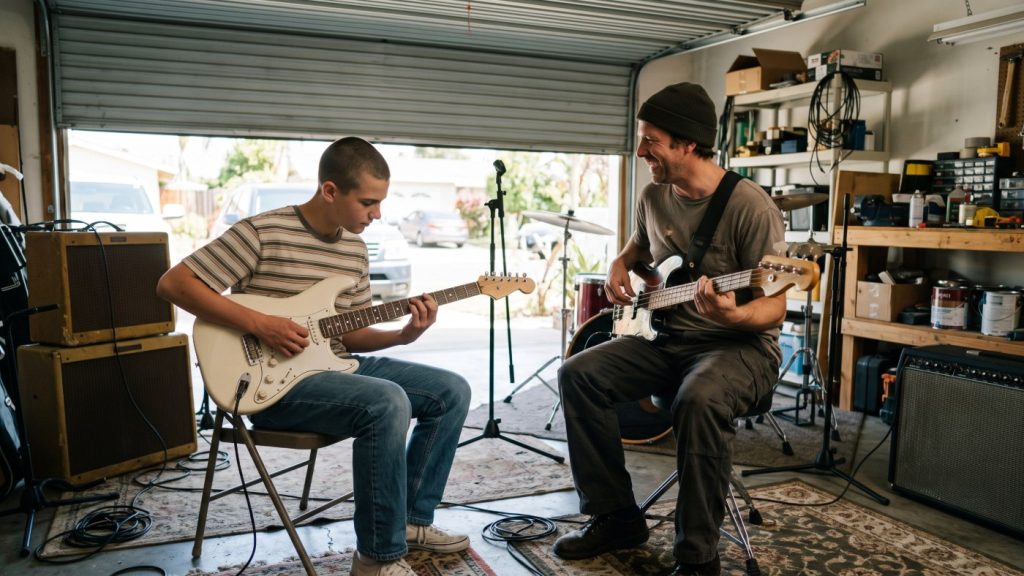
This guide is written for the high-schoolers in Neve Avivim who already know a handful of chords and want to sound like real guitarists, and for the adults in Green Ramat Aviv and North Afeka who grew up on these records and are coming back to the instrument. In our guitar lessons in North Tel Aviv, Hendrix’s style is one of the best bridges between chords and soloing – so let’s break it down into exercises you can start today.
Hendrix the guitarist: why he is still worth studying
Jimi Hendrix recorded most of his music in about four years, between 1966 and 1970, first with The Jimi Hendrix Experience (Noel Redding on bass, Mitch Mitchell on drums) and later with Band of Gypsys. Before that he spent years as a sideman in R&B and soul bands, where he absorbed the rhythm style of players like Curtis Mayfield: small chord shapes on the top strings, full of embellishments.
That is why his playing blends three worlds:
- Soul and R&B rhythm – partial chords with hammer-ons and slides inside the shape.
- Blues – the minor pentatonic scale, deep bends and a wide vibrato.
- Sound and effects – loud amps, fuzz, wah and controlled feedback that became part of the vocabulary.
For a student today this means something practical: Hendrix teaches you to sound complete on your own. In a three-piece – guitar, bass and drums – there was no keyboard to fill the gaps, so the guitar had to be the accompaniment and the lead voice at the same time.
Gear and signal chain: what is actually documented
There is a lot of mythology around Hendrix’s rig, so let’s stick to what is well established:
| Part of the rig | What he used | What it does to the sound |
|---|---|---|
| Guitar | A right-handed Fender Stratocaster, flipped over and restrung to play left-handed | Controls and selector end up on top and the bridge pickup is slanted the opposite way – details that give a slightly different voice from a standard Strat |
| Amps | 100-watt Marshall amplifiers, played loud | Natural amp distortion, sustain and feedback |
| Fuzz | Dallas Arbiter Fuzz Face | A thick, raw tone that cleans up as you roll back the guitar’s volume |
| Wah | Vox wah pedal | The “talking” sound of Voodoo Child (Slight Return) |
| Other effects | Uni-Vibe, and the Octavia built by Roger Mayer | A swirling, pulsing texture and a high octave-up tone |
One more detail that matters in practice: Hendrix often tuned down a half step (Eb). If you play along with a record and something sounds off, that is probably why. And the most important point: a huge part of his sound came from his hands, not his pedals. Play the exercises below on a completely clean tone and they will still sound like Hendrix.
Technique 1: the thumb over the neck
Hendrix was known for fretting bass notes on the low E string with his thumb wrapped over the top of the neck. That frees all four fingers to decorate the top strings while the bass note keeps ringing. A classical teacher would call it bad technique; in rock, blues and soul it is completely legitimate.
Exercise: thumb-over G with embellishments
- Thumb on the low E string, 3rd fret (G).
- Ring finger on the D string, 5th fret (G, an octave up).
- Middle finger on the G string, 4th fret, and index on the B string, 3rd fret – together a compact G major chord.
- Without moving the thumb, hammer on the B string from fret 3 to 5, then slide on the G string from fret 2 up to 4.
Start at 60 BPM, one strum per beat, and only move to 70 and 80 once the chord and the embellishment are both clean. If your thumb doesn’t reach, that’s fine – skip the bass note at first and play only the top strings, or use a regular barre shape. If barre chords still fight you, we have a full guide to barre chords and the F chord.
Technique 2: embellished rhythm – the heart of the style
This is the part most guitarists skip, and it matters most. In songs like Little Wing, The Wind Cries Mary and Castles Made of Sand, Hendrix isn’t “strumming chords”. He holds a chord shape and adds notes from the pentatonic scale around it.
Exercise: sus2 and sus4 on a D chord
- Play an open D (xx0232).
- Lift your middle finger off the high E string: that’s Dsus2 (xx0230). Put it back with a hammer-on.
- Add your pinky on the high E string, 3rd fret: Dsus4 (xx0233). Remove it with a pull-off.
- Combine: D – sus2 – D – sus4 – D in eighth notes at 70 BPM.
The same idea works on A, C and G. The goal is for every embellishment to come out of the chord without letting go of it. Once that feels natural, start changing chords while you do it – exactly where one-to-one guitar lessons with a working guitarist save a lot of time, because a teacher can see instantly whether your fingers are jumping off the neck or staying close to the frets.
Exercise: double stops on the G and B strings
Hendrix loved pairs of notes sliding together. In E minor pentatonic, play the G and B strings together at frets 2–3, 4–5 and 7–8, and slide between the pairs. Play them in quarter notes at 70 BPM, then drop an open Em chord between them. That is the sound of rhythm turning into a solo.
Technique 3: the “Hendrix chord” – 7#9
E7#9 earned the nickname “the Hendrix chord” through Purple Haze and Foxy Lady. It combines a major third with a raised ninth that sounds like a minor third – and the tension between the two is pure blues.
- Fingering: open low E, middle finger on the A string at fret 7, index on the D string at fret 6, ring finger on the G string at fret 7, pinky on the B string at fret 8. Mute the high E.
- In tab shorthand: 0-7-6-7-8-x.
- Drill: short, muted stabs at 80 BPM, then move the same shape (without the open E) to other frets.
You can explore more 7th and 9th chord shapes in the site’s free guitar chord chart.
Technique 4: soloing with pentatonics, bends and vibrato
Hendrix’s solos are built mostly on the minor pentatonic scale with blues additions. What makes them special is how the notes are played: deep bends, a wide vibrato and a quick return to rhythm. If you want to go deeper on bending and vibrato themselves, we wrote a separate guide: blues bends and vibrato, the B.B. King and Clapton way.
- Work in the first box of E minor pentatonic (frets 12–15, or 0–3).
- Bend a whole step on the G string at fret 14 – check that it reaches the pitch of fret 16.
- Play a four-note phrase, go back to an Em chord for two beats, and repeat. This is the single most useful drill: soloing without losing the groove.
Anyone who plays in a band feels this immediately: in a trio, the guitar never “disappears”. Practise it with the school’s jam and backing tracks, which include blues and rock at several tempos.
Common mistakes when trying to play like Hendrix
- Starting with fuzz and volume. With heavy distortion every mistake gets buried. Practise clean first; add gain only when the embellishments sound good.
- Playing too fast. His fills sound quick but sit on a relaxed groove. Use a metronome and slow tempos.
- Neglecting rhythm. Most of a song is accompaniment. If you only learn solos, you won’t be able to play a whole song.
- Forcing the thumb. If your thumb hurts or your wrist bends sharply, go back to a normal shape. Technique should feel comfortable.
- Ignoring the tuning. When playing along with the recordings, tune down a half step or use a pitch-adjusted version.
What to listen to: songs to learn from
| Song | What to listen for | Level |
|---|---|---|
| The Wind Cries Mary | Embellished chords and moving between shapes | Beginner–intermediate |
| Little Wing | Rhythm and lead woven together, thumb and double stops | Intermediate |
| Castles Made of Sand | Hammer-ons inside chords, clean tone | Intermediate |
| Purple Haze | The 7#9 chord and the riff | Beginner–intermediate |
| Hey Joe | A cycling chord progression and moves on the low strings | Beginner–intermediate |
| Voodoo Child (Slight Return) | Wah, pentatonics and bends | Advanced |
A 4-week practice plan
| Week | Focus (15–20 minutes a day) | Goal |
|---|---|---|
| 1 | sus2/sus4 on D, A and G; thumb-over G shape at 60 BPM | Clean embellishments without leaving the chord |
| 2 | Double stops on the G and B strings; E7#9 stabs | Smooth moves between Em and double stops at 70 BPM |
| 3 | E minor pentatonic, whole-step bends, a 4-note phrase and back to rhythm | Two rounds of “phrase – chord” without stopping |
| 4 | One song from the table, first clean, then with a little drive | Play a verse and chorus along with the record |
Once Hendrix’s approach sits in your hands, it is worth exploring the opposite philosophy – fewer fills, more air. That is exactly where we pick up with Nile Rodgers and funk rhythm guitar, which grew out of the same R&B world.
Learning Hendrix-style guitar in North Tel Aviv
At Rockstar music school in Ramat Aviv Gimel we teach Hendrix’s style the way it actually works: through songs. We start with embellished chords, move on to the thumb and double stops, and only then build solos. Our students come from New Ramat Aviv, Azorei Chen and across North Tel Aviv – many of them teens who want to play in a band. If you want to understand how guitar, bass and drums locked together in Hendrix’s trio, the natural next step is the school’s bands and ensembles programme.
FAQ
Can beginners learn Hendrix’s style?
Yes, in stages. sus2 and sus4 moves on open chords are realistic after a few months of playing. The thumb technique, bends and fast solos come later.
Do I need a Stratocaster to sound like Hendrix?
No. A Strat helps you get closer to the tone, but the embellishments, phrasing and vibrato work on any guitar, acoustic included.
My thumb doesn’t reach the low E string. What should I do?
That depends on your hand and the guitar’s neck. Play only the top strings or use a barre shape – musically, the result is almost identical.
How long does it take to play Little Wing?
It varies a lot between students. A simplified version of the intro is within reach for an intermediate player after a few weeks of steady practice; the full version with every embellishment takes longer.
Where can I take electric guitar lessons in North Tel Aviv?
At Rockstar music school in Ramat Aviv Gimel, a short drive from Neve Avivim, Green Ramat Aviv, North Afeka and Azorei Chen. Rockstar Home lessons at your place are also available, subject to teacher availability in your area. Read more about music lessons in Green Ramat Aviv, or book a free electric guitar intro lesson with no commitment.
Read also: Guitar Effects: The 6 Effects Every Guitarist Should Know
Guitar lessons · All lessons · Contact us · Book a free intro lesson