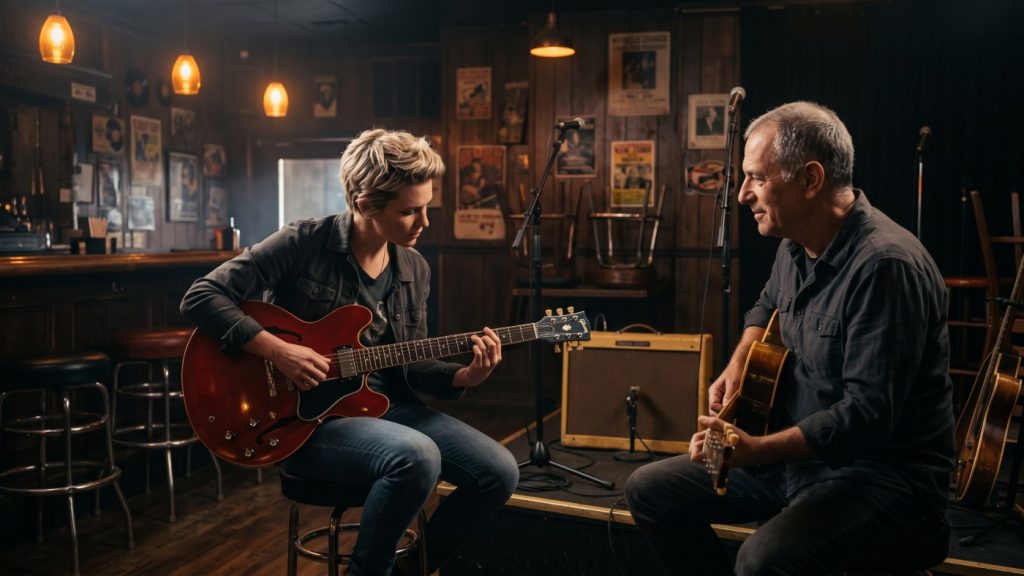
Give two guitarists the exact same note – an A on the B string, 10th fret. From one it sounds like an exercise. From the other it sounds like someone saying something. The difference isn’t the note; it’s what happens after the pick hits it: how the string is bent, how it shakes and how it is let go. B.B. King and Eric Clapton built entire careers on that question, and it is the right place to start playing the blues.
This guide is for guitarists in North Tel Aviv who already know the pentatonic scale but feel their solos are “correct but silent” – high-schoolers from Bavli and Tzukei Aviv, university students, and adults in Ramat HaHayal who have picked the guitar up again. In our guitar lessons for teens and adults we hear it all the time: the notes are there, the bends and vibrato are missing. Let’s turn both into precise technique and drills.
Two great teachers, two approaches
B.B. King: fewer notes, more meaning
For decades B.B. King played semi-hollow Gibsons such as the ES-355 and its relatives, and called his guitar Lucille. He rarely played chords on stage. Instead, his guitar answers his voice: he sings a line and Lucille replies with a short phrase. His vibrato is fast and comes from the wrist, often with the thumb off the neck entirely. The live album Live at the Regal is one of the best lessons in blues phrasing ever recorded.
Eric Clapton: power, sustain and tone
Clapton learned from the bluesmen – B.B. King, Freddie King, Albert King and Robert Johnson – and carried that language into British rock. In 1966, on the John Mayall & the Bluesbreakers album nicknamed “Beano”, he played a Gibson Les Paul through a loud Marshall combo and set a tone that shaped a generation. In the Cream years he developed what became known as the “woman tone”: neck pickup, tone knob rolled almost all the way down, amp turned up – round, singing and smooth. Later he became associated with a black Stratocaster nicknamed “Blackie”, assembled from parts of several 1950s Strats.
In 2000 the two recorded Riding with the King together – a great way to hear both approaches side by side.
Bends: don’t “pull the string”, reach the note
A bend raises the pitch by pushing or pulling the string across the fretboard. The number-one mistake is bending “roughly”. A bend that doesn’t reach the exact pitch simply sounds out of tune.
Correct technique
- Three fingers on the string. When bending with the ring finger, the middle and index sit behind it on the same string and push together.
- Power from rotation. The wrist turns like a key in a lock; the fingers barely curl. The thumb hooks over the top of the neck and acts as a pivot.
- Mute the neighbours. Your picking hand and the side of your fretting hand keep the other strings quiet, or the bend will drag noise along with it.
Drill: the target note – hear it before you bend
- In A minor pentatonic (first box, 5th fret), play the G string at fret 9 (E). That’s your target.
- Now play the G string at fret 7 (D) and bend a whole step until it matches what you just heard.
- Repeat: target – bend – target – bend. Ten times, slowly, at 60 BPM, four beats per note.
- Check yourself with the free online guitar tuner: the needle should land on E, not “near” it.
Repeat on the B string, from fret 8 (G) up to the pitch of fret 10 (A). The B string is easier to bend, which is exactly why players tend to overshoot it.
Four bends every blues guitarist needs
| Type | How | Where to hear it |
|---|---|---|
| Standard bend (whole step) | Pick, then bend to the target pitch | Almost every B.B. King solo |
| Bend and release | Bend, hold, then lower slowly back to the original note | Clapton’s Cream-era solos |
| Pre-bend | Bend before you pick, then pick and release – the note “falls” | Slow, ballad-like phrases |
| Curl (quarter tone) | A tiny bend of the minor third toward the major third | The “blue” colour of the blues |
Heavy strings and high action turn every bend into a fight. If that sounds familiar, read our guide to guitar setup – sometimes a lighter set of strings changes everything.
Vibrato: your personal signature
Vibrato is a small, repeated movement in pitch. You can recognise B.B. King from a single note because of his vibrato, and the same goes for Clapton. Vibrato has two settings: width (how far the pitch moves) and speed (how many cycles per second).
Drill: measured vibrato
- B string, 10th fret, ring finger, with support fingers behind.
- Metronome at 60 BPM. One cycle per beat (quarter notes) for 8 beats, then two per beat (eighths), then three (triplets).
- Keep the width steady at about a half step. Bending vibrato only raises the pitch and comes back, so every cycle should return exactly to the original note rather than hanging above it.
- Then: vibrato on a bend. Bend a whole step and, without releasing, let the string dip slightly and come back up. It’s the hardest of all and worth every minute.
This is exactly where a guitar teacher in North Tel Aviv who plays right in front of you makes a difference: a vibrato that “shivers” instead of “sings” usually comes from a squeezing thumb or fingers that curl instead of the hand rotating, and a teacher sees it in a second.
Phrasing: think like a singer
Both B.B. King and Clapton play in sentences, not streams of notes. Three tools you can use straight away:
- Question and answer. Play a short phrase that ends on an “open” note (the fourth, say), then a phrase that lands on the root.
- Room to breathe. After each phrase, at least one beat of silence. Singers have to breathe; blues guitarists copy them.
- The “B.B. box”. A small zone just above the first pentatonic box. In A: the B string at frets 10 (A, the root), 12 and 13, the high E at frets 10 and 12, and the G string at fret 11. Here B.B. mixes the major sixth with the minor third and bends the B string at fret 12 up a whole step. Try a whole solo using only this area.
Singers get a double benefit: singing a phrase before you play it trains your ear, which is why plenty of students combine guitar with singing lessons. And if you want to hear how another guitarist turned the blues into wild, embellished rock, read about Jimi Hendrix’s guitar style.
Common mistakes
- Out-of-tune bends. “Roughly there” is the biggest problem. Always start from a target note.
- Fast, nervous vibrato. Good vibrato is controlled. Start slowly, with a metronome.
- Bending with one finger. Painful, unstable and inaccurate. Always use two or three.
- Too many notes. A few notes with great bends and vibrato reach an audience more than a fast run.
- Practising without a backing. A bend sounds right or wrong only against harmony. Practise over a 12-bar blues.
What to listen to
- The Thrill Is Gone – B.B. King: short phrases, vibrato and silence.
- Every Day I Have the Blues and Sweet Little Angel – B.B. King, the Live at the Regal versions.
- Hideaway – Clapton with the Bluesbreakers (originally by Freddie King).
- Crossroads – Cream live (originally by Robert Johnson).
- Have You Ever Loved a Woman and Old Love – Clapton playing slow blues.
- Riding with the King – the two of them together.
And if you’d like to hear the same kind of bends played with no pick at all, carry on to Mark Knopfler’s fingerpicked lead style.
A 4-week practice plan
| Week | Focus (15–20 minutes a day) | Goal |
|---|---|---|
| 1 | Target-note bends on the G and B strings at 60 BPM, checked with a tuner | 8 of 10 bends hit the pitch |
| 2 | Measured vibrato in quarters, eighths and triplets; bend and release | Even vibrato at 60 and 80 BPM |
| 3 | Pre-bends, curls and vibrato on a bend; the B.B. box | A 12-bar solo using only the box |
| 4 | Question and answer over a 12-bar blues, with silence after each phrase | Two choruses of a solo that “talks” |
For a real backing, the school’s jam backing tracks include blues at several tempos. To train the ear that tells you whether a bend arrived, try the ear and rhythm trainer.
Blues guitar in North Tel Aviv: how we teach it
At Rockstar music school in Ramat Aviv Gimel, bends and vibrato aren’t an “advanced only” topic. In the first months we teach one accurate bend and build a short solo from it over a real blues. Our teachers are working musicians who play alongside the student, so the ear keeps comparing. Students join us from South Afeka, Kokhav HaTzafon, Revivim and all over North Tel Aviv. If you want to start in an organised way, book a free blues guitar intro lesson with no commitment.
FAQ
How long does it take to learn accurate bends?
For most students who practise a few minutes a day, a whole-step bend that hits the pitch most of the time arrives within a few weeks. A steady, personal vibrato is a project of months – really, a lifetime.
Can you bend on an acoustic guitar?
Yes, but with less range. Acoustic strings are heavier, so start with half steps and curls. On an electric, a whole step is much easier.
Do I need a Les Paul or a Strat to sound like Clapton?
No. His sound rests on his hands – bends, vibrato and dynamics. Any decent electric and an amp with a little overdrive are enough to learn the language.
My fingers hurt from bending. Is that normal?
Tender fingertips are normal at first. Pain in the wrist or joints is a sign to check your technique and string gauge; if it persists, see a doctor or physiotherapist.
Where can I learn blues guitar near Bavli or Ramat HaHayal?
At Rockstar music school in Ramat Aviv Gimel, a short drive from Bavli, Tzukei Aviv and Ramat HaHayal. Rockstar Home lessons are also available, subject to teacher availability in your area. See our page on music lessons across North Tel Aviv.
Read also: The Secret to Tuning a Guitar Easily
Guitar lessons · All lessons · Contact us · Book a free intro lesson