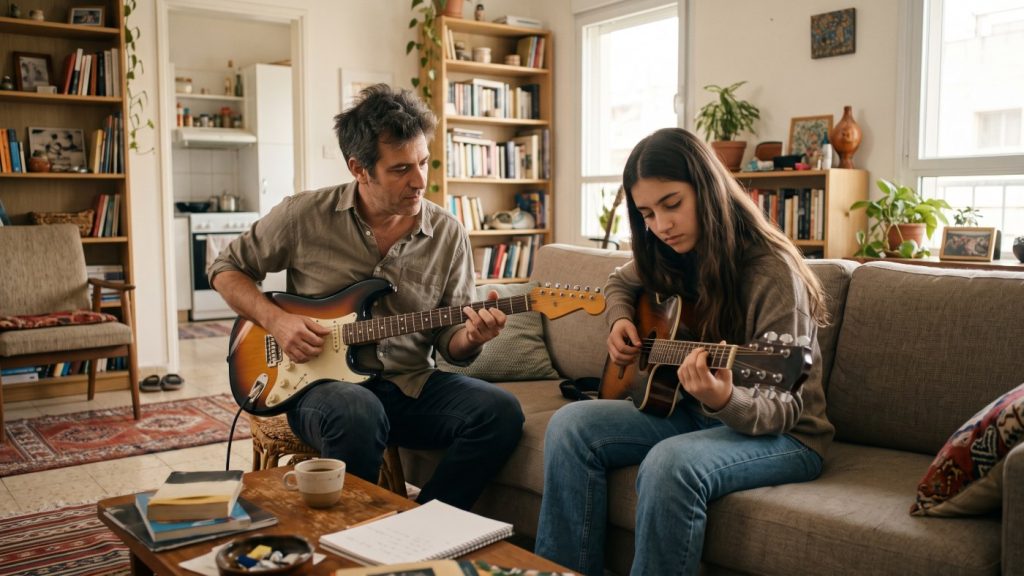
Most guitarists learn to solo with a pick in hand. Mark Knopfler, the guitarist and singer of Dire Straits, went another way: he plays almost everything with his fingers. The result is a sound you can’t mistake – notes that feel plucked rather than struck, dynamics that change from one note to the next, and little chords and bass notes appearing in the middle of a solo. Listening to Sultans of Swing, it’s hard to believe there’s no pick involved at all.
This guide is for guitarists in North Tel Aviv looking for a more personal sound: teens in Neot Afeka A and Tzahala who already play with a pick and want to stretch, and adults in Ganei Tzahala and Tel Baruch who love guitar that sings rather than shouts. In our guitar lessons in North Tel Aviv we meet plenty of students for whom Knopfler’s technique opens a new door – even if they keep using a pick most of the time.
What makes Knopfler’s playing special
Dire Straits broke through at the end of the 1970s with Sultans of Swing and in the 1980s became one of the biggest bands in the world with the album Brothers in Arms. Throughout, Knopfler’s playing rested on a few principles:
- Fingers instead of a pick. Mainly thumb, index and middle, each adding a different colour.
- Dynamics on every note. Without a pick it’s easy to control volume – one note loud, the next almost a whisper.
- Short, melodic licks between the vocal lines, instead of a long solo that takes over.
- Chords and single notes mixed together, the way country and classical players do it.
Knopfler was influenced by fingerstyle players such as Chet Atkins, and in 1990 the two recorded the album Neck and Neck together.
The gear: what’s documented and useful
| Song or era | Guitar | What to notice |
|---|---|---|
| Sultans of Swing and the early years | Fender Stratocaster | The hollow, “in-between” sound of the pickup selector’s middle positions |
| Money for Nothing | Gibson Les Paul with a wah pedal left in one fixed position | The wah works as a tone filter, not a “talking” effect |
| Romeo and Juliet | A National resonator guitar | A metallic, lively tone that suits fingerpicking |
| Private Investigations | A classical nylon-string guitar | Delicate fingerstyle and lots of room for silence |
On a modern Strat with a five-way switch, the in-between sounds are positions 2 and 4. But as with most of the greats, the tone comes from the hands first. If your guitar is hard to play, with strings sitting too high, fingerstyle will feel exhausting – check the setup before you blame your fingers.
Technique 1: dividing the work between your fingers
There’s no single law in Knopfler-style fingerpicking, but this framework helps a lot when starting out:
- Thumb (p): strings 6, 5 and 4 – bass and low notes, with a downward stroke.
- Index (i): mostly the G and B strings.
- Middle (m): mostly the B and high E strings.
Let your hand hover over the strings with the wrist slightly lowered. The pinky or ring finger can rest lightly on the guitar body for support – without pressing.
Drill: p-i-m on an open chord
- Hold an Am chord (x02210).
- Thumb on the A string, index on the G string, middle on the B string. Play p-i-m-i as continuous eighth notes.
- Metronome at 60 BPM. When it’s clean three times in a row, move to 70, then 80.
- Switch to C, then G – same pattern.
If the chord change is what trips you up, go back to the drills in our guide on switching guitar chords fast and smoothly, then come back here.
Technique 2: the pinch and dynamics
A “pinch” is when the thumb and another finger pluck at exactly the same moment – bass and melody together. It’s the basis of the full fingerstyle sound.
- Hold an open Em. Thumb on the low E and middle on the high E together on beat one, then index on G and middle on B.
- Now add dynamics: beat one loud, the rest very soft. The difference should be obvious.
- The “whisper and shout” drill: the same note on the B string four times soft, four times loud, without touching the amp.
Dynamics are what give Knopfler’s playing its “talking” character. A pick can do it too, but with fingers it is far more natural.
Technique 3: the flick and the snap
Part of the secret is how the fingers meet the string. Two moves to practise:
- The index flick: instead of pulling the string toward your palm, flick the index finger outward so the nail meets the string – almost like a tiny pick. Try it on the G string in quarter notes at 70 BPM.
- The snap: pull the string slightly away from the guitar and let go so it slaps against the frets. Sharp and percussive – save it for the important notes in a phrase.
This is where a fingerstyle guitar teacher saves you a lot of time: a small change in wrist angle or a nail that’s too long completely changes the sound, and an experienced eye spots it straight away.
Technique 4: Sultans-style triplets
Some of the best-known fills in Sultans of Swing are built on fast triplet arpeggios on the top strings, over the verse progression Dm – C – Bb – A. That makes a great drill without copying the solo:
| Chord | G – B – high E strings (frets) |
|---|---|
| Dm | 2 – 3 – 1 |
| C | 0 – 1 – 0 |
| Bb | 3 – 3 – 1 |
| A | 2 – 2 – 0 |
- Play each chord as a triplet: index on G, middle on B, ring (or middle again) on high E. The thumb touches a bass note on beat one.
- Metronome at 60 BPM, one triplet per beat. Add 5 BPM every two days – only when all three notes are equal in volume.
- Then play the triplets top-down (E – B – G), like a descending fill.
Keep an online metronome running the whole time: in fingerstyle it’s very easy to rush the strong notes and drag the soft ones.
Licks between the lines: play like a singer-guitarist
Knopfler is also Dire Straits’ singer, and most of his licks slip into the gaps between vocal lines – like a short reply to the line you just heard. It’s a great exercise even if you don’t sing at all. Pick a song you love and play the verse chords with a simple fingerstyle pattern. Each time the singer’s line ends, there is usually a bar or two of “empty” space. That’s where a short lick of three to five notes from the pentatonic scale or the chord goes in – then straight back to the accompaniment. The rules: the lick never steps on the vocal, it ends on a note from the next chord, and the accompaniment never stops. Practise this for a few weeks and the line between “rhythm” and “lead” simply disappears.
Common mistakes
- A tense picking hand. A tight wrist makes a stiff sound and tires you out. Check every few minutes that your shoulder and hand are loose.
- Every finger at the same volume. The thumb is usually stronger. Balance it, or use it deliberately to bring out the bass.
- Untidy nails. A broken or overly long nail is audible immediately. Keep them short and smooth, about level with the fingertip.
- Speeding up before it’s even. Uneven triplets sound messy. Speed comes last.
- Abandoning the pick completely. No need. Many guitarists combine both: pick for driving rhythm, fingers for licks and ballads.
What to listen to
- Sultans of Swing – triplets, licks between the lines and Strat tone.
- Romeo and Juliet – fingerpicking on a resonator.
- Brothers in Arms – a slow solo with lots of space and sustain.
- Private Investigations – classical guitar and extreme dynamics.
- Telegraph Road – a long song that builds its solo over time.
- Going Home: Theme of Local Hero – an instrumental melody.
Knopfler’s melody-first approach is close to David Gilmour’s, and we’ve written a full guide to soloing like David Gilmour. For a guitarist who blended rhythm and lead in a wilder way, compare with Jimi Hendrix.
A 4-week practice plan
| Week | Focus (15–20 minutes a day) | Goal |
|---|---|---|
| 1 | p-i-m-i on Am, C and G at 60–70 BPM; relaxation checks | An even pattern and a quiet hand |
| 2 | Pinches on Em; the whisper-and-shout drill | A clear difference between loud and soft |
| 3 | Flick and snap; triplets on Dm–C–Bb–A at 60 BPM | A full progression in even triplets |
| 4 | Triplets at 70–80 BPM, plus a short lick of your own between the lines of a song | A whole verse with fingerpicked fills |
As with any new technique, a little every day beats a lot once a week. Our smart 20-minute practice routine fits this perfectly.
Learning fingerstyle guitar in North Tel Aviv
At Rockstar music school in Ramat Aviv Gimel, fingerstyle isn’t a separate genre. We bring it into lessons early, even for students who mostly use a pick, because it improves control, dynamics and the ear. Our students come from Neot Afeka B, Ramot Tzahala and across North Tel Aviv. If you sing and want to accompany yourself fingerstyle, combine it with vocal lessons. Ready to start? Book a free guitar intro lesson for teens and adults with no commitment.
FAQ
Do I need long nails to play like Knopfler?
No. Short, tidy nails are enough. Part of the tone comes from the flesh of the finger and part from the nail, so experiment with both.
Can you fingerpick on an electric guitar?
Absolutely – Sultans of Swing is exactly that. Electric strings are lighter and the action lower, so it’s often even more comfortable.
I’ve played with a pick for years. Should I switch?
You don’t have to. We recommend adding fingerstyle as a second skill. Many guitarists use both, depending on the song.
How long does it take to learn the Sultans triplets?
It varies a lot. A slow, clean pattern is realistic after a few weeks of steady practice; the song’s full tempo usually takes longer.
Are there guitar lessons near Neot Afeka and Tzahala?
Yes. Rockstar music school is in Ramat Aviv Gimel, a short drive from Neot Afeka A and B, Tzahala, Ganei Tzahala and Tel Baruch. Rockstar Home lessons are also available, subject to teacher availability in your area. Read more about music lessons in Afeka.
Read also: Guitar Setup: What It Is, Why It Matters and When to Do It
Guitar lessons · All lessons · Contact us · Book a free intro lesson