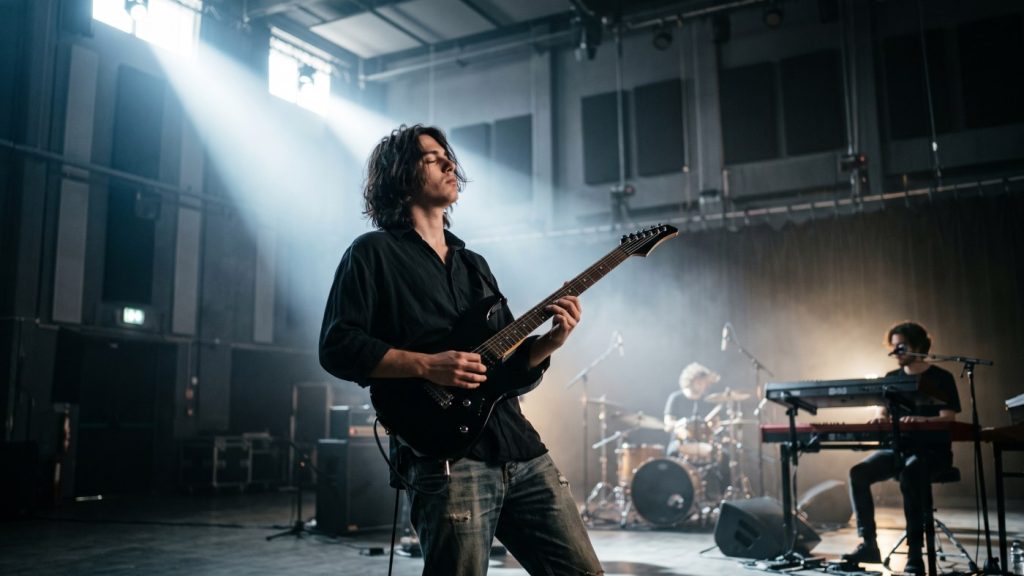
Some solos impress you. Others, people sing. The Comfortably Numb solo is one that people sing – even people who have never held a guitar. David Gilmour doesn’t play the fastest, and he isn’t trying to. He picks a few notes, bends them to exactly the right pitch, lets them breathe and leaves you room to feel something. That may be the most important skill a guitarist can learn, and it is far easier to learn than speed.
This guide is for guitarists in North Tel Aviv who know some basic pentatonic and want their solos to tell a story: high-schoolers from the Old North and Lamed, university students, and adults in Maoz Aviv who grew up with The Dark Side of the Moon. In our electric guitar lessons in North Tel Aviv we bring in Gilmour’s approach early, because it builds the ear, taste and control.
David Gilmour as a guitarist
Gilmour joined Pink Floyd in 1968 and became the band’s guitarist and one of its lead voices. His solos on The Dark Side of the Moon, Wish You Were Here, Animals and The Wall are part of the basic vocabulary of rock guitar. What sets him apart:
- Melody first. A solo sounds like a vocal line, with a beginning, a middle and an end.
- Very precise bends – including step-and-a-half bends and slow bends whose pitch “grows”.
- A slow, wide vibrato that gives every long note a life of its own.
- Space and silence. What he doesn’t play often matters as much as what he does.
- Tone and delay that turn the guitar into part of the song’s atmosphere.
Gear and signal chain – briefly and carefully
Gilmour’s rig has changed a lot over the years, and whole books are written about it. Here is what is well documented and useful to a student:
| Part of the rig | What is known | The lesson for you |
|---|---|---|
| Guitar | A black Fender Stratocaster known as “The Black Strat”, with him since the early 1970s | A clear, defined tone – every note is heard |
| Amps | Hiwatt amplifiers during Pink Floyd’s 1970s peak | Lots of headroom: clean and loud, with the dirt coming from pedals |
| Delay and echo | A Binson Echorec in the early years, various delay units later | Delay is part of the composition, not just an “effect” |
| Fuzz | The Electro-Harmonix Big Muff, associated mainly with the Animals and The Wall era | Long sustain that lets notes sing |
You don’t need any of this to start. An electric guitar, a gentle overdrive and a simple delay are enough. If you’re not sure what each pedal does, start with our guide to the 6 essential guitar effects.
Principle 1: fewer notes, more intent
Drill: the three-note solo
Put on a backing of Bm – A – G (or loop it yourself) at around 65 BPM. You may use only three notes: B, D and F# – the notes of the Bm chord. The rule: every note must get something – a bend, vibrato, a slide or silence after it.
- Round 1: long notes only, each at least two beats, with slow vibrato.
- Round 2: the same notes, but arrive at each one with a bend from a whole step below.
- Round 3: the same notes with a new rhythm – short-short-long.
After five minutes you’ll find you can build a whole, musical solo from them. That’s the point.
Principle 2: bend to chord tones
Gilmour almost always lands a bend on a note that belongs to the chord underneath. That’s why his bends sound right and moving, not just loud. To choose well you need to know what key you’re in and which notes are in the chord; our explainer on major scales and keys sorts exactly that out.
Drill: bend to the root and the fifth
- In B minor pentatonic (first box, 7th fret): B string, fret 10 (A) – bend a whole step to B, the root. Over Bm it sounds like coming home.
- G string, fret 9 (E) – bend a whole step to F#, the fifth of Bm.
- Now a slow bend: count four beats to reach the pitch, then hold for four more with vibrato.
- Bonus: a step-and-a-half bend on the B string from fret 7 (F#) up to A – it needs light strings and good control.
This is where an outside ear really matters. In private guitar lessons a teacher hears instantly if your bend lands slightly flat – something that is very hard to notice while you’re playing. To go deeper on bends and vibrato themselves, read our full guide: blues guitar bends and vibrato from B.B. King and Clapton.
Principle 3: motif, repetition, development
A good solo states an idea and develops it, like a speech. Shine On You Crazy Diamond has a famous four-note motif that Gilmour keeps returning to, and each return sounds a little different.
Drill: four notes, four versions
- Invent a four-note motif from the pentatonic scale.
- Play it as it is.
- Play it again with a different rhythm.
- Play it an octave higher, or starting from a different note.
- End it with a long bend and vibrato.
Together those four versions are already an eight-bar solo with a clear direction.
Principle 4: silence and space within the band
Gilmour plays inside a band with keyboards, bass and drums, and he knows how to wait. A simple drill that is surprisingly hard: two bars of playing, two bars of silence, all the way through the solo. In the silence, listen to the backing and plan your next phrase. If you play in a group, you’ll find this is also what makes you a musician people love to play with – exactly what we work on in the school’s bands and ensembles.
Principle 5: delay as part of the rhythm
On Run Like Hell, for example, the delay is set to a precise rhythm and its repeats complete what the guitar plays. The best-known setting is the dotted eighth (three-quarters of a beat). The formula: 60,000 divided by the BPM gives a quarter note in milliseconds; multiply by 0.75 for a dotted eighth.
| Tempo | Quarter note | Dotted eighth |
|---|---|---|
| 80 BPM | 750 ms | about 563 ms |
| 100 BPM | 600 ms | 450 ms |
| 120 BPM | 500 ms | 375 ms |
| 140 BPM | about 429 ms | about 321 ms |
To find a song’s tempo, tap along with the site’s Tap Tempo BPM counter. Start with one or two repeats and a low mix – if the delay hides your notes, it’s too loud.
How to learn a famous solo without becoming a robot
Learning a famous solo note for note is a great exercise – if you do it right. Instead of racing through the whole thing, pick one phrase of two to four bars. Listen to it ten times before you touch the guitar, and try to sing it. Then find the notes, paying special attention to three things: which note each bend starts on and where it arrives, how long the bend takes, and how the vibrato sounds at the end. Only when the phrase sounds close to the original, move on. At the end of each week, play the phrase you learned “in your own words”: the same idea, but with different notes or somewhere else on the neck. That’s how someone else’s solo becomes your vocabulary.
Common mistakes
- Too much gain. Gilmour’s tone sounds huge, yet every note is clear. Back off the gain until you hear each string.
- Flat bends. A long, slow bend exposes every deviation. Check against a target note.
- Vibrato that’s too fast. Gilmour’s vibrato is slow and wide; fast and nervous sounds completely different.
- Copying note for note without understanding. Learning a whole solo is great, but the goal is to understand why each note was chosen.
- Fear of silence. Silence isn’t a mistake. It’s part of the solo.
What to listen to: a solo map
| Song | What to learn | Level |
|---|---|---|
| Wish You Were Here | Short, vocal phrases on acoustic | Beginner–intermediate |
| Time | Precise bends in F# minor | Intermediate |
| Money | A solo that moves from 7/4 to 4/4 and back | Intermediate–advanced |
| Shine On You Crazy Diamond | Motif, repetition and space | Intermediate |
| Comfortably Numb | Two solos – the first melodic, the second stormy | Advanced |
| Marooned | Instrumental melody and tone | Advanced |
If you’d like to see how another guitarist reaches the same kind of melody with no pick at all, that’s Mark Knopfler’s fingerpicking lead style.
A 4-week practice plan
| Week | Focus (20 minutes a day) | Goal |
|---|---|---|
| 1 | Three-note solo over Bm–A–G, slow vibrato | Two minutes of musical soloing on three notes |
| 2 | Bends to the root and fifth; a slow 4-beat bend | 8 of 10 bends on pitch |
| 3 | A 4-note motif in 4 versions; two bars on, two bars off | An 8-bar solo built on one idea |
| 4 | Dotted-eighth delay, plus a section of a famous solo | Play that section along with the record |
For backing, use the school’s improvisation backing tracks – ballads and slow progressions suit Gilmour’s approach especially well.
Learning melodic soloing in North Tel Aviv
At Rockstar music school in Ramat Aviv Gimel we teach soloing the way you’d teach storytelling: listen first, sing the phrase, then play it. In the first lessons students already build a short solo of their own over a real backing, and later learn sections of the great solos. Our students come from Nofei Yam, Yisgav, New Lamed and all over North Tel Aviv. Ready to start? Book a free lead guitar intro lesson with no commitment.
FAQ
Can a beginner learn the Comfortably Numb solo?
Not all of it. But once you know basic pentatonic and bends, phrases from the first solo are within reach. The second solo needs advanced control.
Do I need a black Strat and a Hiwatt?
Not at all. Any electric guitar with a clear tone, a gentle overdrive and a delay is enough to learn the approach. Most of the sound is in the fingers.
What’s the difference between delay and reverb?
Delay repeats what you played after a set time, like an echo. Reverb simulates a space – a room or a hall. Gilmour uses both, but delay is the one that takes part in the rhythm.
How long does it take to build a melodic solo?
It depends mostly on your ear and listening habits. Most students notice a clear change after a few weeks of working with three notes and motifs.
Where can I take guitar lessons near Lamed or the Old North?
At Rockstar music school in Ramat Aviv Gimel, a short drive from Lamed, New Lamed, Yisgav and the Old North. Rockstar Home lessons at your place are also available, subject to teacher availability. Read more about music lessons in Lamed.
Read also: Home Recording Studio: A Budget Guide to Great Sound
Guitar lessons · All lessons · Contact us · Book a free intro lesson