
ADÉLA’s “Ain’t In LA” sits at number four on Spotify’s weekly global chart after 13 weeks on it, and any guitarist will notice something unusual: four chords, in the same order, from the first bar to the last. No bridge with a new chord, no key change. What it does offer is a crash course in the hardest thing to teach – how one loop becomes a whole song through rhythm, dynamics and the strumming hand. Here are the Ain’t In LA chords, the structure, the strumming, an easier capo version and a seven-day plan.
The short version: E major, 139 BPM, 4/4, built on E, G#m, C#m and A, and with a capo on the 4th fret you play it with C, Em, Am and F shapes. It is exactly the kind of song teens and adults bring to guitar lessons in North Tel Aviv when they want to play something complete in their first week.
Ain’t In LA chords: the song at a glance
| Fact | Value |
|---|---|
| Key | E major |
| Tempo | 139 BPM |
| Time signature | 4/4 |
| Capo | Optional on fret 4, with C, Em, Am and F shapes |
| Difficulty | Easy (1 of 3) |
| Chords | E, G#m, C#m, A |
| Main progression | I–iii–vi–IV, in every section |
You can also open the song in the Rockstar Song Analyzer, which shows the chords, tempo and progression together so you can play along.
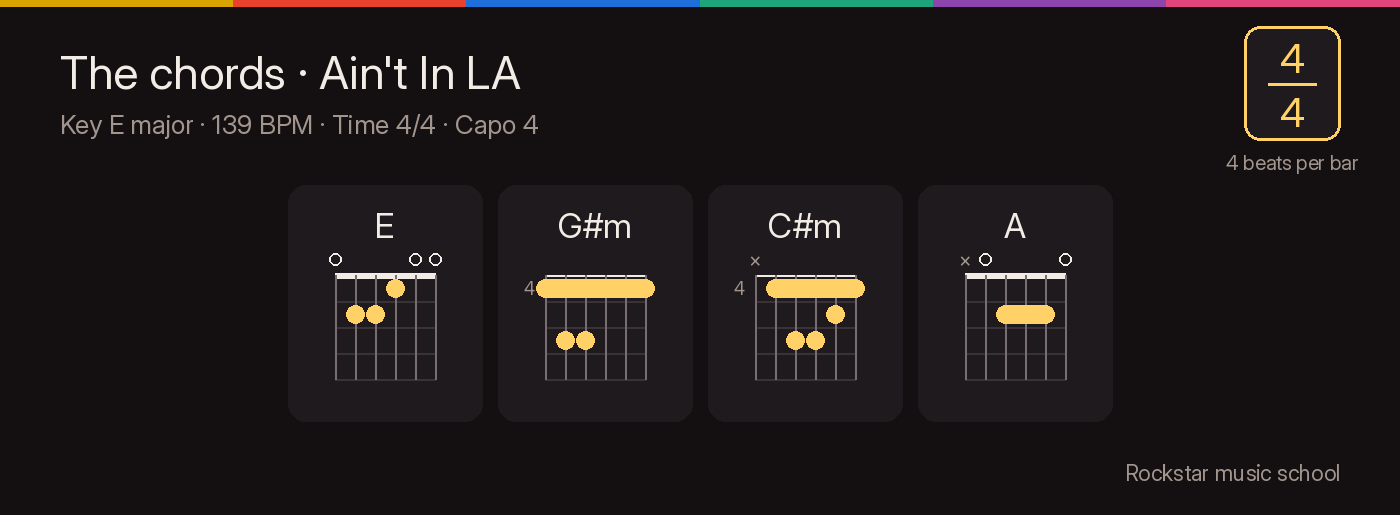
The chords and how to play them
All four chords belong to E major (E, F#, G#, A, B, C#, D#). E is home, the tonic (I); G#m is the third degree (iii), C#m the sixth (vi) and A the fourth (IV). If you know the ubiquitous I–V–vi–IV, you will spot the difference: where you expect B, the fifth, you get G#m. The two share the notes B and D#, so G#m does a similar job without the dominant’s strong pull back to the tonic. The loop keeps turning rather than landing, which is why it can repeat for a whole song without sounding like the end of a sentence.
It also sounds smooth because almost every change keeps common notes: E and G#m share G# and B, G#m and C#m share G#, C#m and A share C# and E. That last step, A to E (IV–I), is the soft “amen” cadence from the endings of hymns, so it does not close the loop firmly either.
The shapes without a capo
- E – open: 022100.
- G#m – Em-shape barre at fret 4: 466444.
- C#m – Am-shape barre at fret 4: x46654.
- A – open: x02220.
The hardest shape is G#m, a full barre at fret 4 where the index finger alone holds the G, B and high E strings. The hardest change is E to G#m: from an open chord near the nut to a barre in two beats. The good news is the next change. G#m and C#m both sit at fret 4, so your index finger stays put, shortening from the sixth string to the fifth while the other fingers regroup beneath it. Feel it as an anchor and half the work is done. If the barre buzzes, our guide on how to play barre chords covers thumb position and finger angle.
A focused drill: one minute of E and G#m back and forth, four metronome clicks per chord, counting your clean changes. Then one minute of G#m and C#m without lifting the index finger. Write both numbers down and beat them each day. The guitar chord chart shows these shapes in other positions too.
The song section by section
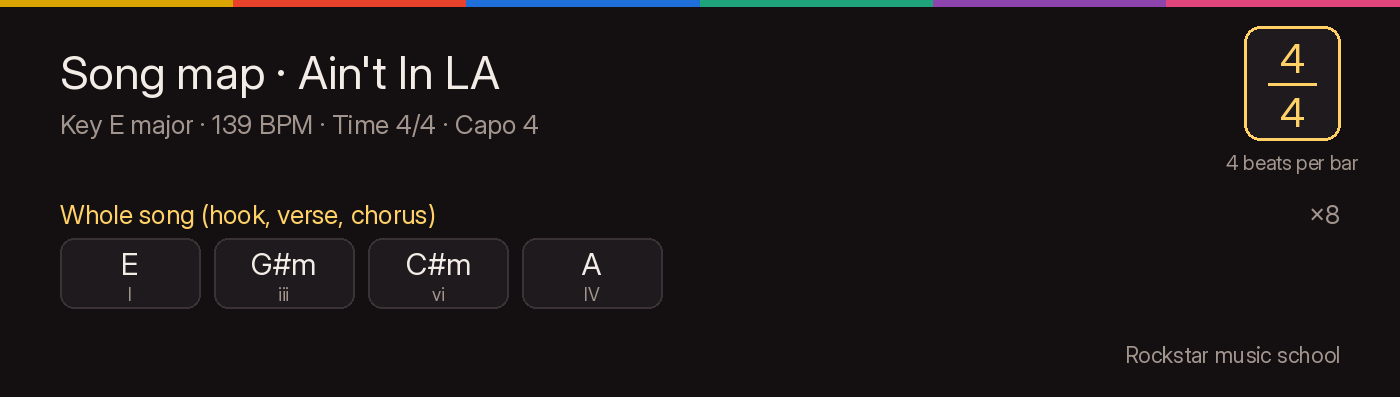
According to the sources we checked, the hook, verse and chorus all run on the same loop – E, G#m, C#m, A – with two chords per bar, so one turn takes two bars. The sources do not give the number of turns per section, so listen with the guitar in your hands and mark where each section starts. The harmony never changes, so the whole difference between sections lives in your strumming hand.
Hook and verse: I–iii–vi–IV, quietly
The verse needs room for the voice. Strum closer to the neck than the soundhole, lightly, with short strokes, so the chords sit underneath. Be precise: every chord changes exactly on beat 1 or beat 3. At 139 BPM a half bar flies by, and being slightly late makes the song run away from you.
Chorus: same progression, full energy
Same four chords, but the hand opens up: over the soundhole, all six strings, the full pattern below. The sources are clear: keep the verse quiet and hit the chorus at full power. One harmony, two energy levels. For extra lift, accent beats 2 and 4 in the chorus, like a snare.
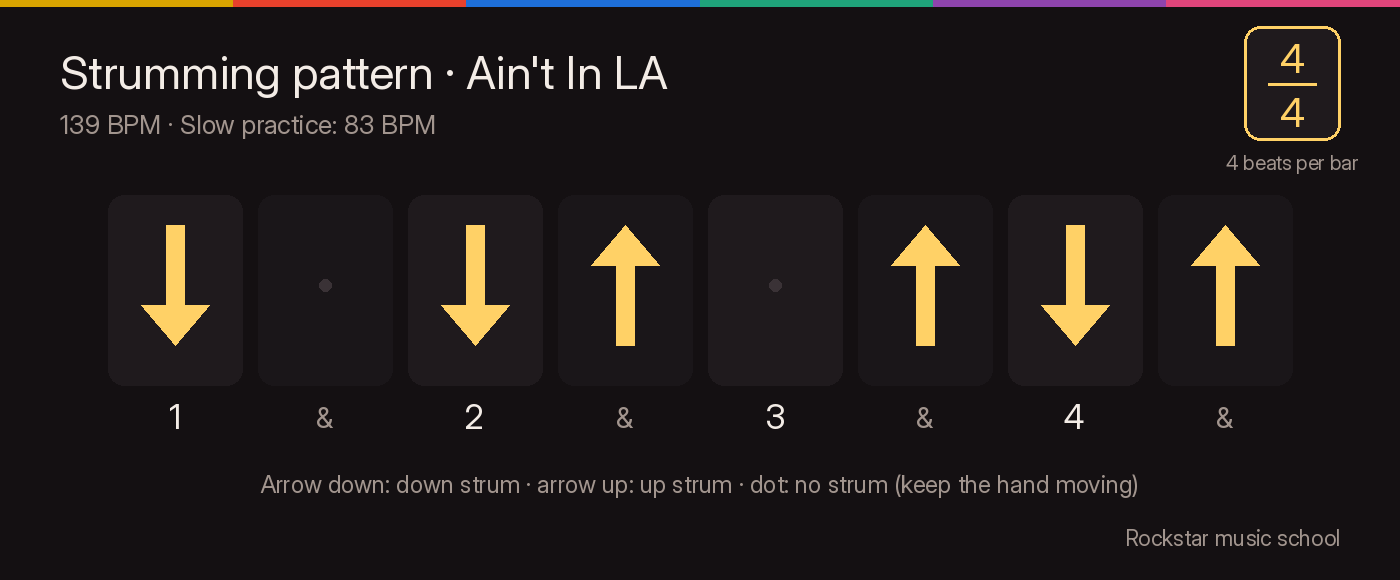
Strumming and groove: D D U U D U
The song is in 4/4, so you count “1 and 2 and 3 and 4 and” – eight slots per bar. The sources give D D U U D U for the chorus, and it sits on the count like this: down on 1, down on 2, up on the “and” of 2, skip beat 3, up on the “and” of 3, down on 4, up on the last “and”. The gap on beat 3 is the heart of it: the hand keeps moving down through the air without touching the strings, then catches the upstroke. That gives the chorus its bouncy, syncopated feel.
Now the key detail: with two chords per bar, the chord changes on beat 3 – exactly the stroke you skip. Your fretting hand gets a small window to change, and the new chord is first heard on the upstroke after 3, slightly ahead of the next strong beat, which pushes the groove forward. On the first chord of the bar you play D D U, on the second U D U.
At 139 BPM a beat lasts under half a second, so the motion comes from the wrist, not the elbow, eight motions per bar without stopping. In the verse, play the same pattern softly or one downstroke per beat, and save the full pattern for the chorus.
Practice tempo ladder
Do not start at full speed. Open the free online metronome and climb in steps:
| Step | Tempo | Goal |
|---|---|---|
| 60% | 83 BPM | D D U U D U on E only, the hand never stopping on beat 3 |
| 75% | 104 BPM | The full loop, changing chords exactly on beat 3 |
| 90% | 125 BPM | Quiet verse into full chorus without the tempo shifting |
| 100% | 139 BPM | Play along with the recording from start to finish |
Move up only after three clean runs in a row. The 125 BPM step is where bad habits tend to appear, like a strumming hand that freezes on the change – exactly where a guitar lesson with a teacher saves weeks, catching the break before it becomes a habit.
An easier version: capo on fret 4
If barre chords are not comfortable yet, a capo on the 4th fret raises every shape by four semitones, so you play C major shapes and it sounds in E major, like the recording:
- C (x32010) for E.
- Em (022000) for G#m.
- Am (x02210) for C#m.
- F for A: the full barre is 133211, but start with the four-string xx3211.
| Capo | Shapes you play | What it sounds like |
|---|---|---|
| No capo | E, G#m, C#m, A (two barres) | E major, like the recording |
| Fret 4 | C, Em, Am, F (small four-string F) | E major, like the recording |
The changes are short: C and Am differ by one finger, and from Em to Am the two Em fingers move over one string and the index joins them. Drill Am to F, where the index lies flat across the top two strings. Our Housewife guitar guide also uses capo 4, so if you learned that one you know the feel. Check the conversions, or move the capo to suit your voice, with the chord transposer.
A 7-day practice plan
- Day 1 (15 minutes): Choose capo or no capo. Pick each chord string by string and make sure every note rings, especially G#m or F.
- Day 2 (15 minutes): Your version’s hard change (E to G#m, or Am to F): three one-minute counted drills.
- Day 3 (15 minutes): Strumming hand only: D D U U D U on one chord at 83 BPM until skipping beat 3 feels natural.
- Day 4 (15 minutes): The full loop at 104 BPM, changing on beat 3, four turns without stopping.
- Day 5 (20 minutes): Dynamics at 125 BPM: one quiet turn, one full turn, repeat.
- Day 6 (20 minutes): Play with the recording at low volume, marking where each chorus begins.
- Day 7 (20 minutes): A full run at 139 BPM. Record yourself and check that the verse is quieter and the chorus does not rush.
Fifteen minutes a day beats two hours once a week. If you live in Green Ramat Aviv and get home after classes or work, tie practice to a fixed moment, say before dinner.
Common mistakes in this song
- One volume throughout. When the harmony never changes, flat dynamics make a flat song, and nobody feels the chorus arrive.
- Playing B instead of G#m. Habit from I–V–vi–IV. B pulls hard back to E and the circular feel disappears.
- Freezing the strumming hand on the change. Keep moving through beat 3. A small stop twice per bar becomes a limping groove.
- Lifting the index finger between G#m and C#m. Both are at fret 4; searching again costs time you do not have at 139 BPM.
- Rushing the chorus. A quiet metronome in the background keeps you steady when you play loud.
Frequently asked questions
Is Ain’t In LA good for beginners?
Yes, especially with a capo on fret 4: four chords in the same order all song, and only F takes some work, with a shortened shape available. The real challenge is holding the pattern at 139 BPM.
Why does the song feel like it never quite ends?
The progression leaves out B, the fifth degree that usually brings the ear firmly home; G#m and A lead back to E gently. Some analysis tools even label the song C# minor, the relative minor, because of the weight of C#m in the loop, but the chord charts treat E as home.
Does the capo change how the song sounds?
Not in pitch: capo 4 with C, Em, Am and F gives exactly the same chords. The color differs a little, because open chords ring more, and many players like that here.
Can I sing and play it at the same time?
It is a great song for that, because your fretting hand soon runs on autopilot. Start with one strum per chord while singing, then add the full pattern. In vocal lessons we work on exactly that coordination.
Are there guitar lessons near Green Ramat Aviv?
Yes. Rockstar music school is in Ramat Aviv Gimel, a few minutes’ drive from Green Ramat Aviv, and Rockstar Home also offers lessons at your home, subject to teacher availability. See music lessons in Green Ramat Aviv.
Learning chart songs at Rockstar in North Tel Aviv
At Rockstar, the music school in Ramat Aviv Gimel in North Tel Aviv, students bring the songs they are listening to now, and our teachers – working musicians – turn them into a lesson plan: shapes, changes, strumming and dynamics. Students come from Neve Avivim, North Afeka, Bavli and across the north of the city, and a song like “Ain’t In LA” becomes a lesson in chord function, syncopated groove and building energy without changing the harmony. Our guitar lessons for teens and adults start with a free intro lesson with no commitment.
Read also: How to Play Nicole Kidman on Guitar
Guitar lessons · All lessons · Contact us · Book a free intro lesson