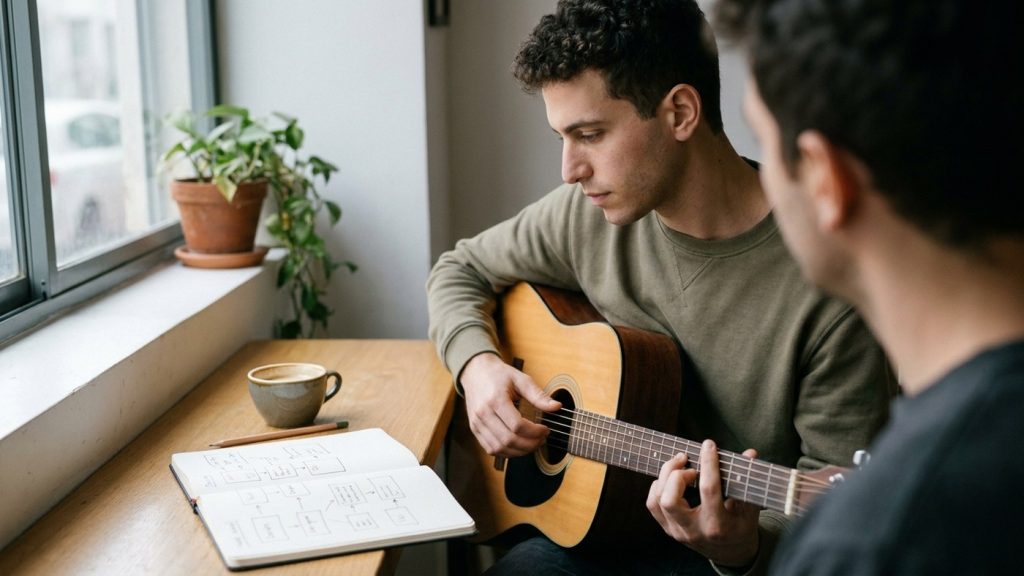
You have a riff you have been playing for two weeks, a melody that loops in your head on the bus, maybe even a whole chorus. Then you try to turn it into an actual song and everything stalls. That is not a talent problem. Most of the time what is missing is song structure: a simple map of what comes after what, how long each part lasts, and why a listener would want to stay until the end.
This guide is for high schoolers, students and adults in North Tel Aviv who write songs or want to start: the guitarist working out ideas in a bedroom in Azorei Chen, the pianist sketching chords after work in Neve Avivim, the Tel Aviv University student recording voice memos between classes. In our guitar lessons for teens and adults we work on structure from the very first song, because once you understand it, every small idea finds its place.
Song structure: the building blocks
Almost every pop, rock or singer-songwriter track you know is built from the same handful of parts. What changes is the order, the length, and how each part builds tension or releases it.
- Intro – a few bars that set up the sound, the groove and often the main riff. In current pop it is very short, and sometimes there is none at all.
- Verse – the storytelling section. The melody usually sits lower and calmer, and the words change from verse to verse.
- Pre-chorus – a short ramp between verse and chorus that raises the tension: chords that refuse to resolve, a rising melody, drums that fill out.
- Chorus – the heart of the song. Same words and same melody every time, usually the highest and fullest section, and very often where the title lives.
- Bridge – a section that appears once, typically after the second chorus, and brings something new: different chords, a new angle in the lyric, a drop in energy.
- Solo or instrumental break – room for an instrument to lead. A good solo retells the melody in a new way instead of just showing speed.
- Outro – how you leave the song: a repeating chorus that fades, the intro riff coming back, or a hard stop.
Two more terms worth knowing. A hook is the short musical phrase that sticks in your head – the chorus melody, a guitar riff, even a synth sound. A bar (or measure) is the basic unit of time; in most songs in 4/4 a bar is four beats, and sections are usually 4, 8 or 16 bars long.
Four song forms worth knowing
You do not have to invent a structure from scratch. Most songs you love lean on one of these forms or a mix of them.
| Form | Order | Where you hear it | Use it when… |
|---|---|---|---|
| Verse – chorus | Intro, verse, chorus, verse, chorus, bridge, chorus, outro | Most pop and rock since the 1960s | You have a strong chorus and want it to come back several times |
| Verse – pre-chorus – chorus | Verse, pre-chorus, chorus, verse, pre-chorus, chorus, bridge, double chorus | Modern pop, and also Nirvana’s Smells Like Teen Spirit | You want to build tension before every chorus |
| AABA (32-bar form) | Verse, verse, bridge, verse (often 8 bars each) | Over the Rainbow, many jazz standards, The Beatles’ Yesterday | You have one beautiful melody and no shouted chorus |
| 12-bar blues | The same 12-bar cycle repeating, with solos in between | Chuck Berry’s Johnny B. Goode and countless blues and rock and roll songs | You want to jam with friends and write over a familiar shape |
A few famous examples show how flexible the rules are. In Yesterday the verse is seven bars long instead of eight, which is part of what makes it feel so unexpected. In Hey Jude the repeating outro runs for several minutes, nearly half the track. And Queen’s Bohemian Rhapsody moves through completely different sections with no recurring chorus at all. Learn the rules first, so you can break them on purpose.
What each section has to do
The verse: tell, but do not give it all away
The verse pulls the listener in without handing over everything. A reliable trick: keep the verse melody lower in your range, with fewer long notes, so the chorus feels like a breakout. In the second verse keep the melody but add one small arrangement detail – an extra percussion part, a second guitar – so the song keeps moving forward.
The pre-chorus: the ramp
This is where you set up the payoff. The simplest move is to end it on the V chord (G in the key of C), which sounds like it has to go somewhere. Another option: shorten the phrases, push the melody upward and switch the drums to eighth notes. If your verse already flows straight into the chorus, do not add a pre-chorus just because you think you should.
The chorus: simple, repeated, higher
A good chorus is singable by the second time you hear it. Three tools work almost every time: a melody that sits higher than the verse, a simpler lyric rhythm, and a central line that repeats at least twice. Songwriters like to say “Don’t bore us, get to the chorus”, and in plenty of pop songs the first chorus arrives within the first minute.
The bridge: the thing nobody saw coming
After two verses and two choruses the ear knows what is next. The bridge breaks that pattern. Try starting it on a chord the song has not used yet (IV or vi if your verse starts on I), drop the energy, or shift the point of view in the lyric. Eight bars is almost always enough.
The outro: a decision, not a stop
Plenty of first songs simply run out. Decide in advance: does the last chorus repeat twice and fade? Does the intro riff return and close the circle? Does the band stop together on a single hit? Any of these works, as long as you chose it.
Drill: map three songs you love
The fastest way to understand structure is to listen like a producer. Grab a notebook, a phone stopwatch and three songs in the style you want to write.
- Listen once without writing anything.
- On the second listen, write down the time each section starts: 0:00 intro, 0:12 verse, and so on.
- Count the bars in each section: count “1, 2, 3, 4” with the beat and make a mark every time you get back to 1. Our tap tempo BPM counter helps you find the tempo.
- Note what changes between the first and second verse: a new instrument, a harmony vocal, different words.
- Ask yourself: where is the peak? How long until the first chorus? What does the bridge do?
After three songs you will see the same patterns again and again, and that is exactly the material for your next song. If you play in a band, the same map is the starting point for arranging a cover song, because a good arrangement starts from knowing what the original structure is doing.
A 4-week plan: from idea to finished song
The plan assumes 20 to 30 minutes a day, four or five days a week. It works on guitar or piano.
| Week | Goal | What you do |
|---|---|---|
| 1 | Understand | Map three songs with the drill above. Pick one form and copy it as is for your own song. |
| 2 | Chorus | Write the chorus first: a four-chord progression, a metronome at 90 to 110 BPM, and humming over it until a hook shows up. Record every attempt on your phone. |
| 3 | Verse and bridge | Write a verse that sits lower than the chorus with slightly different chords. At the end of the week add an 8-bar bridge that starts on a new chord. |
| 4 | Assemble and record | Put the sections together in your chosen form, play it top to bottom three times a day and record a simple demo. Listen the next morning and cut anything that drags. |
If you run out of harmonic ideas, our chord progression generator gives you a quick starting point, and you can record the demo at home with our guide to a home recording studio on a budget. This is also where a teacher makes a real difference: in a one-to-one guitar lesson you can play the song from start to finish and get immediate feedback on the transitions, the length and the hook.
Common mistakes in song structure
- An intro that goes on forever. Thirty seconds of riff before the vocal comes in feels endless to a listener. Cut it to 4 or 8 bars, or start straight on the verse.
- Verse and chorus at the same height. If nobody can hear where the chorus starts, it will not land. Raise the melody, change the first chord or add energy in the arrangement.
- Too many sections. Two bridges, three pre-choruses and an instrumental in the middle, and the song falls apart. For a first song, a few clear sections beat many vague ones.
- No change between repeats. The third chorus is identical to the first. Even a small change, like a doubled vocal or one bar of silence before it, gives it weight.
- A bridge that is really another verse. If it uses the same chords and the same melody, it is not doing its job.
- An ending nobody decided on. The song just stops halfway through a cycle. Plan the ending the way you planned the intro.
Songwriting at our music school in North Tel Aviv
At Rockstar, the music school in Ramat Aviv Gimel, writing is a natural part of lessons rather than a separate subject. Students bring a riff or a melody, and in guitar lessons in North Tel Aviv we build the structure with them on the instrument: where the verse sits, what the chorus is, and how to get from one to the other. If you write for your own voice, vocal lessons fit right in, and if you compose at the keys, piano lessons give you tools for harmony and accompaniment. If you have never finished a song, start with how to write your first song and come back here once you have an idea.
Frequently asked questions
What is the difference between a verse and a chorus?
The verse tells the story and changes: each verse has new words over the same melody. The chorus comes back almost unchanged and is usually the highest, fullest and most memorable part of the song.
Does every song need a bridge?
No. Plenty of great songs are only verses and choruses. A bridge is worth adding when you feel the song starting to repeat itself after the second chorus.
How long should a song be?
There is no rule, but most pop and rock songs land somewhere around three to four minutes. For a first song, short and finished beats long and crowded.
Can I learn songwriting without knowing music theory?
Yes. A few basic chords and the ability to count bars are enough to start. Pick up theory gradually while you write, because then it solves real problems in your song.
Are there songwriting lessons near Azorei Chen?
Rockstar’s music school is in Ramat Aviv Gimel, a few minutes’ drive from Azorei Chen, North Afeka and Tzukei Aviv. Rockstar Home lessons at your place are also possible, subject to teacher availability. See music lessons in Azorei Chen for details.
Read also: How to Mix Your First Song: A Beginner Workflow · How to Write a Catchy Melody
Guitar lessons · All lessons · Contact us · Book a free intro lesson