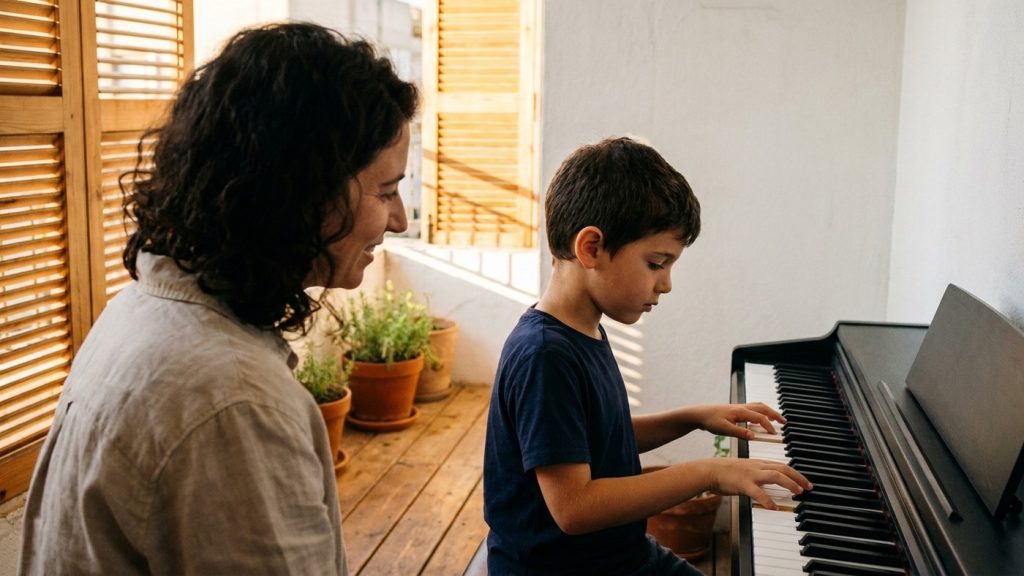
Put a child in front of a piano for the first time and almost every one of them does the same thing: presses a handful of keys at once, listens, and grins. The piano is one of the few instruments that sounds good from the very first touch, which is exactly why so many children start their musical life on it. But once you decide on piano lessons for kids, the practical questions arrive fast. What age is right? Do you need a real piano at home? How much practice is enough? And how do you know the teacher is a good fit?
This guide is for parents in North Tel Aviv weighing up piano lessons for their child, whether you live in Green Ramat Aviv, Neve Avivim or Tzukei Aviv. It is not about choosing between instruments (we have a separate guide for that). It is about everything that comes after you have picked the piano: age, the instrument at home, practice habits, the first lesson and the teacher. In our piano lessons for kids in North Tel Aviv these questions come up every week, so here are honest answers.
What age should kids start piano lessons?
There is no single magic age, but there are clear signs of readiness. At our music school we take students from age 6, and that is not arbitrary. Around that age most children know their numbers and letters, can focus for 20 to 30 minutes at a stretch, and have enough finger control to press one key at a time without the whole hand collapsing.
What matters more than the birth date:
- Short but real focus. A child who can stay with a puzzle or a drawing for a quarter of an hour can stay with most of a lesson.
- Knowing left from right. On the piano the hands do different jobs, and that starts within the first few weeks.
- Curiosity about sound. A child who picks out familiar tunes on any keyboard they find is telling you something.
- Their own wish, not only yours. You can encourage, but it is very hard to teach a child who does not want to be there.
What if your child is already 10 or 12? Great. Older kids often move faster at the start because they read easily, follow explanations and can practise on their own.
Piano or keyboard at home: what you actually need
Nobody progresses on piano without an instrument at home. That said, you do not need to buy an acoustic piano on day one. Most families in North Tel Aviv apartments start with a digital piano, and that works well as long as it ticks a few boxes:
| What to check | What to look for | Why it matters for a child |
|---|---|---|
| Number of keys | 88 keys, or at least 76 | Children’s pieces quickly spread across the keyboard |
| Key action | Weighted, hammer-action style keys | Builds finger strength and control, like a real piano |
| Touch sensitivity | Volume changes with how hard you press | Without it you cannot learn to play loud and soft |
| Pedal | A separate sustain pedal, not a button | Comes into use in the first or second year |
| Headphones | A headphone output | Evening practice without bothering neighbours or siblings |
| Seating | An adjustable bench and a stable stand | Elbows level with the keys, feet supported |
A small 61-key keyboard with light keys can cover the first few weeks, but in most cases it holds a child back within a few months. If you have an old acoustic piano at home, get it tuned before lessons start. A child who practises on an out-of-tune instrument is training their ear on the wrong notes.
One small detail makes a big difference: shorter kids cannot reach the floor. Put a box or a low footstool under their feet so the back stays straight and the arms stay free.
How much should kids practise piano at each age?
This is the question parents ask most, and the most important answer is simple: short, regular practice beats long, occasional practice by a wide margin. Five sessions of fifteen minutes will leave far more in the fingers than ninety minutes on a Friday. The table below is a general starting point, not a rule; the teacher will adjust it to your child.
| Age | Typical session | Times a week | What a session might include |
|---|---|---|---|
| 6 to 7 | 10 to 15 minutes | 4 to 5 | One piece from the lesson, a rhythm game, free play to finish |
| 8 to 10 | 15 to 25 minutes | 5 | Short warm-up, a new piece in small chunks, an old favourite |
| 11 to 13 | 20 to 35 minutes | 5 to 6 | Scales or chords, a piece from notation, a song they chose |
What a good fifteen minutes looks like
- 2 minutes of warm-up: five fingers up and down slowly, one hand at a time.
- 8 minutes of focused work: the hard part of the new piece, just two bars, one hand, slowly. Only when it sits do you put the hands together.
- 3 minutes of review: a piece they already know, start to finish, without stopping.
- 2 minutes of freedom: play anything, find a tune from the radio, make something up.
Once your child is working on a steady pulse, an online metronome at a slow tempo (say 60 beats per minute) helps them keep the same speed through the whole piece. For more on building a habit, see our guide to a smart 20-minute practice routine.
Your role as a parent
You do not need to play to help. What works: a fixed time each day (right after lunch, for example), listening to the end of a piece and commenting on something specific (“your left hand sounded much more confident today”), and asking now and then for a mini concert for grandma over video. What works less well: hovering over your child and correcting every wrong note. If practice has turned into a daily argument, our article on keeping kids motivated without practice wars is worth a read.
What a first piano lesson looks like
Many parents picture a first lesson full of notation on a whiteboard and dry drills. A good first lesson for a child looks quite different:
- Getting to know the instrument: where the low and high sounds live, what the black keys are, how to find C next to each pair of black keys.
- Posture and hand shape: how to sit, how far from the keys, and a rounded hand as if holding a small ball.
- A first tune in the first lesson: something short in five-finger position, so your child walks out feeling “I can already play”.
- Rhythm games: clapping, stepping to a beat, echoing a rhythm the teacher plays.
- One small task for home: clear, single, and easy to succeed at.
Over the following weeks, note reading, hands together and a sense of how a piece is built come in gradually. Young children learn notation slowly and through play; older kids can go faster, and our general guide on learning to read sheet music shows the steps. A good lesson also mixes in songs your child knows and loves, from film themes to pop, alongside simple classical pieces. That is why, in a free intro piano lesson, the teacher always starts by asking what your child likes to listen to.
How to choose a piano teacher for your child
A great teacher for adults is not automatically a great teacher for children. Here is what to watch for in the intro lesson:
- They talk to your child, not just to you. They ask questions, listen to the answers and pitch their language to the age.
- They have a plan, but a flexible one. They can explain where the first year is heading, and they change course when something is not working.
- They play themselves. A teacher who is a working musician brings live examples and a real love of playing into the room.
- They set clear tasks. Your child (and you) leave knowing exactly what to practise this week.
- They mix styles. Classical, pop, film music, not a single method book from cover to cover.
- Your child leaves smiling. Maybe the simplest measure, and the most important.
Consistency matters too. A child who switches teachers every few months keeps starting over. Give the relationship time, and talk to the teacher if something bothers you.
Common mistakes parents make in the first year
- Buying a cheap keyboard “for now”. Light, non-touch-sensitive keys train the fingers in the wrong movement, and you end up buying twice.
- Expecting results within a month. The first year builds the foundation: reading, hand shape and coordination. The impressive progress comes later.
- Practising only the night before the lesson. One evening a week leaves almost nothing behind. Ten minutes on most days is far better.
- Treating every mistake as a problem. A child who is afraid of mistakes stops trying. Let the teacher correct; you be the audience.
- Comparing with siblings or friends. Every child moves at their own pace, and comparisons only drain motivation.
- Quitting at the first bored phase. Almost every child hits one. Before stopping, talk to the teacher about new material or a new goal.
When piano leads to other instruments
Piano is a wonderful foundation for understanding music: the notes are laid out in front of you, so chords and scales make sense to the eye. Children who have studied piano for a few years usually pick up a second instrument more easily. Some start singing while they play, and then vocal lessons are a natural addition. If you are still deciding on the instrument itself, our guide to choosing a child’s first instrument will help.
Piano lessons for kids in North Tel Aviv at Rockstar
Rockstar is a music school in Ramat Aviv Gimel that has been teaching for more than 20 years, with students from age 6 to 90. Our teachers are working musicians, and children’s lessons combine note reading, technique and songs the child picks. Many of our younger students come from Green Ramat Aviv, Azorei Chen and Kokhav HaTzafon, a few minutes’ drive from the school. For families who prefer the teacher to come to them, there is Rockstar Home: lessons in your home in nearby neighbourhoods, subject to teacher availability. Either way, the best way to start is a free intro lesson with no commitment, where your child meets the teacher and you see how it feels. You can read more about piano lessons in Ramat Aviv on our lessons page.
Frequently asked questions
Can my child start piano lessons before age 6?
Some 5-year-olds are ready, but most get more from a general music class with singing, rhythm and movement. At our music school one-to-one lessons start from age 6, when focus and finger control allow real progress.
Does my child have to learn to read music, or can they just play songs?
Starting with songs is fine, and for young children it is often better. But reading music opens up a whole world of pieces they can learn on their own, so it should come in gradually during the first year.
How long is a piano lesson for a child?
For young children a lesson of 30 to 45 minutes usually fits, depending on age and attention span. Older kids and teens can manage 45 minutes or more. We will work out what suits your child in the intro lesson.
What if my child does not want to practise?
Do not panic; it happens to nearly everyone. Set a short, fixed practice time, let them choose one song they love, and talk to the teacher. Sometimes a small change in material brings the spark back.
Are there piano lessons for kids near Green Ramat Aviv?
Yes. Our music school is in Ramat Aviv Gimel, a few minutes’ drive from Green Ramat Aviv, and home lessons through Rockstar Home are also available, subject to teacher availability. Read more about music lessons in Green Ramat Aviv.
Read also: Piano Hand Independence: Exercises for Both Hands
Piano lessons · All lessons · Contact us · Book a free intro lesson